 Sticky logo
 Search


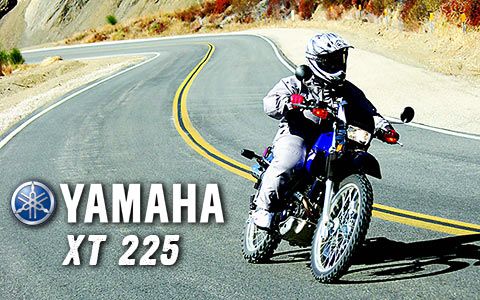
Once upon a time in the seventies, Yamaha’s slogan was ‘It’s a Better Machine.’ At the time, the AT, CT and DT series Enduros, aka street legal Trailbikes, aka Dual Sports really were. It is very likely this little XT is the blend, synthesis and evolution of all those years of experience. 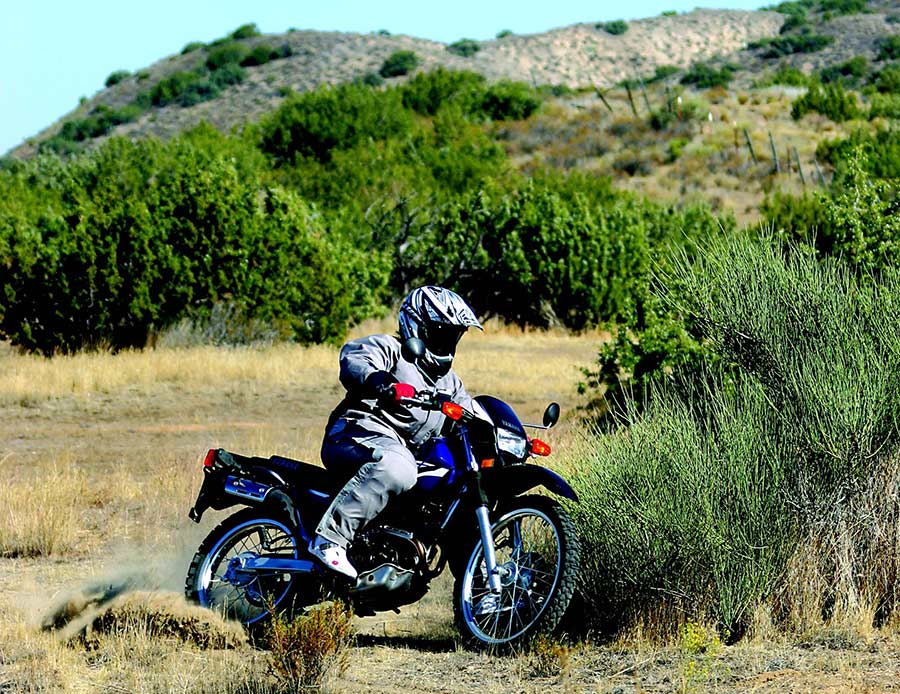
Point to any single feature of the XT and you won’t find its secret. Combine even several features and you will still miss it. It is only when you realize the whole of the bike’s features and capabilities before the light will come on. In quest of that secret we begin by looking at bike height.
This sharp-looking bike, with a seat height of 31.9 inches, is perfect for riders who might prefer a handy-sized bike. I am 5’7” and when seated on the XT 225 my feet were flat on the ground with a slight bend in my knees. In a market where decent height dual purpose bikes are sparse, the XT is a welcome discovery.
Starting the XT225 is a simple procedure. After you turn on the key, flip the orange on/off button (on the right side of the handle bar) to ‘on’ and pull the easy-to-use choke lever mounted on the left side handle bar clamp. This location is a good idea, preferable to many of those not-so-easy-to-use choke controls found on engines or carburetors. At this point all you do is push the starter button and the XT’s motor easily cranks over. The bike is a tad bit on the cold side at first, but once warmed provides steady throttle delivery.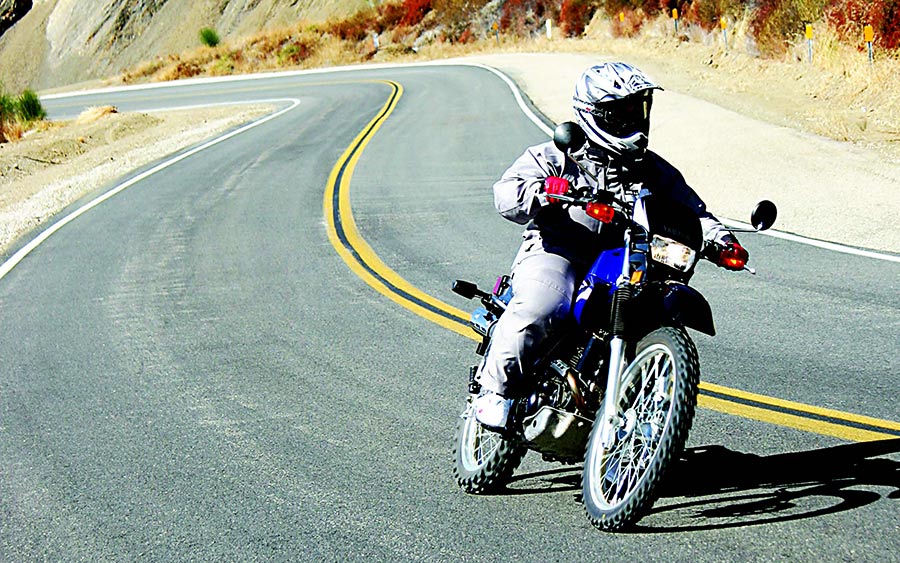
Moving onto the street the XT’s great maneuverability quickly becomes noticed. With a wheelbase of a mere 53.1 inches the bike tends to negotiate downtown traffic and turning very nicely. At first impression the bike’s first gear seemed to be too low. However it wasn’t long before I grew used to it, and during trailriding later it was a plus. During local city driving I really came to feel at home on the bike. Gearing is well suited to downtown driving. Mirrors, signals and dashboard are all at comfortable positions in the cockpit. The standard XT’s instrumentation includes a speedometer with odometer re-settable trip-meter, and indicator lights for neutral, high beam and turn signals. I found that the trip-meter and odometer to be slightly off. Hand and foot controls also have good positioning, and good throws during shifting and braking.
Heading onto the freeway, the XT accelerates nicely and gains enough speed to merge with most freeway traffic safely. Once you have shifted through all the gears to sixth, you’ll find the bike can travel up to about 75 MPH rather smoothly. However, I felt the ride was most stable traveling around 65 MPH. At one point, traveling up a long steep grade, I felt the motor start to bog, and my top speed dropped to about 52 MPH. Feeling the need for more pull, I shifted down into fifth. The bike accepted the downshift nicely and pulled hard to gain speed back up to 62 MPH. As rpms increased, the bike begged to shift once more into sixth, however I realized the bike’s power limitation here and slowed to remain in fifth. Due to the XT’s weight and top speed, traveling longer distances can be dicey. When the bike’s pace can be kept in a range of about 65 to 75 MPH long distance travel isn’t too bad. Up to a couple hundred miles a day one can travel in relative comfort. Add bad weather, bad traffic, rough roadways or steep slopes in high elevations and the comfort factor lessens.
Because of the XT’s size, bike and rider are more at home on country roads or two lane highway. I did some night riding in these conditions. The XT’s Enduro style 60/55 watt halogen headlight was surprisingly bright. This is true whether using high or low beam options. The low beam offered plenty of light to see a good distance directly ahead yet still provided enough light to somewhat see the side of the road. Flip the high beam on and— look out world — it lit up the road like a football field. This gives any rider added confidence when traveling in darkness anywhere. The beam illuminates far in front of the bike and a good 20 feet to each side of the road. This helped me see any potential objects that might have intersected the path ahead.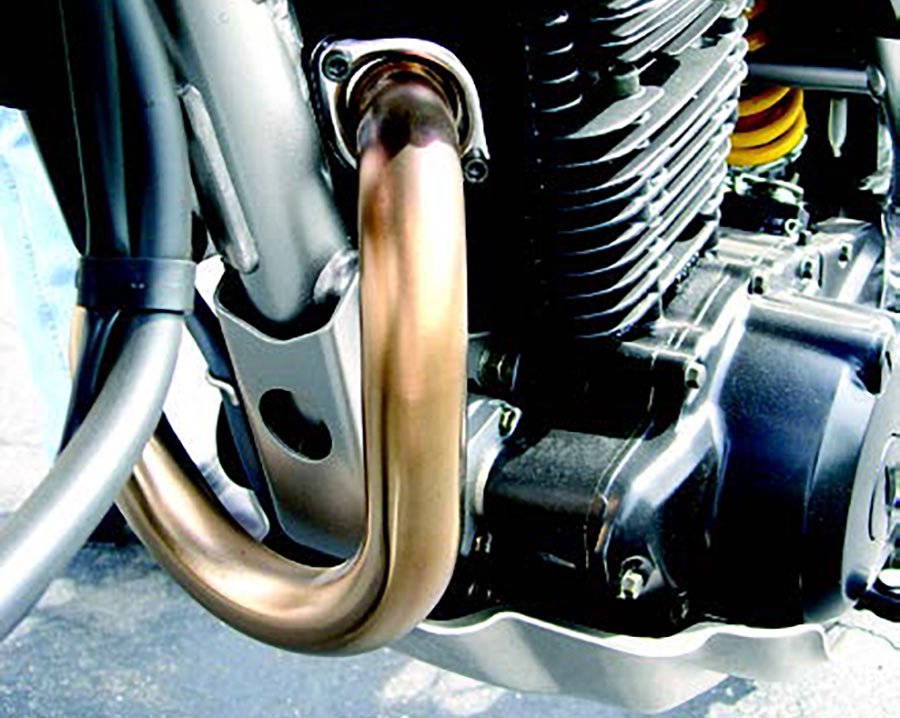
The XTs seat is a long one. Besides being designed for two-up riding it also allows a rider to shift balance during riding. The seat proved to be comfortable for long rides; however its angle seemed to require that I be seated forward and that caused some discomfort after about two hours’ riding. This minor discomfort was easily fixed by simply sliding back on the seat and stretching out my legs.
During the test ride we dropped in on Revpack, the makers of bike luggage. While there we tried on some of the soft bag items that seemed well suited for the XT. They were the Junior Tour Pack and the standard Saddlebags they offer. You wouldn’t want to overload a bike like the XT. Some arrangement close to our Revpack fitting should work well though.
One of the great things about this little Yamaha was how fun it was on curving mountain roads. Keeping pace with a canyon carver is a bit over doing it with this bike. Still, when running at its own pace it was really fun, both up and down canyon. Gearing, center of gravity and suspension all worked well here. I experienced a secure feeling in the turns as the bike leaned into and out of corners. Brakes, both front disc and rear drum, worked well here also. They are well tuned with plenty of feel and they apply consistently according to pressure.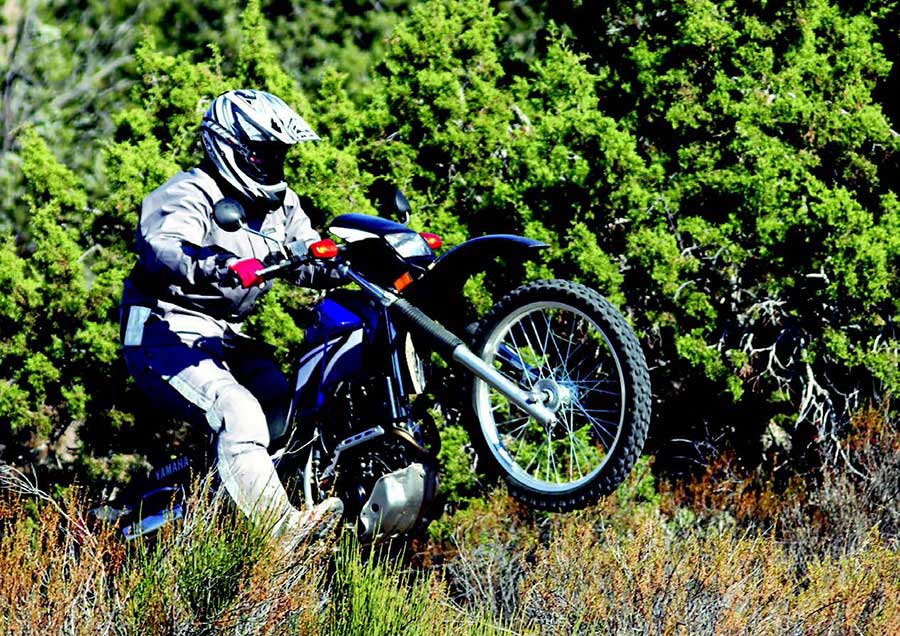
Upon making the transition from asphalt to dirt, the bike remained surprisingly stable. One reason for this was suspension. The XT features 7.5 inches of travel in the rear and 8.9 in the front. Another reason was its OEM Cheng Shin aggressive knob dual sport tires.
Compared to larger bulkier bikes this bike is a blast on the trail. Here XT gearing, powerband and maneuverability combine to make it an excellent trailbike. Overall size allows the XT to slip along and really enjoy all kinds of trails. In tight steep places there is enough torque in first or second to climb almost straight up. Its wheelbase and turning radius are tight enough so that when on switchbacks you can just power through them. This is instead of having to stop halfway through them, rollback and go again like you would on larger bikes. With 11.2 inches of ground clearance, and a heavy duty aluminum skid plate for added protection, this little bike finds itself well protected when riding rocky trails.
In one spot I was side-hilling on a narrow off-camber silt-topped trail. I rolled right across it without either tire slipping off the trail. Smooth, gradual throttle roll, predictable braking and good suspension provided for sure tracking here. These are places you would have problems with on any larger bike. During hill climbing it was always comforting to know that I could drop into a lower gear and have even more power if the hill called for it.
Have you ever tried trials riding? Yes, the slow speed competition type. Sometimes it is really fun to just putt around at a real slow speed and climb around through big obstacles. Amazingly the XT will let you play around at doing that. You never know when you might have to do that kind of riding. Especially if you’re in a new riding area or you have gotten off the trail. Because of the XT’s super granny low first gear, and because it is light and well balanced it is really fun to mock trials ride with this bike. 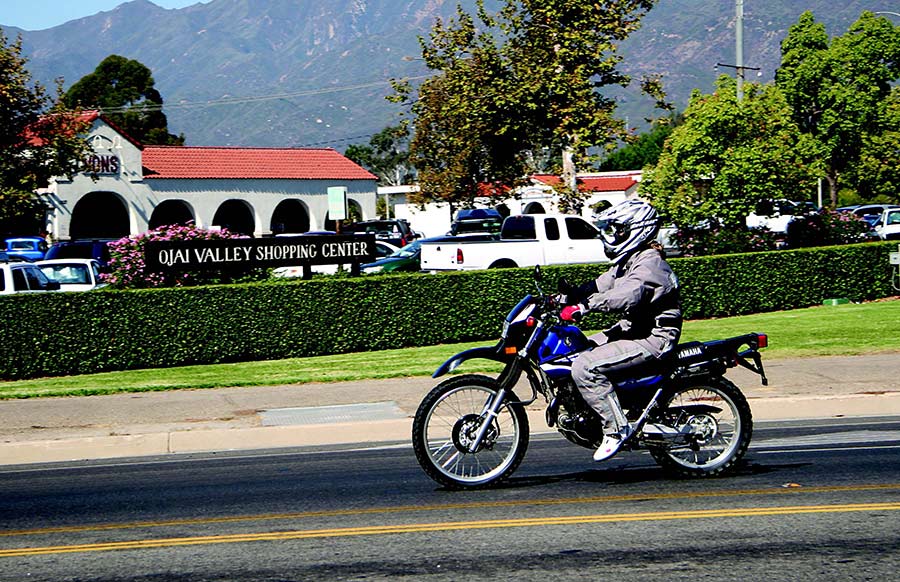
There are two places where the XT performs at its weakest. One is in deep ongoing sand and the other is in open high speed, big-whoop filled terrain. It’s not that the bike won’t go these places, it will. It just requires more skill on the part of the rider, and letting the bike finds its own pace.
For many owners the XT is beloved for its durability and versatility. This of course translates into trouble-free seat of the pants fun. Designers built in many features to support offroading. Flex-mounted turn indicators help save signals from breakage. Footpegs are small and fold up style, and these work to a rider’s advantage in narrow rocky sections. Additionally many parts on the XT are rubber mounted.
The Yamaha XT is many things. It features all the qualities we think of when envisioning the consummate smaller dual sport motorcycle. It can go almost any place bigger bikes can and some places they probably can’t. Known for wide range versatility and dependability it can serve many purposes. It is an excellent trainer, excellent trailbike, acceptable long distance highway, shorter range freeway machine. It will climb virtually anything but competition hill climbs and you can play around riding trials with it. If there is one thing this bike is best at it is trailriding.
Some racer types are quick to dismiss bikes like this, but real veterans respect them. Here is a case where bigger isn’t better. The smaller height and well integrated power band, gearing and suspension allow the bike to do many things. Therefore it is a bike for all skill levels. The Yamaha XT 225 is greater than the sum of its parts.
*For a list of other great small displacement adventure bikes, check out our Best Used 250cc Adventure/Dual-Sport Bikes article.
Originally published December 2006
{gallery}ARTICLES/Bikes/Yamaha_XT-225/Gallery{/gallery}