 Sticky logo
 Search


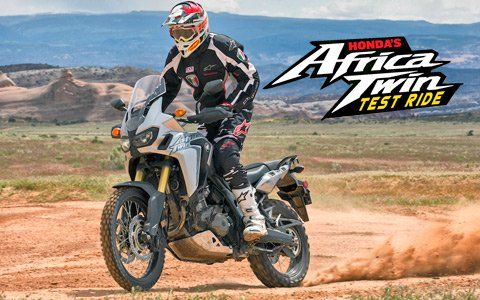
Let’s get straight to the point: The CRF 1000L “Africa Twin” has been so highly anticipated as the next standard of adventure that Big Red has no choice but to raise the bar for BMW, KTM and the others. Honda has come with their A-game and the final verdict may be surprising to riders of all skill levels and taste: I’ll take the DCT (Automatic) Dual Clutch Transmission model as the “do-it-all” adventure steed. Before we tried it in the dirt, the DCT model was dismissed as the intro/beginner model for newbies. After switching back and forth between the 2 models, we found the DCT to be more manageable, safer and fun to operate than its manual sibling.
The DCT is actually a “net” higher performance machine whose transmission resembles a Porsche or Ferrari. With its left-side finger and thumb controlled “paddle shifting”, the rider can override the automatic mode with subtle push-button up and down gear changes. Don’t kid around, the standard model is a sturdy beast but the DCT is on another level. It takes a little bit of getting used to and riders will find themselves reaching for foot and hand levers for the first few miles. But after acclimating to the DCT system, the rider is relieved of using mind and motor skills on shifting and can focus more attention on line selection, throttle and braking.
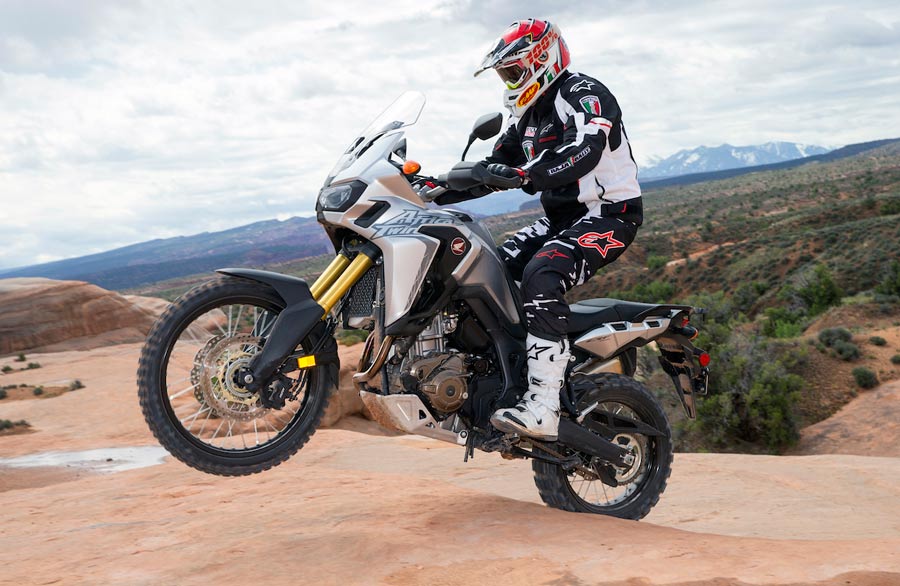
Here’s how it works from the rider’s perspective: The DCT has no shift or clutch lever; everything is automatic on the left side. Replacing the clutch lever is a parking brake that simply locks the back wheel when needed. When started, the bike is in neutral. A thumb switch on the right activates standard D mode (drive). A second push of this switch moves you into S mode (sport) with 3 different levels, increasing the shift points, essentially allowing the bike to rev out to higher RPM before shifting up. This creates a variable, sporty feel based on throttle input. The best part is, at any point, the rider can override the DCT system with subtle finger and thumb clicks. The resulting effect of DCT: Formula 1 style shifting on the fly that gives the rider “cognitive relief” from hand-foot coordination and 3 fewer things for your mind to worry about when pounding the dirt.
DCT also feels safer and frankly allows the rider to harvest more power and performance from the machine. Some will scoff and that’s ok. From our perspective, the computer is smarter and responds faster than we can. When we switched back to the standard unit on more technical tracks, we found the front end wandering on loose soil and slippery conditions due to the bikes drive being un-regulated. Hence, DCT has 2 unique benefits: 1) Cognitive relief and 2) a more controllable extraction of the bikes power and performance.
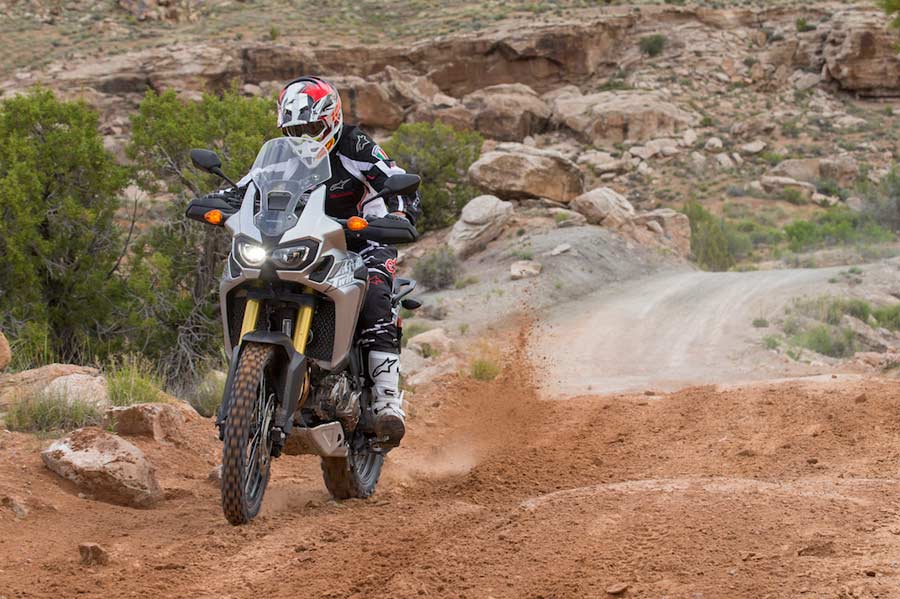
We traveled to Moab UT for a media event hosted by Honda engineers, quality control and marketing staff where we spent 2 days riding both models in a variety of conditions and challenging terrain. Our ride days were limited to 3 journalists with Honda staff and local guides.
Day One: Pavement—Traction Test
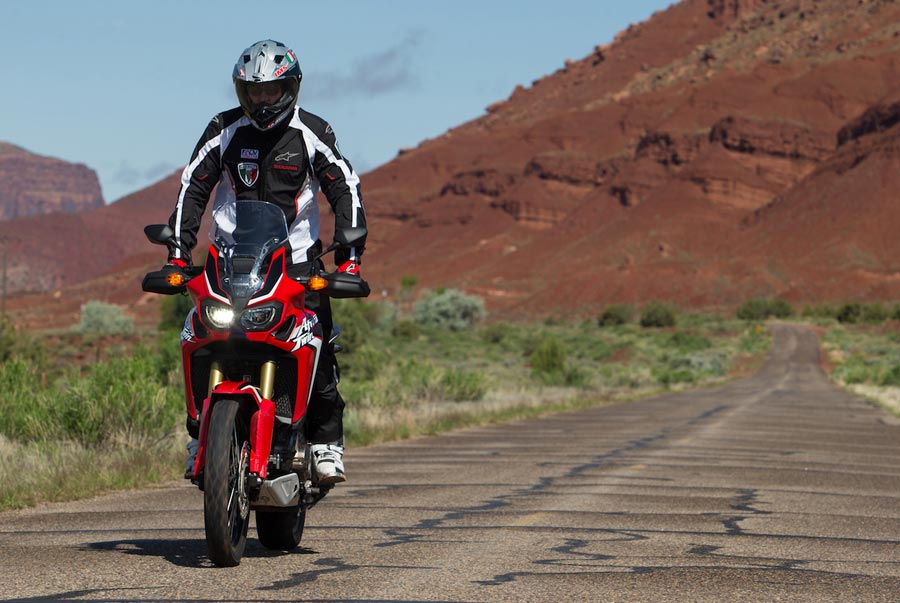
We awoke to wet weather and light rain that had soaked the tarmac. Its hard to look forward to a day of riding brand new bikes on wet and twisty mountain roads but this provided us a real world opportunity to test the HSTC traction control. Here we rode both models and, of course, used the system to keep the bikes mostly upright. The HONDA team seemed carefree that everything would be fine and, after several hours of wet riding, we built confidence in the system that was fairly simple to understand and change the settings. Comparatively to BMW and YAMAHA Super Tenere, it’s slightly easier to learn and operate. The “Twins” performed similarly on road although the DCT has a curb weight 22 lbs heavier.
Day Two: The Real Test is Off-Road
Baja racing legend and 4-time Dakar finisher Johnny Campbell led our 100-mile ride that was mostly unregulated in the sense that we were encouraged to jump, pound, stomp and slide the bikes, which were outfitted with Continental TKC 80 tires. Riding conditions were ideal for this unfettered shakedown that we’ve been waiting years for. The first obvious trait is the stout suspension and durable wheels. Compared to stock German and British bikes, the “out of the box” Africa Twins were noticeably more sturdy and stable landing small jumps, riding through compressions and barreling over square edge rocks. The pace of speed for our test ride was brisk which provided a few “pucker” moments on the trail. With rear ABS disabled and HSTC set at T1, we got the rear end to release, accelerating through sweeping turns with total confidence. On the DCT, we noticed a difference between G mode (gravel) that allows the rear end to drift through the up-shift on Sport 3 mode. I realized this is the dawn of a new era in ADV motorcycling, not the reincarnation of an old one.
Why We Favor the DCT Model:
Even though its 22 lbs heaver than the standard model, the DCT compromised nothing else when it came to off road performance and handling. Additionally, the “cognitive relief” afforded by the DCT allowed us to pull more HP out of the machine. Conversely, after jumping back on the standard model, the verdict was clear: The automatic shifting you can override with hair-triggers button clicks is a game-changer and we want one. If, by chance, you can locate one, there’s very little to find wrong with these bikes other than the stock grips, handlebar rake and tiny foot pegs, which are normal shortcomings on most all production bikes. Despite these minor nuances (except for the pegs) we find the stock controls & ergonomics to be mostly manageable for a variety of rider sizes. Delving deeper into the thoughtfulness of the engineering and design, the core of the bike is tapered into an hourglass shape in the saddle, adding comfort and enhancing rider confidence.
Key Features and Takeaways:
• DCT can be switched to strictly “manual” paddle-shifting mode.
• DCT “S” mode has 3 different levels of shifting patterns. We liked S3 the best for its higher revving shift points.
• Both color options are delivered in either standard or DCT models.
• T mode is (Honda Selective Torque Control-aka traction control) has 4 levels 0, 1, 2 & 3 on both models.
• G mode (Gravel) comes on the DCT model only and allows the clutch a more abrupt up-shift, letting the rear wheel drift.
• ABS (anti-lock brakes) can be disabled on the rear wheel only. The front brakes are always on ABS.
• Seat height is adjustable and ranges from 34 – 33 in. The low seat offered as an optional accessory lowers the range to 33-32in.
• Honda's accessories include luggage panniers, center-stand, heated grips, light bar, tall windscreen, low seat, 12-volt power adaptor.
• KLIM offers Africa Twin branded Gore-Tex apparel line.
Summary:
Let’s be very clear on something: Straight out of the box, either model is ready for adventure and 95% ready to tackle 2 weeks of Baja CA’s off road. The only thing needed are knobby tires, over-sized foot pegs and the personalization of ergonomics and controls and NAV. A similarly outfitted F800GSA or Tiger would be demolished buy this bike’s handling in the rough stuff. The majority of owners won’t take the Africa Twin even near its limits and that’s a main point: we just want to know its built tough and could hold up to a pounding. There’s been some online-whining blaming Honda for the AT’s weight, and they only have a slight point. But you should remember two things: 1) You’re not going racing on this bike and 2) they could have shaved weight off the wheels, chassis and suspension.
The non-identical “Africa Twins” are the new co-champions but my first choice is the DCT “automatic” especially for off road use. This is the dawn of a new era in ADV motorcycling, not the reincarnation of an old one. Despite Honda's resurrecting of the AT branded legacy from a generation past, these aren’t your uncle’s Africa Twin. Production is slowed due to the earthquake in Japan, but once they start proliferating later you’ll see lots of Twins popping up at adventure rallies, road ways and trail heads. It’s markedly the best “out of the box” adventure bike I have ridden and I'm sure you will agree once you try it. Powersports.Honda.com
PROS |
CONS |
| ▲ Sturdy suspension and wheels | ▼ Good luck getting one this year |
| ▲ Narrow profile feels more like a dirtbike | ▼ Obnoxiously undersized footpegs |
| ▲ Game changing DCT option |
{gallery}ARTICLES/Bikes/Test-Africa-Twin/Gallery{/gallery}