 Sticky logo
 Search


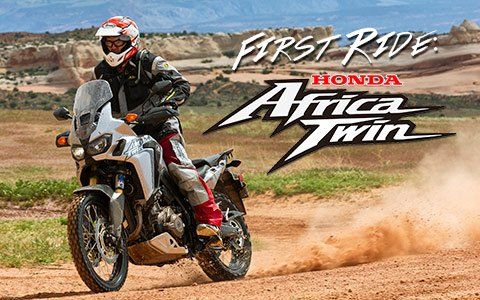
News of the Honda CRF 1000L Africa Twin had been circulating for months, thanks to the early European release. Meanwhile, we’d been gathering information and lusting for its arrival. Finally, the day came—the bikes started rolling into U.S. dealers late May, shortly after American Honda’s press junket in Moab, Utah, where ADVMoto had the opportunity to put the bike through its paces both on and off road. We didn’t hold back on riding the machine as hard as we could, especially when the pavement ended. The Africa Twin definitely holds up to Honda’s claim of “True Adventure” and it was well worth the wait.
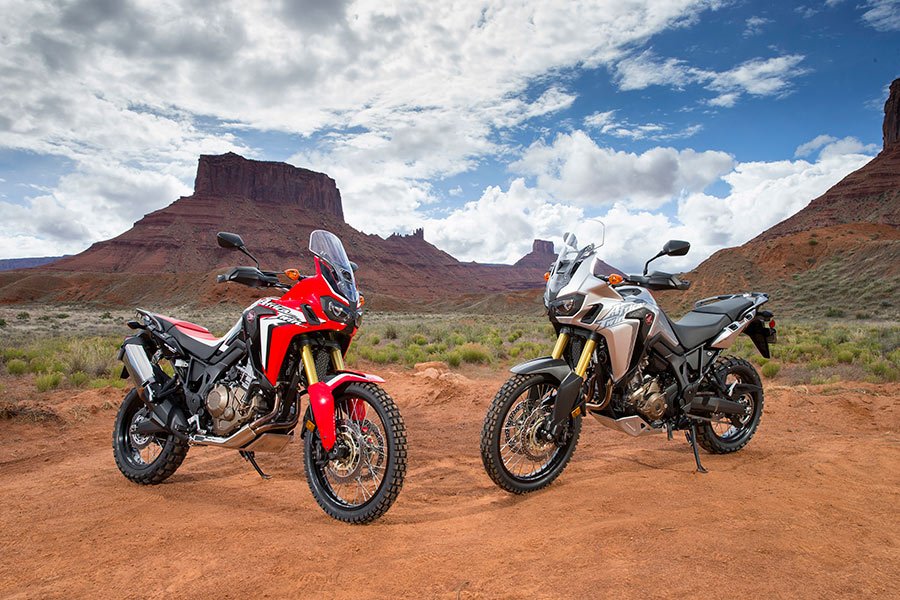
Engine/Performance
The Africa Twin is powered by a 998cc parallel twin power plant using a light Unicam design to actuate four valves per cylinder. A 270-degree phase crank gives the AT the tractor performance of a V-twin. Power comes on smooth and linear with a usable 68.6 ft. lbs. of torque. Although the output isn’t as gnarly as a KTM 1190R, it’s perfect for any off-road excursion. The motor truly screams, especially at mid-to-redline RPMs. Surprisingly, the stock exhaust produces a healthy growl—you’ll be happy with how the big CRF sounds from the factory. Fuel and air are fed through a pair of 44mm cable-actuated throttle bodies. Honda nixed the fly-by-wire to keep costs down and maintain the old school reliability of a good ol’ cable.
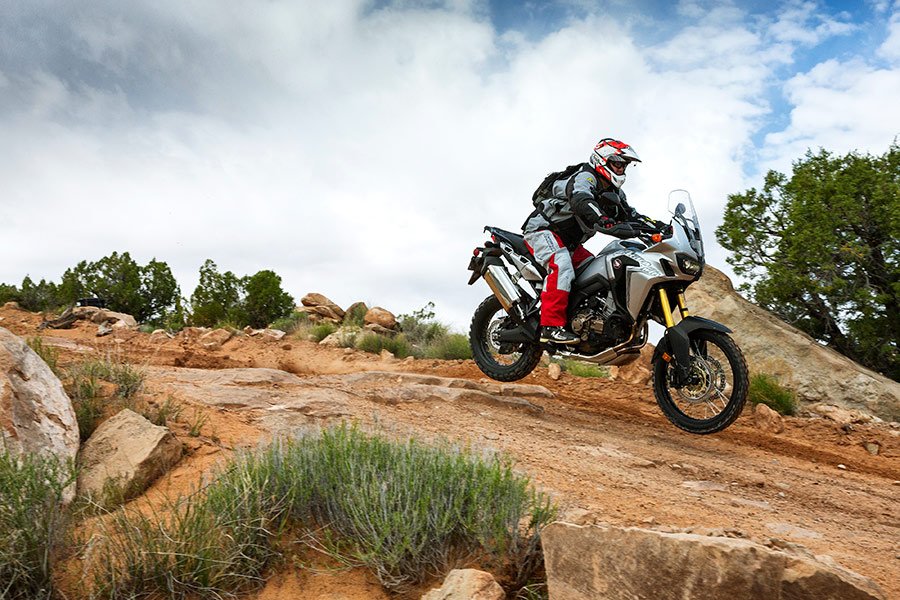
It’s hard to imagine how a 500-plus pound motorcycle can be as much fun off road as a dirt bike. Off the tarmac, I grabbed a handful of throttle and immediately knew my day was about to get a whole lot better. Performance from the compact, fast-revving motor was addicting and easy to handle. Both the Dual-Clutch Transmission (DCT), and manual versions worked like a champ off road, but as the day wore on I found myself gravitating toward the DCT, which eliminates stalling during technical situations and will make riding off-road easier for those with limited dirt experience.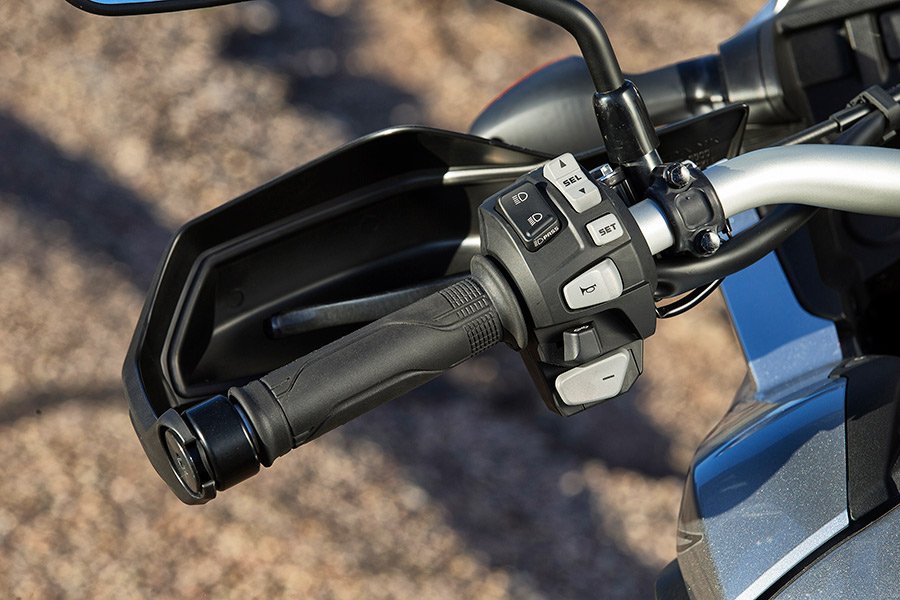
Ergonomics/Styling
Honda has always been known for ergonomics that fit a wide range of riders and that holds true for the AT. The cockpit is laid out much like a rally bike with the negative LCD display mounted vertically for fast reading. Dirt bike-style tapered handlebars are rubber-mounted to reduce vibration, and are wide and high for optimal control when things get rough.
Tall seat heights have always been an issue with ADV bikes, but not with the AT, thanks to an adjustable seat which can be lowered from the standard position of 34.3 inches down to 33.5 inches (Honda even offers a low saddle for shorter riders). A tall seat is available in Europe and Honda says with enough demand it will be available here, too.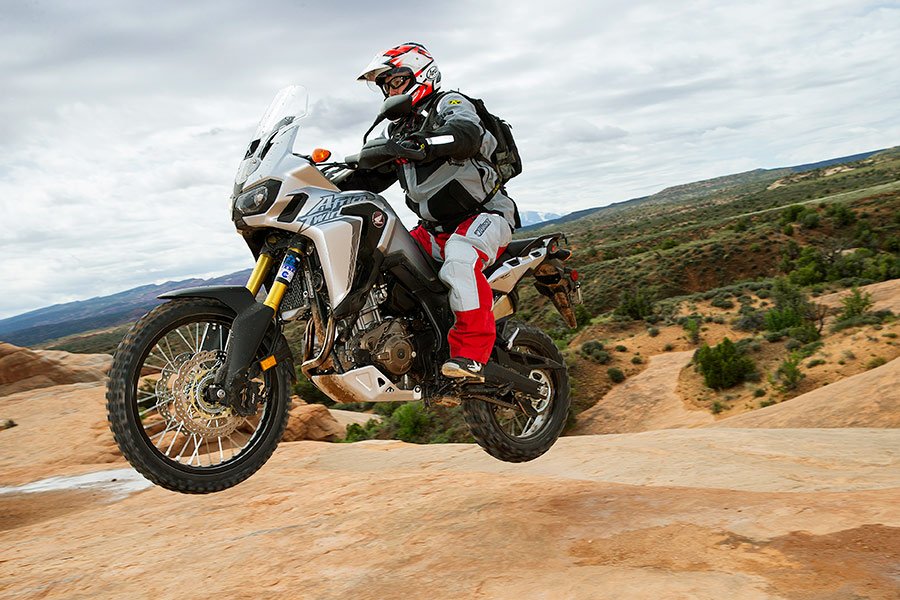
Chassis/Handling/Suspension
Even though the CRF 1000L is a little heavier than KTM’s 1190R, the engineers gave the AT a low center of gravity, making it feel much lighter. The semi-double cradle frame has been carefully thought-out to work well on and off road, with or without full luggage. The outcome is a frame that has finely tuned rigidity and balance. Six carefully placed engine mounts offer a solid feel, and little vibration is transferred to the rider. This gives the AT almost 10 inches of ground clearance.
The legendary Johnny Campbell led us through more than 100 miles of Moab desert and, after riding the Africa Twin as hard as we could, I’m convinced it feels like its little brother, the CRF 450X. Even approaching triple digits on long, sandy straights the bike is quite stable. We encountered an array of diverse terrain including sand, rock and sand/dirt mix, and the AT performed as if it were a 250-pound enduro, not a 534-pound adventure bike.
Rumors had spread that Honda was going to miss the target by installing substandard suspension components, a case we see often when motorcycles turn from concept to production models. This is definitely not the case and we are thankful Big Red stood up to the “True Adventure” claim. The AT is equipped with 45mm inverted Showa cartridge-type forks with fully adjustable rebound and compression, giving the rider plenty of fine tuning. And, taking care of the rear is a Showa shock delivering 8.7 inches of travel using a 46mm cylinder, along with a remote reservoir as used on the CRF motocross bikes. Spring preload, rebound and compression are all fully adjustable. Honda didn’t pull any punches when it came to the suspension. It’s sure to please 90% of buyers, while heavy or more aggressive off-road riders may need stiffer springs for compliant handling at higher speeds.
Twin 310mm floating wave rotors and two-piece radial-mount four-piston calipers offer adequate stopping power up front. A 256mm wave rotor with special hole punching and shaping provides optimal braking performance in the rear. The AT uses two-channel ABS that can be turned-off (rear wheel only) for serious off-road fun.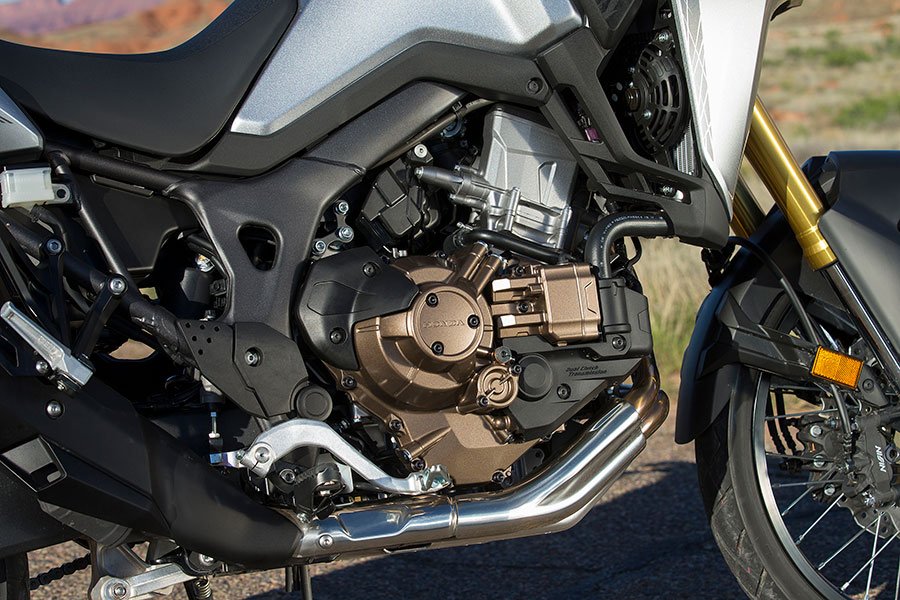
Dual-Clutch Transmission (DCT)
This is where I walked away scratching my head, telling myself, “I shouldn’t like this new DCT thing.” Boy was I wrong, along with most of the other journalists at the junket. There's no doubt the manual clutch version has a torquey feel that gives the impression you’re riding a dirt bike, but once the DCT controls were dialed in, I didn’t want to go back to the manual version. The DCT works much like the transmission in a car equipped with a paddle shift option. Put the AT in “Drive” with the controls on the right handlebar, twist the throttle, and the bike does all the clutch and shift work for you. If you want to take shifting into your own hands, you can use the buttons located on the left handlebar cluster, which incorporates an “Up” shift thumb switch and a “Down” shift index trigger. On the right cluster you'll find an AT/MT select button and N-D-S (Neutral, Drive, Sport) switches. There are modes for different types of riding and terrain:
Sport mode allows you to select three different levels of activation, which boils down to how fast or how long the transmission shifts gears in an aggressive to most aggressive style. The selected drive is then stored and used as the default the next time S mode is used.
G mode disables the adaptive clutch capability control, giving you more direct drive feel.
HSTC (Honda Selectable Torque Control) has three levels and off. Level three has the most aggressive control, mostly for wet street riding conditions. Each level down lessens the interaction of the traction control system. For dirt riding we kept it off to have the ability to break traction and drift through long sweepers.
The CRF 1000L is a game changer in the ADV bike segment, especially the DCT model. The auto version can inspire confidence with its low seat height, encouraging riders to venture where it really shines—off the tarmac. The multiple riding modes suit just about any situation. We can’t wait for production to ramp back up after the recent earthquakes in Japan and expect to see the AT as one of the most popular bikes at rallies across the U.S.
PROS |
CONS |
| ▲ Feels lighter than it actually is | ▼ Non-adjustable windscreen |
| ▲ Low standard seat height and optional low seat with two more lower positions | ▼ Small foot pegs |
| ▲ DCT is a lot more fun than you think | ▼ There's currently a shortage |
| ▲ Price |
SPECS:
Engine Type: Liquid-cooled 4-stroke 4 valve per cylinder parallel twin with 270° crank and Unicam
Displacement: 999cc
Bore x Stroke: 92.0 x 75.1mm
Clutch Manual: Wet, multiplate with coil springs, aluminum cam assist and slipper clutch
DCT: Two wet multiple clutches with coil springs. Manual transmission—constant-mesh 6-speed. DCT—6-speed
Final Drive: O-ring sealed chain
HSTC: HSTC (Honda Selectable Torque Control) 3 levels + switch off
Chassis Type: Steel semi-double-cradle type with steel rear subframe
Dimensions (L x W x H): 91.9 in. x 36.6 in. x 58.1 in.
Wheelbase: 62.0 in.
Seat Height: 34.3 in. standard position/33.5 in. low position
Ground Clearance: 9.8 in.
Curb Weight: 511 lbs. manual transmission, 534 lbs. DCT
Turning Radius: 8.5 ft.
Fuel Capacity: 4.9 U.S. gal.
Front Suspension: Showa 45mm cartridge-type inverted telescopic fork with preload adjuster, plus compression and rebound damping adjustment, 9 in. stroke
Rear Suspension: Mono block cast aluminum swing arm with Pro-Link, w/gas-charged damper, hydraulic dial-style preload adjuster, plus compression and rebound damping
Instruments: Rally-style negative LCD instrument display including speedometer, tachometer, fuel, gear position, ABS, HSTC, odometer, trip and clock
Headlight: Dual LEDs (1 High/1 Low)
Taillight: LED
Indicators: Bulb-type
Front Wheel: Wire spoke with aluminum rim 21x2.15. Tire size 90/90/21 tube type
Rear Wheel: Wire spoke with aluminum rim 18x4.0. Tire size 150/70/18 tube type
Front Rim Size: 21 x 2.15 | Rear Rim Size: 18 x 4.0 | Front Tire: 90/90-21 tube type
ABS System Type: ABS 2-channel with rear ABS off-switch
Front Brake: 310mm dual wave floating discs with aluminum hub and radial-fit 4-piston calipers and sintered metal pads
Rear Brake: 256mm wave disc with 1-piston caliper and sintered metal pads. Also lever-lock type parking brake system on DCT model with additional slide-type 1-piston caliper.
Colors: Red/white/black Dakar Rally, silver (manual transmission and DCT available in both colors)
MSRP: DCT—$13,699 | Manual transmission—$12,999 PowerSports.Honda.com
{gallery}ARTICLES/Bikes/2016-Africa-Twin-DD/Gallery{/gallery}