 Sticky logo
 Search


Just like Goldilocks and the Three Bears the BMW F800GS is “just right” with enough comfort for the pavement, but still light enough to be fun in the dirt. The BMW G650GS is too small for high mileage days in comfort, and the R1200GS is too cumbersome when the road turns to trail. As much as I like the F800GS there is always room for customizing, as anyone infected with “farkleing” disease will attest. Every bike starts as a blank canvas where I can dump my life savings and spend my children’s inheritance. But, if you hang out at any ADV rally or local BMW shop, you’ll eventually hear “when is BMW going to build an F800GS Adventure?” So, I took things into my own hands and built my own F800GS Adventure.
The F800GS is superb starting point, but needs some help for use as a long distance Adventure companion. I weigh in at 190 lbs without gear, so the already under sprung forks were in dire need of help, the damping was off and the rear shock would need attention as well after a year of hard use. The seat was designed by an angry fraulein as a medieval torture devise, and the fuel capacity at 4.2 gal (with a range of 180–200miles) was barely acceptable for street touring. So it was up to me to prop up the world’s economy single-handedly and began building my own F800GS Adventure using the best-of-the-best components.
PHASE ONE: TURN THE GS INTO A SERIOUS MILEAGE BURNER…
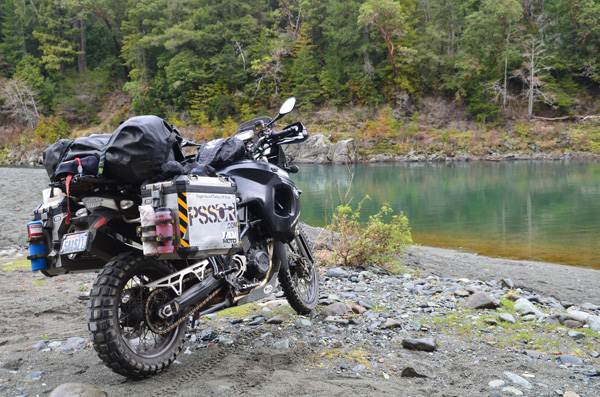 According to Paul Guillien (GM at Touratech U.S.A.), BMW told Touratech in 2008 they had no intentions of building an F800GS Adventure. According to Paul, this was one of the reasons Touratech committed to building the 5.3 gal big tank for the mid-sized GS. Installing Touratech’s 5.3 gal tank gives the F800GS a total capacity of 9.5 gal, beating out the R1200GS Adventure by .6 gal and raising the range to 400 miles (give or take 50 miles).
This was by far the most expensive and challenging of the improvements, taking nearly an entire day to finish as the entire rear of the bike had to be disassembled so that I could drill the original tank to tap in new fuel lines. If you are the type that gets queazy at the sight of your beloved GS spread all over the garage floor, you may want to have someone else do it. With time, patience and a digital camera it can be done by anyone with mechanical aptitude. Once installed, removing the big tank is easier than removing the OEM body work.
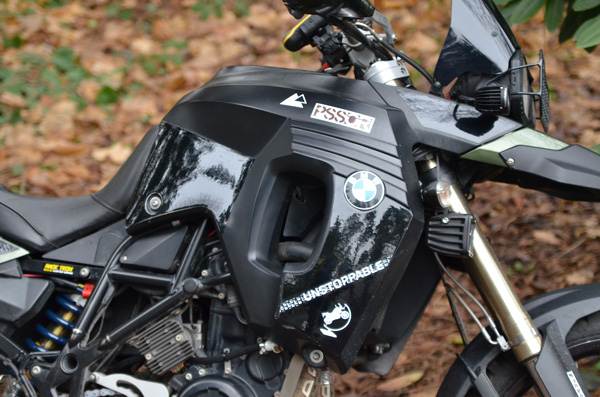 The 5.3 gal Touratech tank provides much better weather protection and settles the front end on high speed runs, making it handle the road more like the road-bias R1200GS, no more squirmy front end at high speed. The tank is made of a nearly indestructible material and wraps the radiator eliminating the need for a set of crash bars, making the weight penalty almost a wash.
The only significant drawbacks are the tank is much wider than the stock bike, making it more difficult to lock my knees into when standing up on the trail, and it leaks from the fill cap when the bike falls over. Fully fueled the F800GS still carries its weight lower than the R1200GS Adventure. With Rotopax mounts on both of the factory aluminum touring boxes, that gives me a fuel capacity of 11.5 gal, which will be useful when I tackle the McKenzie Trail in B.C. Canada (450 miles off road with no fuel available).
Verdict: The “big Tank” is an expensive and time-consuming install and not for the faint of heart, fit and finish could be better but a big tank is a must have to call the F800GS an “Adventure.”
• 5.3 gal Touratech tank, $1,971.30 painted, $1358.20 unpainted
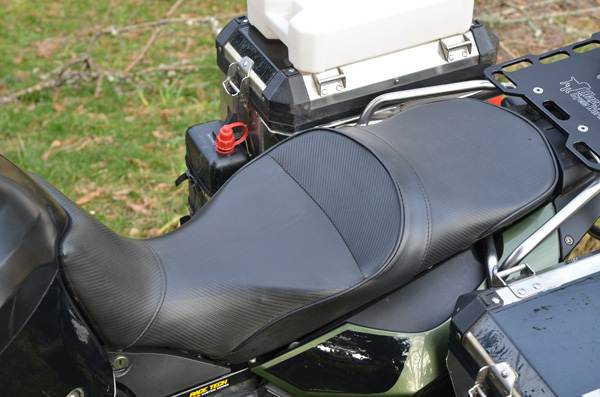 Next I quieted down the cockpit with an MRA Touring Screen, and improved my comfort with Sargent’s excellent World Sport Performance Seat. There are taller shields on the market but since there are a lot of trails in this bike’s future a shorter shield was a must for safety. The Sargent seat has performed amazing during 600+ mile days, and the MRA shield is a must have. As a bonus the Sargent comes with a small compartment build into the seat pan that holds my tool kit.
Verdict: The Sargent World Performance Seat is a must have with great fit and finish and outstanding customer service, the Touring screen works great at creating clean air flow and is one of my all-time favorites.
• World Sport Performance Seat, $459.95
• MRA Touring Screen, $169.99
Lighting is one of two major weaknesses of the F800GS; the second is the relatively weak 400 watt alternator (the R1200GS has a 600 watt output), not a great combination. To address this problem I called up Kurt of Black Dog Cycle Works and ordered up an Ultra-Slim Ballast HID conversion for the low beam, and installed a set of the excellent Rigid D2 LED lights using a set of CVM machined light brackets that mount directly to the frame. I also tucked the lights inside the turn signals where they are well protected.
The HID conversion was easy to install and did not require any modification to the factory wiring. With the HID and Rigid D2s having a very low voltage draw, I had power to spare so I added a set of Twisted Throttle’s Denali D2s for day runners—these don’t give me much additional lighting over the HID conversion but are great for being seen.
To thwart off pesky rock dings, I added a Touratech steel headlight guard. This is a screen design that does not obscure light output like the more common Plexi or clear plastic style guards, which also collect dirt on both sides of the guard as well as the headlight, creating three layers of dirt blocking the light.
Verdict: HID conversion is a must have. If I run all the lights at once cars burst into flame as I pass by (not really but it seems they should), all of this with power left over to run heated grips, GPS, and a heated jacket. The Touratech headlight guard works as intended but creates a checkerboard lighting effect.
• Ultra-Slim Ballast HID, $74.95 (Bargain winner and a must have!)
• Rigid D2 LED lights, $360.05
• Denali D2 LED lights, $359.99
• Touratech Steel Headlight Guard, $99.50
My F800GS Adventure is destined to have a split personality, spending equal time on pavement and uncharted dirt roads. I needed a GPS that would work well both situations and picked up the new Garmin Montana 600 with a power cradle using an SW-Motech vibration damping GPS mount from Twisted Throttle. My first impressions about the Montana were lukewarm, but the more I use it the more I like it. The only notable issue is that vibration will bring up a message telling you it can’t charge the battery and you need a genuine Garmin battery. The fix is simply to place two foam ear plugs in the battery cover which holds the battery tight but does not break the waterproof seal.
Verdict: The Garmin Montana is a good compromise as a do-it-all GPS and well worth considering, but can be a little glitchy; the SW Motech mount is a solid well made mount that works well.
• Garmin Montana 600, $549.99 (does not include maps)
Just for fun I installed on a Kaoko throttle lock available through Twisted Throttle. To operate this you have to spin the throttle lock, located on the outside of the throttle grip, which creates friction and holds the throttle open. It works okay and allows you to relax the throttle hand on those long runs between stops… it works but isn’t my favorite design.
Verdict: Easy to install and stays tucked out of the way when not in use, cumbersome to use.
• Kaoko Throttle Lock Cruise Control, $125.00