 Sticky logo
 Search


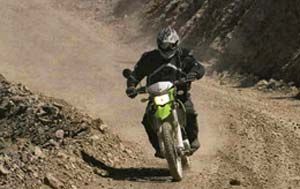
What is green or red and rides all over? The newly updated 2009 KLX250S from Kawasaki! What is apparent with this ultra -versatile machine is that, barring any single profound change to the bike, cumulative updates add up to further enhance its overall performance. Let me clarify briefly, by “overall” I’m speaking about “overall terrain” performance rather than individual bike niche performance.
Alongside the pleasant sighting of several other new 250cc size dual-sports to appear this year, the KLX ranks high in the pack. Derived from the lineage of what once were termed “trail bikes”, this now termed “dual-sport” is taking the technology and capabilities of those former once “more preferred machines” to a new level.
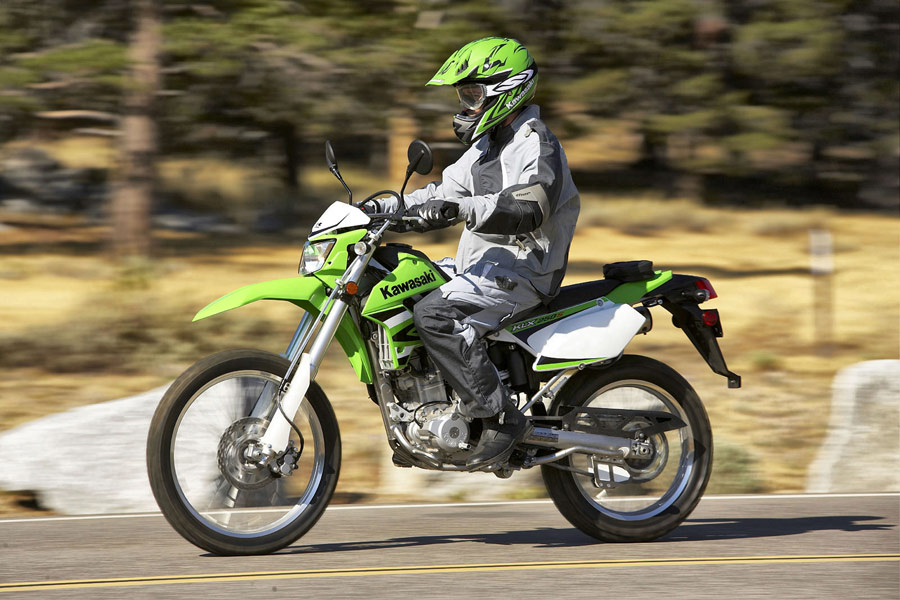 Photo Credit: TotalMotorcycle.com
Think of a bike that is light, say 275-280 pounds, then give it a nice leggy suspension, say nine to ten inches of travel. Place the rider in an upright seating position that allows for ultimate comfort, control, and minimal fatigue. Make sure the bike has healthy ground clearance, with a profile where the seat isn’t too high. Throw in a six-speed transmission that will perform from a walk-like crawl to above 70 mph with ample torque…and, what do you have? You have a super street bike, and a trailbike! Now you’re getting the picture of a KLX.
The KLX250 dual-sport has been around for about 3 years now. With the latest updates we find the bike has predominantly been sweetened. To begin, let’s look at some features, both frame and handling related.
ON THE BIKE SIDE
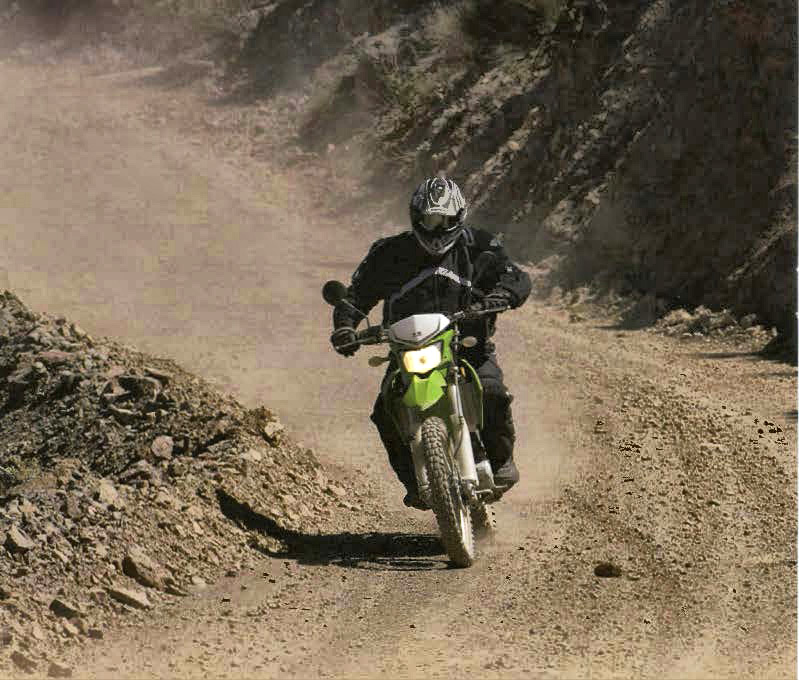 For one, the rake has been changed from 27.5 to 26.5 degrees. This accounts for the wheelbase being slightly shorter than the previous model. However, we should note, that among the other new similar sized bikes, the KLX wheelbase is three to four inches longer than its competitors. With the KLX wheelbase, wheel sizes (21 inch front, 18 inch rear), and rake combine to make an interesting situation.
For one, the bike has better stability due to a longer wheelbase when on open highway or outback. In contrast, this may make some tighter switchback trails a bit more difficult. Yet, as a balancing benefit, with a rake of 26.5 degrees, and typical offroad competition wheel sizes, the bike tends to turn responsively on both trails and tarmac.
New smaller block tread Dunlop D605F tires, and beefier 4.0mm spokes further enhance quick turning stability. These tires provide lighter smoother handling, with more grip on street, and greater longevity overall. On dirt, I found these tires to track effectively. They have a sense of durability; however with minimal sidewall height off-road, forgiveness is nominal.
Frame improvements further refine KLX250 handling. For one, the KLX utilizes a lightweight box tube style high tensile steel frame, with a new D shape cross section rear swing arm. This set up provides for rigidity and vibration damping within a rugged design. New racing type precision adjusters mount on the end of the swing arm for finer tuning chain adjustments.
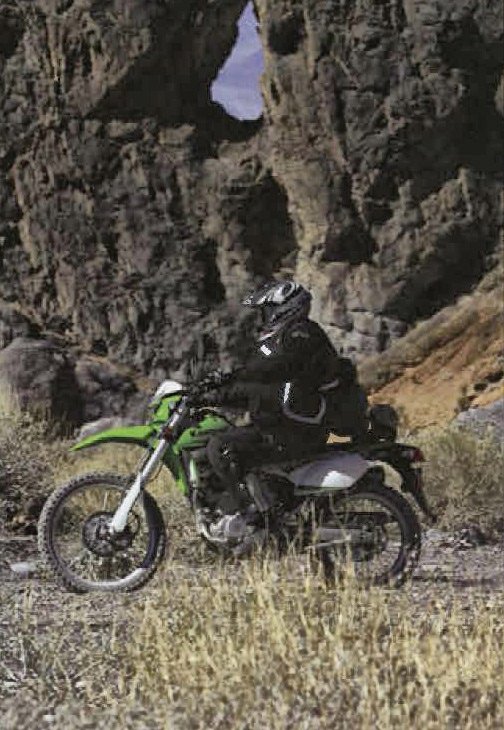 Suspension and braking have also improved. Starting up front, down turned 43mm diameter, 10 inch travel, 16 position adjustable forks have new internals. In the back; a revised Uni-Trak link, with a 16 position adjust compression/rebound damped shock has been retuned to 9.1 inches of travel. Overall suspension travel in this year’s model KLX has lessened by one inch. While this is likely an improvement in the overall sense, for open cross-country offroading we find it a slight pinch of compromise.
Brake refinements include; a 20mm larger rear disc, new petal discs front and rear, different brake pad material, and a revised lever ratio. Together with twin piston front and single KX ™ type rear calipers we find braking has improved power and feel.
Moving to the cockpit, one notices the KLX’s virtually all digital dashboard. The display window is a healthy 6 in. wide by 2 in. high and its well-designed readout makes for easy viewing in all but the worst bright sun-angle scenarios. A bar graph type tachometer spread across its entire width makes rpm viewing quick and excellent. Conveniently, both clock and trip meters are spread apart and at opposite sides of the view screen. In between them, a larger speedometer readout integrates nicely to make overall viewing uncomplicated, clean, and fast. At the bottom of the view screen’ high beam, neutral, oil, temperature, and turn signal indicator lights add further to the simple trim.
Handlebars on the KLX are about two inches narrower, slightly higher, and is highly personal, I found all but the narrower width to be an improvement. Ideally, I feel two inch wider bars would provide better leverage, control, and long ride comfort.
The bike’s new seat contour provides greater comfort and ease of ride position change due to the new shape. However, its firmer and thinner padding began to be noticed at the end of one long, good days ride. All hand and foot levers are tight and responsive. They have good ergonomic feel, they are positioned well, and they actuate cleanly and with little play.
*For a list of other great small displacement adventure bikes, check out our Best Used 250cc Adventure/Dual-Sport Bikes article.
(continued on page 2.)
ON THE RIDE SIDE
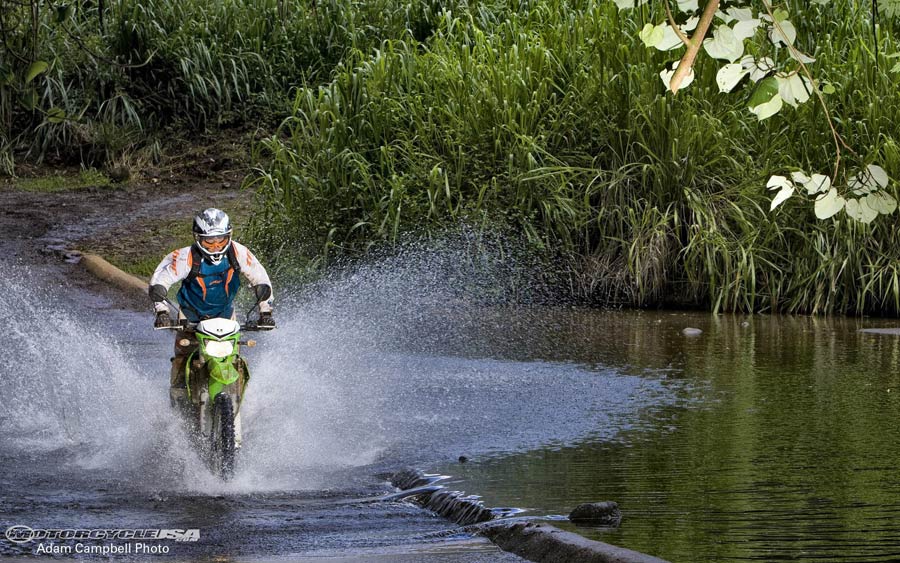 Photo Credit: MotorcycleUSA.comFrame and handling features of the 2009 KLX250S are numerous and noteworthy, however power and performance aspects of the machine equally deserve attention.
It was mid-morning in Death Valley. The sun had not risen high enough yet to begin baking the desert and its creatures as the ride leader led us up into the hills. The route was loose packed gravel, sand, and dust. Our path would take us up into one dry creek bed, through a canyon, and to a summit.
Next, it dropped us down into another canyon via another creek bed. Then later, it would lead upward once more atop loose pack sand, gravel, and solid rock outcrops before leading out into a vast expanse of rolling hills and flat desert. From here the path would eventually find asphalt, and a lengthy but speedy return to civilization.
At a moderate pace, as the sun rose in the sky, we wound our way upward atop the loose pack two track path. The path transitioned from straight and wide sweeps to become tighter and tighter. Simultaneously its surface transitioned from being shallow sand and small gravel to become deeper sand, larger stones, and rocks. The KLX moved up the canyon cleanly. I was pleased to discover wide ample power, torque, and gearing which seemed to make ascending in loose pack easy. As the turns became tighter, the climb angle increased, as did the depth of the loose material.
The KLX seemed to tack, and track well upon the loose stuff, with the right weight applied. As turns became tighter I noticed the bike’s quick to turn capability, as well as its plantedness due to the longer wheelbase. With about 22 horsepower, the bike beckoned to be spurred a few times in order to climb in the rough, but with ample throttle, the bike answered the call agreeably. After several miles of this, I came to rely on this’ eventually becoming assured enough throttle was on tap to do about anything we might run across.
At one point while ascending the first creek bed, we came upon a sheer, stair-step type, solid rock outcropping. It was only about six feet high but steep enough to think about, and the prior 25 foot something approach was lined with loose creek bed rock. The group paused here for a time, and one by one we each made our run and climbed over it. What I noticed was that the KLX might be slightly geared too tall in first gear for crawling steep climbs like this one. Fortunately our path allowed a short run before the obstacle.
We continued climbing, up and over the first pass, and then down into the next valley. The route took us side hilling, up and down, and winding upon alternating hard and loose terrain. The tightness of turns, and angles varied widely. Here I found the KLX able to change direction quickly while remaining stable. We ran upon downhill loose pack straights with whoops, and among more creek beds. A few times, drop offs into creek routes or climbs back up and out of them were on solid, angular, stair-step rock.
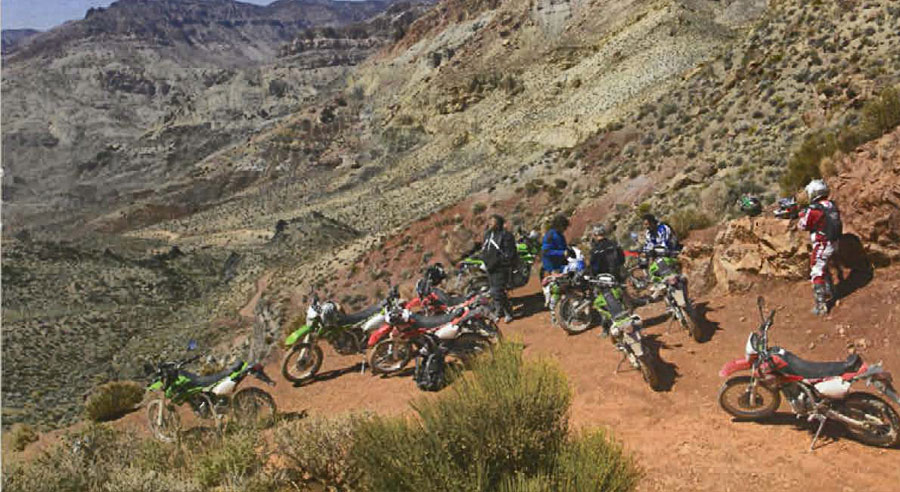 Through this we rode at a good pace. We were riding at the higher speed limits for which the bike was designed. I found the bike to retain integrity. Power and gearing remained ample, handling remained stable. Suspension capability was perhaps the first limiting factor to be noticed. Yet, ridden within its capability, for the most part, the KLX remained at home.
Before long we cleared a second summit and then moved onto the desert. Out in the open, as our route stretched toward asphalt, there was opportunity to again ride at higher speeds. Along the route there were a couple of whoop filled straights. The bike retained integrity with, once again, suspension appearing as its limiting factor. It tracked well yet found new lines quickly as I avoided berms, bushes, and bailouts. After this twenty-something mile desert stretch we intersected the tarmac route that we would take up and return upon.
By now the sun had risen high in the wide desert sky, and temperatures were nearing one hundred. The immense mass of desert air had warmed, and the dry desert wind had begun to blow. Ahead, our forty mile paved path arced through hills and across a wide tilted plain. Lighter, better asphalt tracking tires were evident as I found my way on the winding pavement. Here the bike remained stable yet quick to find new direction.
As the route led out and down, upon the flat straight desert I let the bike stretch its legs. Here 40mph crosswinds intersected my path. As the miles passed the wind shifted direction several times. First it came from three o'clock, then one o'clock, and then head on. The impressive rather light KLX remained in control.
For the most part the bike was able to tool along happily at speeds ranging from seventy to eighty miles per hour. While working between fifth and sixth gears, the bike revealed enough torque to press into a 40 mph headwind and pull at 70 mph. A ten to fifteen mile stretch of this revealed the bikes underlying, but determined nature.
SUMMARY
The 2009 KLX250S is one fun, and by all appearances, dependable bike. It does many things very well. It is excellent for both street and trail. Improvements to this year's KLX make it better by a noticeable degree.
The KLX250S is a nimble and stable city runner whose quick turning and wide gearing allow it to move nicely in commuting scenarios. Of the new 250cc size bikes we've tested this year, the KLX is perhaps best at freeway riding. This is because of its ability to cruise at between 70-80 mph without much difficulty. Long distance riding, say more than 350 mile days, would be less than ideal on the KLX. . . unless otherwise accessorized.
Stability, wide spread gearing, excellent suspension, and quick turning make this bikes ability on trails commendable. To compliment this, the bike only weighs 277 lbs (3 lbs more for CA models). Therefore, it's easy to maneuver on trails, or load and haul on vacations or camping trips. Only at the extremes, such as very tight steep trails and wide open high speed offroad does the bike show its limits.
The 2009 Kawasaki KLX250S is one of those of bikes that enjoyable lifelong motorcycling experiences are begun or built upon. I have been considering purchasing one myself.
2009 KAWASAKI KLX250S SPECIFICATIONS
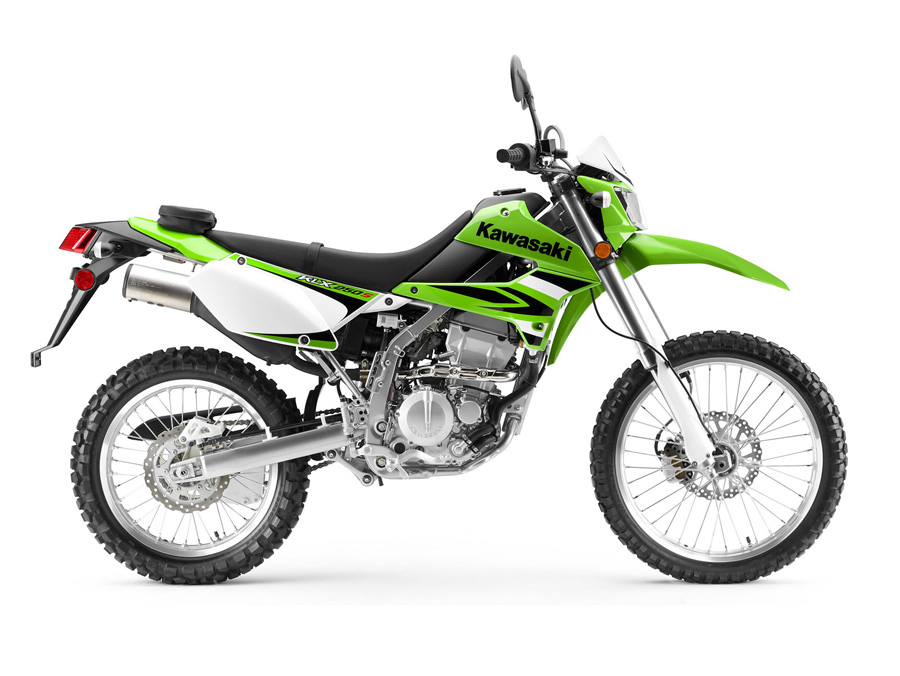 Photo Credit: TotalMotorcycle.com
|
ENGINE |
Four-stroke, Liquid-Cooled, DOHC, four-valve single |
| DISPLACEMENT | 249cc |
| BORE/STROKE | 72.0 x 61.2mm |
| COMPRESSION RATIO | 11.0:1 |
| COOLING | Liquid |
| CARBURETION | Keihin CVK34 |
| IGNITION | Digital CDI |
| TRANSMISSION | 6-speed |
| FINAL DRIVE | Chain |
| FRAME | Semi-double cradle, high-tensile steel |
| RAKE/TRAIL | 26.5 degrees/4.1 inches |
| FRONT SUSPENSION | 43mm Inverted Cartridge Fork with 16-Way Compression Damping Adjustment/10.0 inches |
| REAR SUSPENSION | Uni-Trak with Adjustable Preload, 16-Way Compression and Rebound Damping Adjustment/9.1 inches |
| FRONT TIRE | 80/100x21 |
| REAR TIRE | 100/100x18 |
| FRONT/REAR BRAKES | 250mm semi-floating petal disc with two-piston hydraulic caliper/240mm petal disc with single-piston hydraulic caliper |
| OVERALL LENGTH | 86.6 inches |
| OVERALL WIDTH | 32.3 inches |
| OVERALL HEIGHT | 47.4 inches |
| SEAT HEIGHT | 35.0 inches |
| WHEELBASE | 56.3 inches |
| GROUND CLEARANCE | 11.2 inches |
| FUEL CAPACITY | 2.0 gallons |
| DRY WEIGHT | 277.8 lbs. (280 lbs CA model) |
| COLORS | Lime Green, Sunbeam Red |
{gallery}ARTICLES/Bikes/2009_KLX250S/Gallery_Images{/gallery}
 Read Our Project KLX250SF-Part I, HERE!