 Sticky logo
 Search


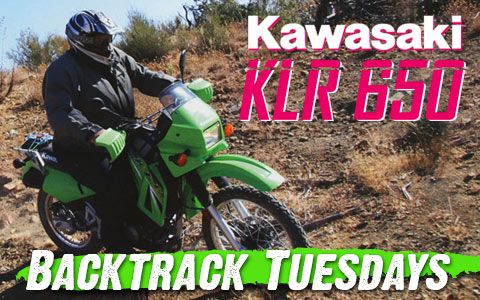
The KLR 650 is a dichotomy. It is midpoint among other dual sport machines in the dual-sport spectrum. For a road-riding enthusiast the KLR may be considerably lighter and less powerful than other rides. For a dirt enthusiast, it's really too big, but it might offer wondrous street or touring capabilities.
Given the above it is essential for a rider to be honest about his/ her expectations before considering the bike. Are you a dirt-rider interested in expanding horizons? Maybe you're a street-rider and for the first time are listening to the dual sport sirens. Or, perhaps you're thinking of this machine as a first time motorcycle (in this last case, get a smaller bike and learn on dirt first).
History
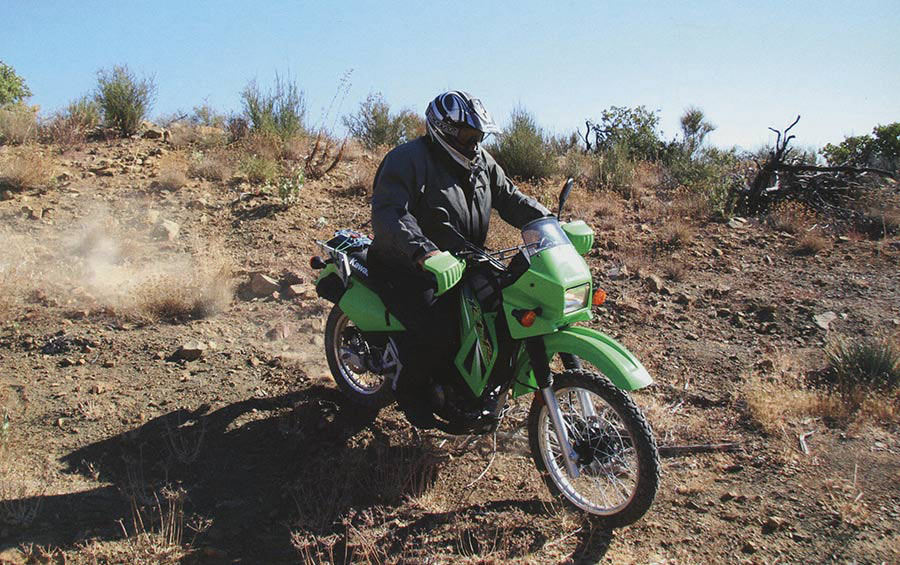
In the early 1980s, Kawasaki introduced the KLR 600 series. In 1987 came a 50cc displacement increase, larger Dakar type tank, new shroud with windscreen, and a basic frame geometry change. Barring upgrade to the clutch and cam chain system in 1995, we find basically the same machine today.
Weighing in at roughly 420 pounds, with seven-to-nine inches of suspended travel, the 34 horsepower, water-cooled single cylinder KLR 650 is a classic old school enduro machine. It's as large a machine as anyone would want to consider for trails. By contemporary standards, the KLR is an underperformer and responds poorly to attempts to improve power with aftermarket upgrades.
Having owned one for years, I am qualified to say it reminds me of utility van handling. Imagine a linear continuum depicting ride capabilities with off-road being one end of the scale and on-road being at the other. The KLR would place to the street side of center.
However bulky, the KLR is a rugged bike and typically will withstand considerable abuse. Though many have sought to update the bike's performance, the machine's power and handling systems are entrenched in old school technology; modding to become a modern performer is impractical. While not leading edge, the KLR 650, when run moderately, might run forever. Many today use it as a global tourer, and some bikes have lived beyond 200,000 miles.
Commuting, Twisting, and Touring
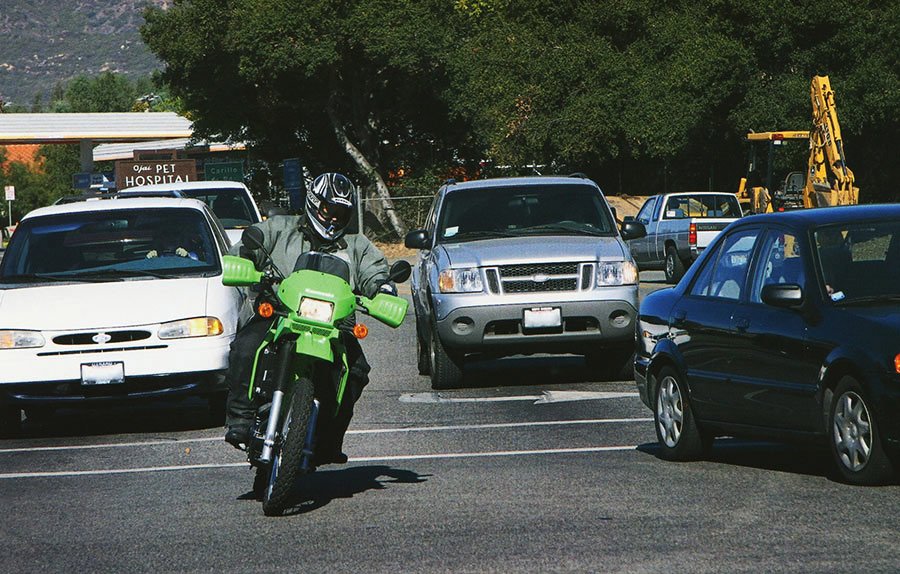
City driving with the KLR is a pleasure. Though somewhat top heavy, the bike responds nimbly and quickly. Starting from a stop, lane changing, turning, and stopping are comfortably predictable. The overall power and handling setup from the factory is well-balanced, though dated. One nice feature of the KLR is how the cockpit places the rider up high. With a seat height of roughly 34 inches, the rider is eye level to SUV drivers, and can see beyond cars ahead.
The five speed transmission allows the bike to move in and among traffic with fluidity. For whatever speed zone you seem to be traveling in on surface streets there seems to be a perfect gear for it. By most reports the KLR transmission is indestructible. Ironically, the same is not true of the shift lever which is prone to failure at the weld joint. While the clutch is nearly as tough, greater numbers of clutch problems emerge compared to transmission failures.
Lighting systems on the KLR are adequate. In terms of illumination, turn signals, headlight, taillight, and brake lights on the bike are highly visible day or night. The electric harness wire gauge is minimal. Occasionally, factory connectors are poorly attached to wire ends. In some cases, this leads to flickering head or taillights. Sometimes overheating the connection occurs as well.
The battery and charging system of the KLR is also rather minimal. This means the cumulative load of aftermarket electrical add-ons (heated grips, vests, jackets, GPS, additional lights, etc.) must be carefully planned. While adequate for normal daily operation, should a battery go dead, the charging coils and related wiring aren’t well-suited for recharging the battery. Furthermore, the battery needs to be in good shape and fully charged to appreciate the Kerr's convenient electric starter.
In freeway conditions the KLR retains its poise relatively well. It is heavy enough to remain acceptably well-planted. At 70 mph the KLR is very smooth. At 80 mph the vibration of the bike increases noticeably with stock gearing. Though the KLR will run all-day at 80 mph the bike’s rpm start to feel stretched. Fast long distance riders report the engine is susceptible to increased oil consumption.
With a single 40mm CV carburetor the motor of the KLR is tuned primarily for low-end torque. When traveling on the freeway at speeds above 60 mph, the bike's power is slow to roll on. Careful over taking of traffic is required. This can be awkward in the modern commuting environment. In cases where half the cars are traveling above 80 mph, the KLR is a bit weak kneed.
Other features come as a welcome surprise when commuting on the KLR. One of these is its inherent long travel suspension. Having 7-9 inches of travel, both front and back, gives the KLR an advantage over most street bikes. Also, with greater ground clearance, a KLR is capable of handling potholes and debris that will spell trouble for street only bikes. Lastly, having wide handlebars and upright seating allows the rider to lock elbows and more effectively brace for impacts.
It is the KLR's typical enduro qualities that make it fun in the twists. While admittedly not a sport bike, it will give canyon machines and cruisers a run for their money. Tall seating allows a rider to look ahead among the twists. Predictable braking, wide spread gearing, and smooth low end roll on torque allow one to adjust to the variable undulations of curving roads. This is true on most grades both up and down hill. Though top-heavy, in factory setup, the KLR's center of gravity has the illusion of moving a bit lower into the bike's frame. Overall these factors provide for fun times in the twists.
Long range adventure travel is perhaps the KLR650's ideal niche. Over the last five years the bike has had unprecedented exposure as an adventure tourer. And as a tourer what bike was it set against? The renowned BMW GS series of course! The comparisons and contrast between these two machines would be a fun topic, for another story.
The Kawasaki is a smooth ride at 70 mph. At low rpm in 5th, and with a large fuel tank the KLR can cover many comfortable miles in a day (stock fuel mileage is typically 35-so+ mpg). The bike's upright seating position promotes less fatigue and more positive handling. Though acceleration is somewhat sluggish above 60 mph, with a little momentum, backwind, or a downhill a rider might experience 100 mph in short distances.
A surprising aftermarket industry has grown to support KLR touring owners accessorize for long range by modifying items such as seat, windshield, suspension, and may add an array of hard or soft luggage components and protection devices. This helps position the KLR for long range camping or even world-touring. One weakness the KLR has revealed when rigged for touring are the sub-frame bolts up under the rear of the gas tank. These have been known to fail under extreme testing as well.
Off-roading, Trails, Dirt Roads
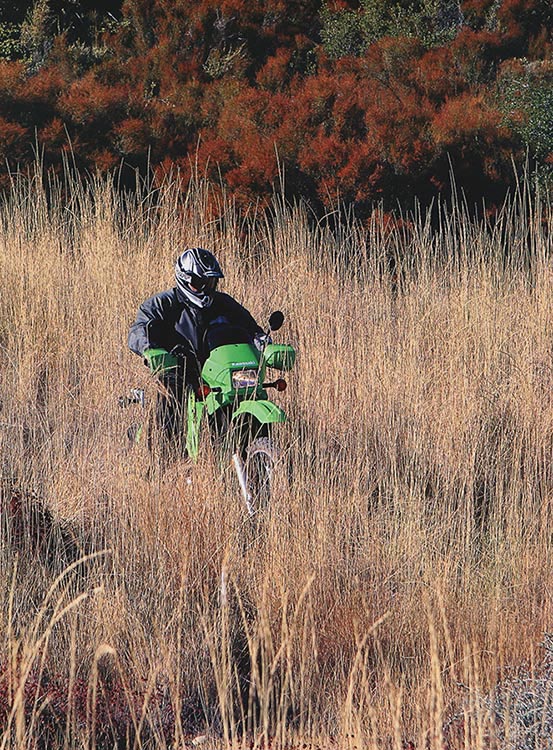
On the trail the KLR is a beast. Even in relatively open conditions when this beast hits whoops or moguls it becomes an armful. It's not that the bike won't do it it's just a matter of it not being as fun as with a lighter counterpart. To some degree moderate trail capability can be offset with mindful slower pace riding, but as off-road experiences increase so does the desire to avoid these conditions altogether.
Still, when asked to, the KLR can traverse some of the roughest trails out there. Just have a few fellow riders on hand to help muscle the bike back on the trail if needed. The wheel base of the KLR inhibits easily accomplishing the tightest of switchback turns. While plenty of torque is on tap from the bike's motor with stock gearing, the bike lacks snappy throttle response. Furthermore, in first gear the gear ratio is too high. It doesn't allow for slow speed grannying around, as would be desirable on some of the tightest of trails. This is commonly remedied with lower countershaft gearing.
On dirt roads or sweeping trails the KLR is much friendlier. In this situation most of the bike's qualities are wellsuited. Perhaps among all bikes currently manufactured no bike has the versatility to ride several hundred miles on asphalt and, nearly without a thought, be able to explore logging or other mountain roads on a whim.
While the KLR's weight might be ideal for general asphalt riding, during general off-roading its weight becomes its greatest drawback. Its bulky six-gallon fuel tank and high center of gravity don't help. But the suspension is not great either. Though commendable for street, and adequate for dirt roads and light off-road duty, it is minimal when tackling serious conditions. This would include aggressive riders with above average weight, or being loaded with additional cargo. Many KLR owners have trusted the flimsy plastic skid plate to their dismay when experienced a cracked case on rocks.
As I mentioned earlier, transmission of the KLR is tough. Similarly the clutch, since 1995, has few reports of failure. During our off-road test slippage or overheating of the clutch did not occur. By contrast the brake system showed a soft spot. Though no problems occurred during street testing, during off-roading the rear brake pads overheated with considerable fade. In this situation the bike had been ridden on a downhill switchback road of moderate grade for several miles. Though both front and rear brakes were utilized, with some engine braking thrown in, the rear pads became glazed, faded, and were useless for some time after. This may have been an anomaly. After many thousands of miles on a KLR of my own with factory pads as a regular choice, no such fade has occurred.
Features, Strengths, Weaknesses
Within the cockpit, controls on the KLR are easily visible and reachable. Most levers, though debatably having awkward feel, remain within tolerable amounts of slop. 0ne exception is the throw of the rear brake lever. The front windscreen and fairing are effective in redirecting the most fatiguing, torso level wind nicely. Wide, enduro style handlebars compliment the upright seating configuration of the KLR by allowing greater rider stabilization for oncoming impacts. Rearview mirrors extend high and wide to each side of the machine. While this provides common rear viewing two potential disadvantages exist. One is the existence of blinds spots on left and right rear (8 and 4 o'clock). The other is having tall post like obstructions should the rider ever be thrown over the bars during a crash.
One nice feature of the KLR is an electric starter. Another is the presence of a manual choke lever located on the left handlebar, below the switch cluster. Handlebar switches such as turn, start, hi/low beam are of rugged old school design. One must utilize feel rather than press to touch when canceling signals. This can require finesse when wearing gloves. Un-reinforced plastic handguards deflect most light brush and wind.
Though the KLR's seat is comfortable for most situations, long periods in the saddle inspire some to go aftermarket. The rear rack on the KLR is a cast composite metal. Passenger handles are incorporated into its design. This may be viewed as good or bad. Posts on its underside, while apparently intended for hooking, could be more frequent and better placed. Options for replacing this rack offer another set of trade offs.
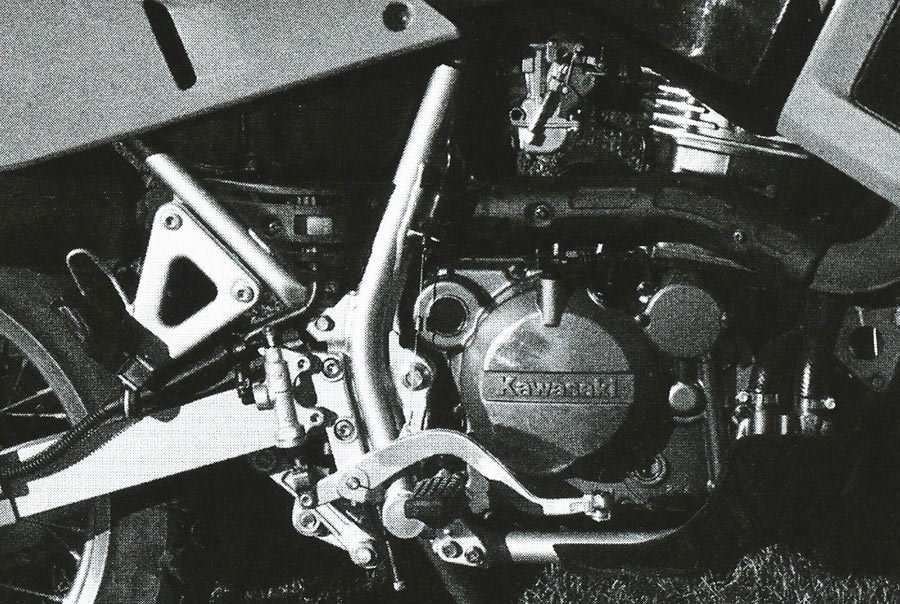
One key feature which further establishes the KLR as a machine of longevity is water-cooling. Its coolant reservoir is located (with coolant level visible), just below the right front side of the fuel tank. Additionally, a single radiator with fan is mounted below the front lower left side of the fuel tank. Though it is minimally protected, aftermarket accessories can be found to change this situation. Motor oil level can be inspected by removing the oil filler cap at the crankcase and viewing the gauge attached to it. The battery on the KLR is located under the seat. Removal or checking fluid level is possible from the left side by removing the plastic side panel. A nominal tool kit is set down in a strapped in plastic container found in the cargo rack. Fuses are accessible following seat removal only. Many KLR owners have relocated the twin fuse compartment and switched to blade type fuses less prone to failure. Access to the air filter is rather simple. This is done by removing the right side panel and subsequent plastic air box door.
The KLR exhaust, while quiet, sports a built in catalytic converter. This adds significant weight and heat to the area where it is located at the right rear upper portion of the motorcycle. Many owners complain of a whistling noise that develops around the 5,000 mile mark. It has become commonly known as the tweety sound.
Conclusion
As a generic dual sport, the KLR is commonly described as a bike that "... doesn't do any one thing very well, but rather many things acceptably." In a practical sense, it is as heavy a dual sport as anyone would want to consider for real off-roading. Outfitted with classic old school enduro features, the bike will withstand considerable abuse.
A bit of a paradox, it is many things at once. Depending on one's experience or expectations the bike may be variously viewed as: preferred for street, preferred for long distance, or preferred for versatile on and off-road riding. Several aspects of the machine are viewed as lacking. These are: wiring, the charging system, overall suspension, and power to weight ratio.
Two items are important to mention about the KLR 650. The first is illuminating the machine's Achilles Heel. Technically it is a part in the motor known as the Balancer chain system adjuster backing plate. Informally, it is referred to by cultish owners as the Doohickey. Thanks to the efforts of KLR aficionados: Elden Carl, Gino Pokluda, Fred Hink, the late Jake Jakeman, Tim Bernard, Kurt Simpson and Mike Colishaw. Hundreds if not thousands of failures have been carefully documented, photographed, measured and witnessed.
Kawasaki acts as though there isn't a problem and their dealers won't have a clue if you ask them about this weakness. This part's failure could possibly lead to catastrophic engine failure and traumatic injury to the reader. This story is best documented in Kurt Simpson's article printed in the October 2003 issue of Dual Sport News. A second important item to mention regards KLR handling. When altering any single component affecting handling, there seems to be an exponential drop off in quality of handling. Usually this means going a long way, even if making slight modification, before coming full circle where optimal handling might once again be achieved.
The KLR 650 might be considered the utility van of dual sport bikes. For one, because of the feel of the ride with highup center of gravity and bulky fuel tank. Secondly because of a power to weight ratio that enables it for only average duty. Thirdly because, owners often load these bikes, like a utility van, in order to travel the world. This being said, the bike does have considerable dirt capability. Enough so that it just might open a doorway to a whole new world of riding for a heretofore strictly street rider. From the off-roading perspective it is a beast. It is too heavy for extended rigorous off-road fun, unless one is intent on body building via motorcycling. Besides, there are other more preferred models for dual sporting when the equation calls for 50% or greater off-road use, right? Perhaps the greatest feature an off-roader would appreciate most about the KLR 650 is its range. With the capability of riding between 200 and 300 miles per tank KLRs today trek into some of the worlds remotest places. At one time BMWs were viewed as the sine qua non for world touring aficionados. No more! Today the KLR ranks as a top choice for touring enthusiasts.
Originally published April 2006.
{gallery}ARTICLES/Bikes/2006-Kawasaki-KLR650/Gallery{/gallery}