 Sticky logo
 Search


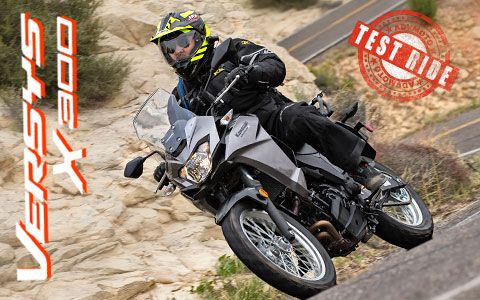
$5,400 and 300cc's of power can get you more than ever with Kawasaki's new Versys-X 300. With two days and several hundred miles of the finest Utah roads and landscapes, we found the highs and lows of Kawasaki's latest addition to the Versys family of bikes.
• Power and Performance
Power wise the Versys-X 300 is very similar to the venerable Ninja 300, which has historically been one of Kawasaki’s best selling street bikes and is track proven. As such, the motor still makes almost all of its horses near the exhilarating 12,000 RPM red line. Although nothing has changed internally, the fuel injection mapping, airbox design and exhaust header length make a very slight change in power delivery. Both the Versys and Ninja feature Kawasaki’s dual-throttle valve system which helps this hard-working mill crank out 39 horsepower at 11,500 RPM reaching a reported top speed of around 100 MPH.
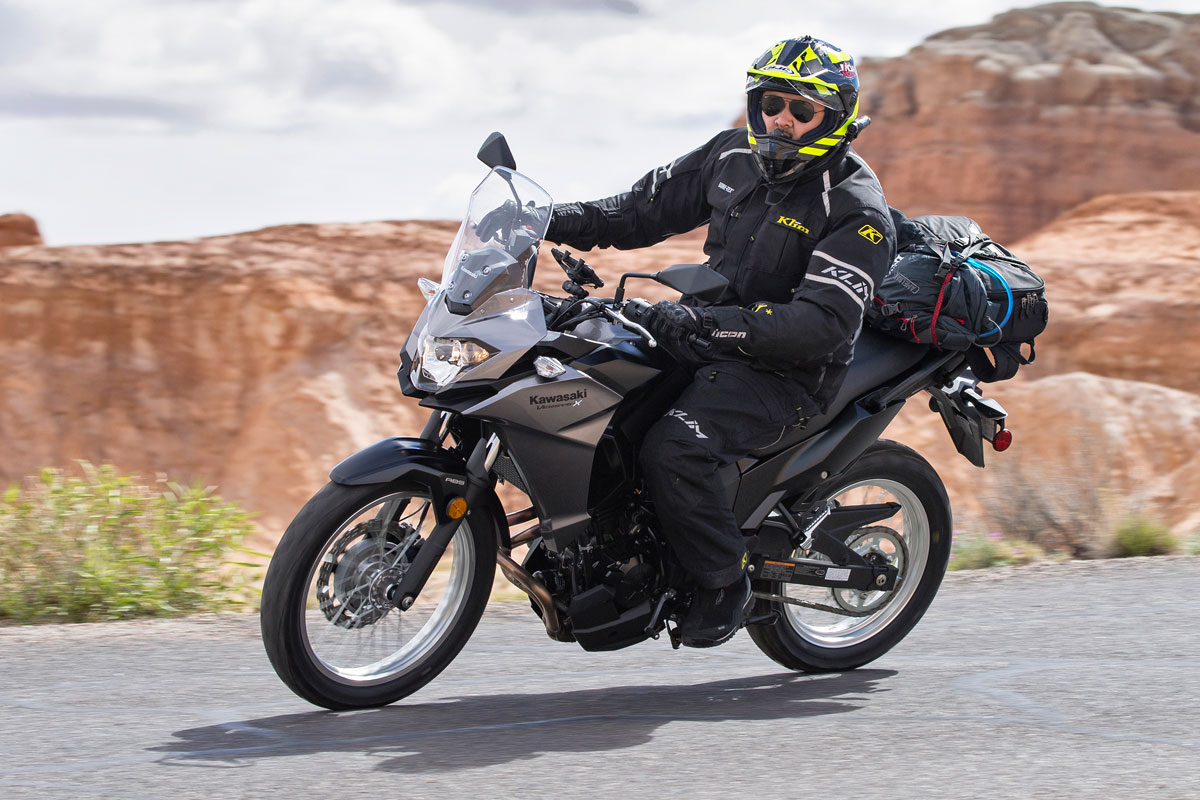 Kawasaki's Versys-X 300 is well composed in both on and moderate off-road surfaces.
On the highway, this means sustained cruising speeds of over 80 MPH where legally allowed to do so. Many of the roads we tested in Utah had 70+ MPH limits where the Versys-X 300 spent a lot of time bouncing off the red line. What’s most impressive about this is the vibration stayed about the same from 6,000 to 12,000 RPM. I caught myself recording a video doing 70 MPH at 13,000 RPM not realizing I was in 4th. All things considered, it seems likely the tachometer is labeled with a 12k redline just to be kinder to the engine, but I have no doubt this furious little mill can take the beating for extended periods of time.
Low end torque lovers who plan to spend most of their time off-road or on trails are not likely to opt for this platform. The Versys-X 300 is not a trail bike and should never be mistaken for, or compared to, one. Instead, it excels on a mixture of pavement and gravel, or packed dirt roads, much like a V-Strom 650.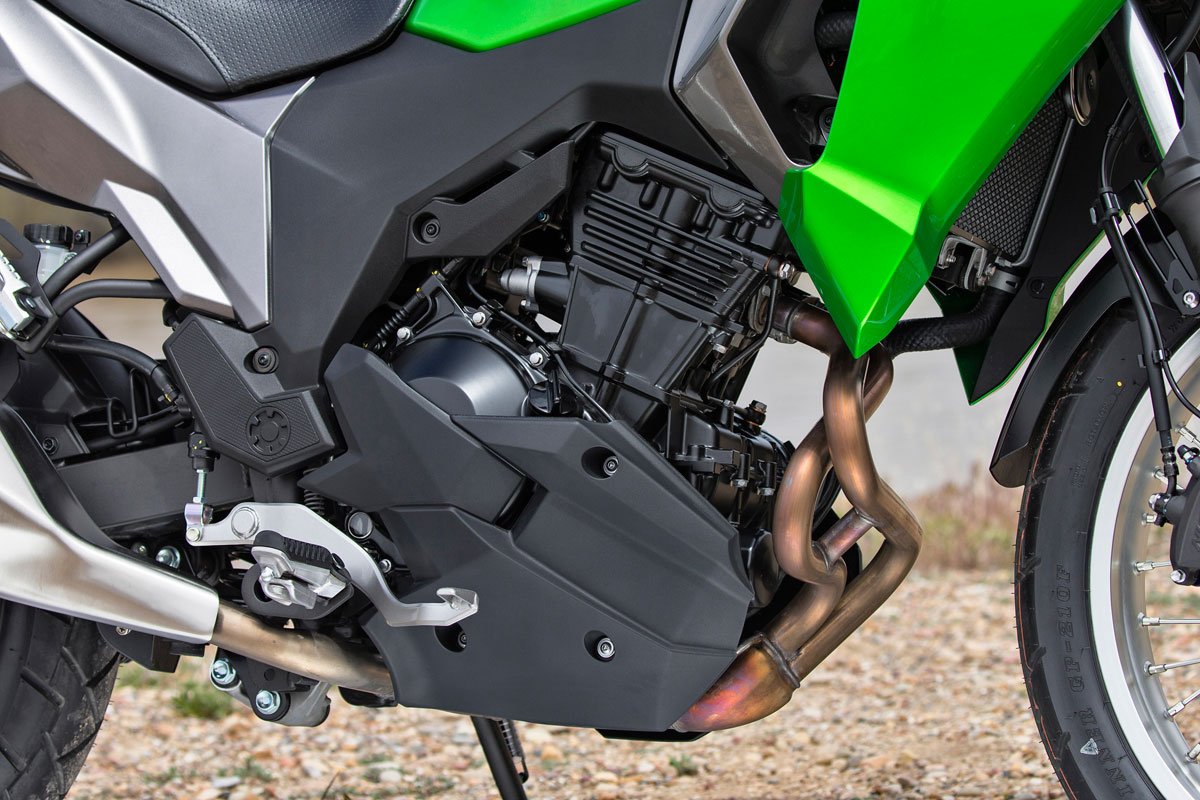 Versys-X 300 motor shares the Ninja 300 heart. Changes are made to the airbox, FI mapping and header length.
As much as I love to extol the virtues of small engines, they have obvious limitations. Heavier 200+ pound riders will notice they’re riding a small displacement bike more than a lighter rider. Chasing a lighter counterpart through twisties will demand more downshifting, but anyone less than 170 or so pounds should have plenty of power on tap for quick acceleration and passing.
Braking is very positive on front and rear dual-caliper Nissin brakes. Front end bite is nearly immediate and the ABS system works well on road. On a slow speed, off-road downhill section with some rocks, I noticed the front wheel would still lock up and slide sideways while the rear wheel kept skipping. Unfortunately, there’s no official way to disable the ABS so those who have dirt aspirations should save themselves $300 and opt for the non-ABS version.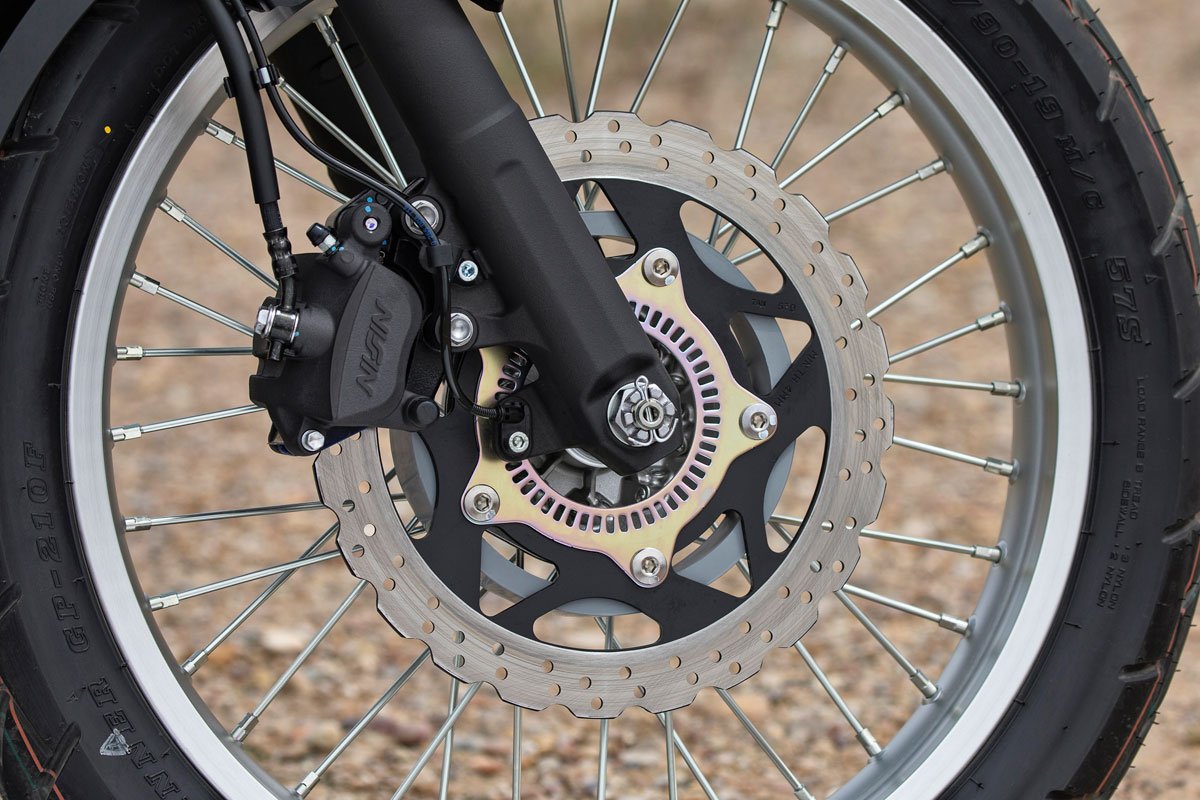 Dual-pot Nissin calipers provide plenty of bite for both front and rear wheels.
Kawasaki also included a clutch assist and slipper clutch design into the Versys-X 300, yielding one of the lightest clutch pulls around on any bike. The pull is smooth, with no binding or grabbing and light enough to be operated with one or two fingers. The slipper clutch is much appreciated when banging down gears to pass at high RPM. These two features help make the baby Versys incredibly user friendly for both new and experienced riders.
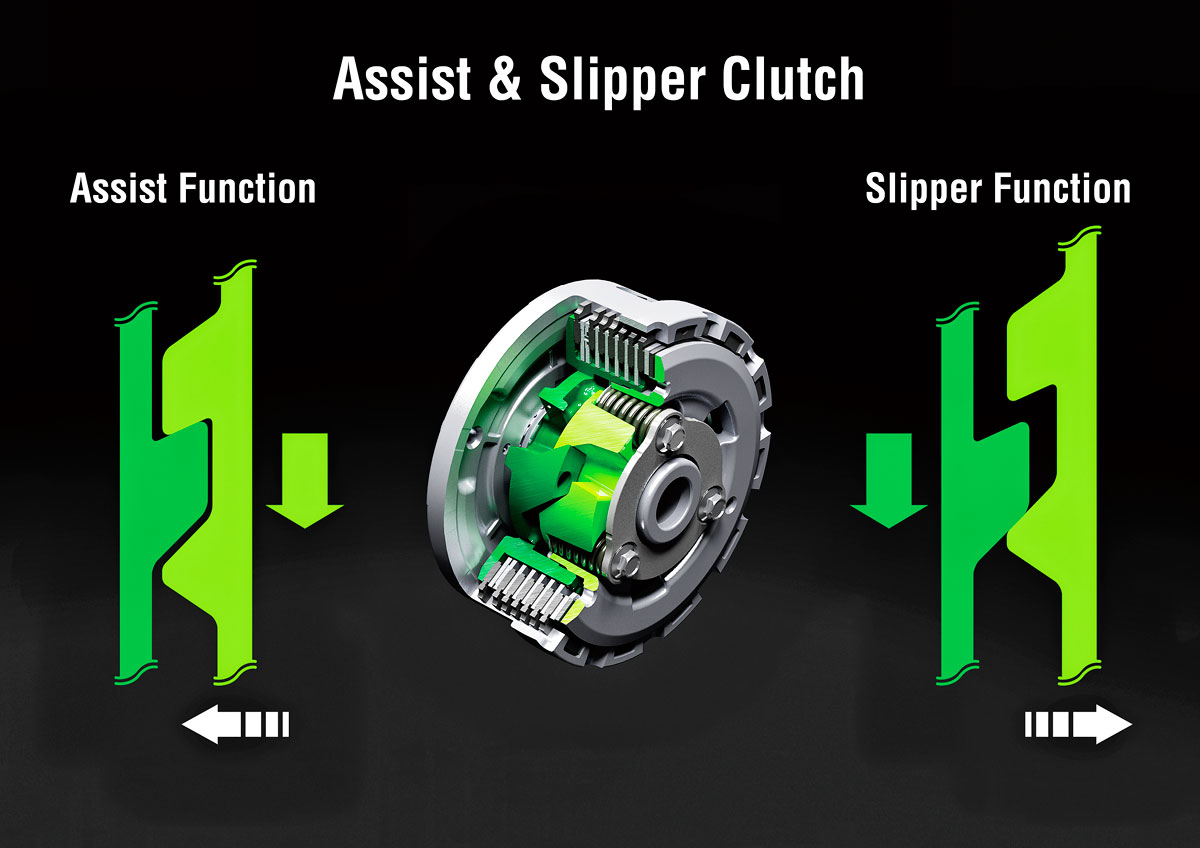 Clultch Assist makes for very light lever pull while the slipper clutch make high rpm downshifting a stable affair.
• FRAME, COMFORT and ERGONOMICS
Aside from the engine, nothing is shared with the Ninja 300. The strengthened frame is entirely different and sports a more relaxed and upright riding geometry we love for extended days in the saddle. Standing is also much easier, but it’s still a small bike, so six footers would need some modifications to make standing more comfortable. Thankfully, the base geometry is close enough so that lowered pegs or handlebar risers will do the trick.
A one inch drop in foot pegs and maybe an inch rise on the already ATV-like handlebar would be a great help for getting on the pegs from time to time. I would guess any riders between 5-foot to 5-foot, 8-inches or so would find the stock geometry quite acceptable for stand-up riding.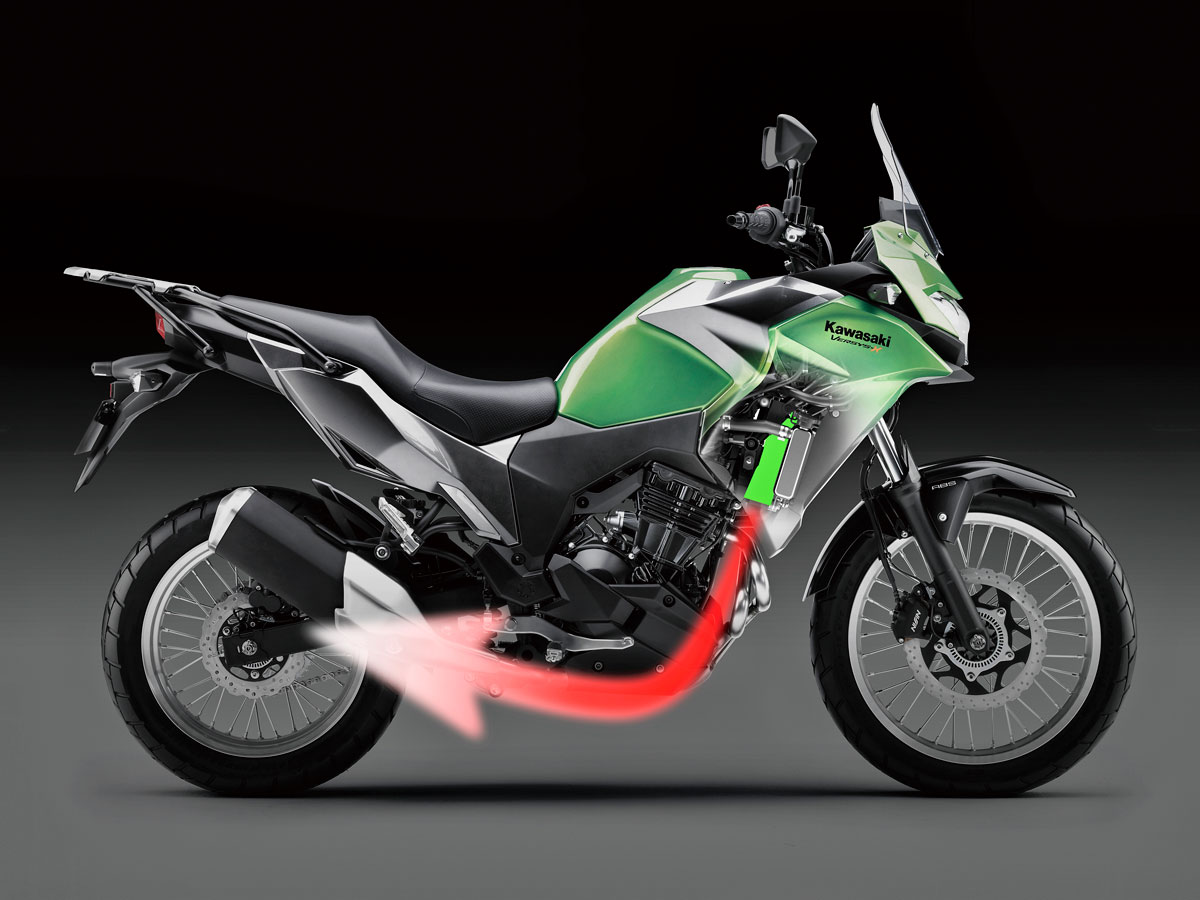 Tthe Versys-X 300's ergonomics are good for most mid-sized riders. Taller riders may want to make some adjustments. Heat is moved away under the bike
The biggest hardship, both literally and figuratively, is the saddle. The short/standard saddle is almost like sitting on a plank of wood and after about 2–3 hours of riding, your tush needs an intermission. Problems like this are usually solved by the aftermarket. Kawasaki offers a softer seat for taller riders that sits about one inch higher to create more leg room and reduce knee bend. A couple of the bikes were equipped with the taller seat option but unfortunately I didn’t get a chance to ride one.
Controls and gauges are all well placed and easy to both read and use. Nothing too surprising on the handle bar control clusters with buttons in all the standard positions. The mirrors worked well but were rather long and would likely be the first things to be break in a crash.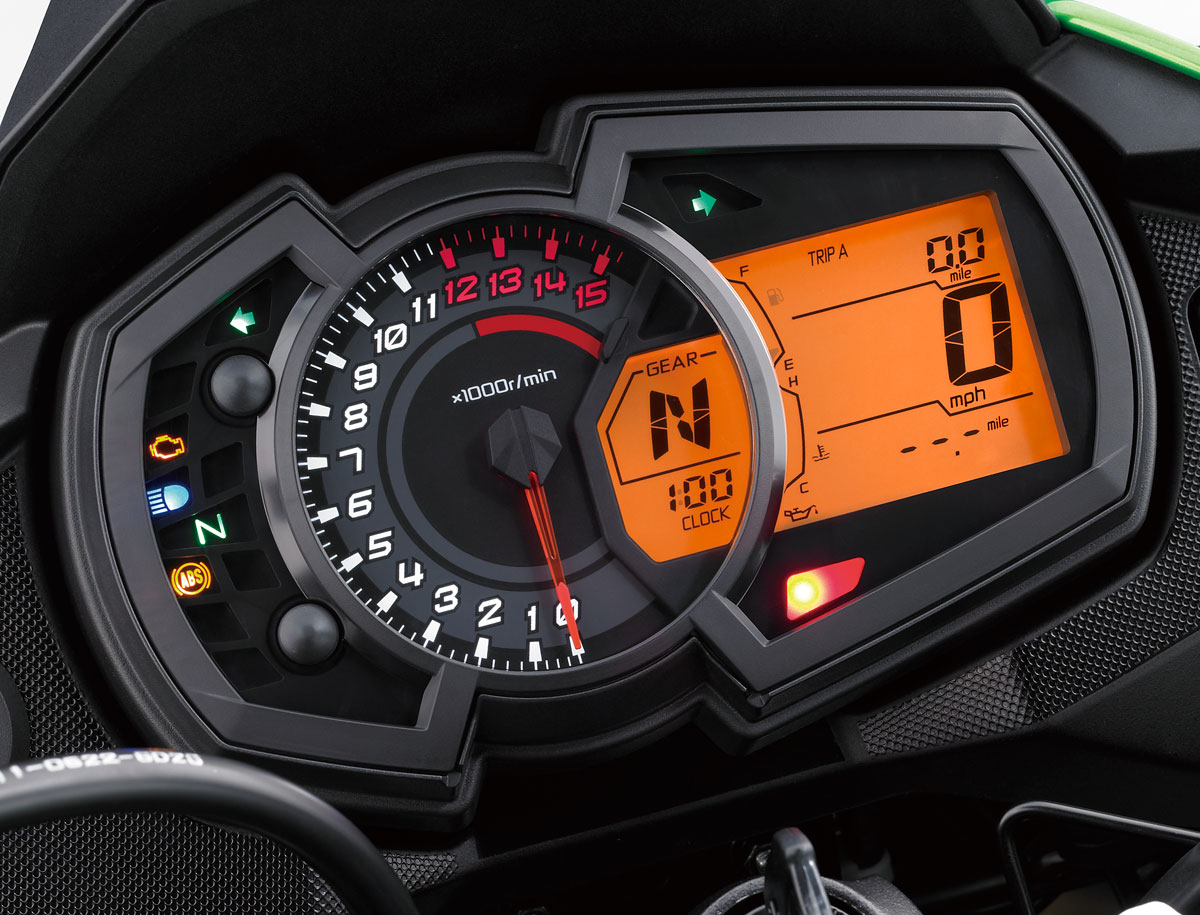 Clear gauges with plenty of information to make sure you're getting the most from every gallon/liter of gas!
The gauge cluster is full of useful features. A giant, easy-to-read analog tachometer lets you know when redline is around the corner and also hosts a large gear indicator. Just right of that, we have rather small but still usable fuel level and coolant temperature meters. The speedo numbers are large and everything is easy to read, even with polarized glasses. The fuel level indicator bar won't go donw very fast considering the over four gallon tank. With an average of 60 to 70 mpg (depending on weight and other factors) most riders should easily see over 200 miles range to a tank.
Two different fields on the upper and lower right hand corners give you adjustable data. On the top are your standard Trip A, B and odometer numbers, while the bottom gives you current fuel economy and total average fuel economy. As an extra bonus, there’s a small and easy to miss indicator shaped like three small circles that tell you when you’re operating at an optimal throttle level for fuel efficiency. All the digital numbers are easy to read making me wish more dual-sports could have slightly smaller versions of the same gauge set.
• ACCESSORIES
Until the aftermarket catches up with the new model, Kawasaki has a healthy dearth of accessories already available for the Versys-X 300. The left and right side of the dash has blanks for a 12V power socket and auxiliary light switch. A centerstand is available as well as robust crashbars that mount directly to the frame, not using clamps. Official Kawasaki/PIAA 530 LED auxiliary lamps mount up to the crash bars and are probably the most useful upgrades on the list next to the optional centerstand.
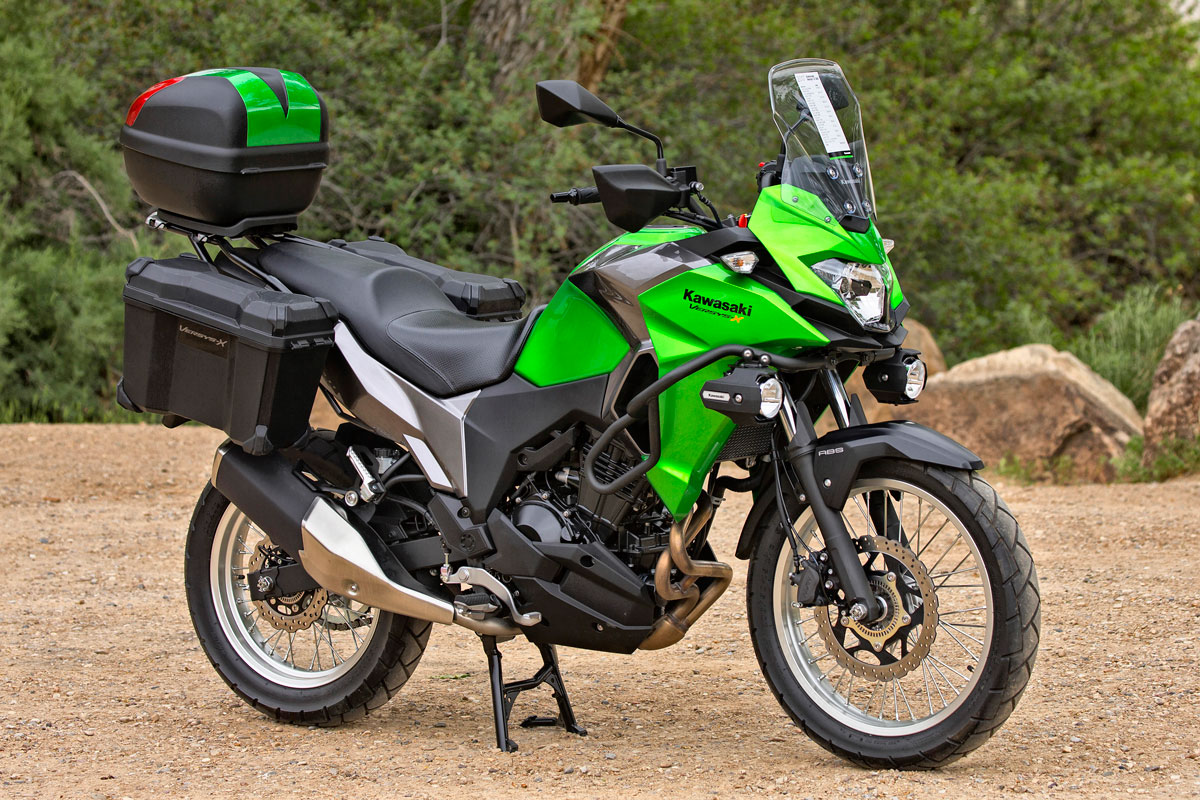 A wealth of accessories are available from the factory. If you plan to ride off-road, save 300 bucks on ABS and get the crashbars instead.
• WHEELS
One of the most striking differences between the Versys-X 300 and its soon to be available counterparts is the spoked 19-inch front and 17-inch rear wheels. The new Honda CRF250 Rally uses more off-road friendly 21/18 combination which contributes to a three inch higher 35-inch seat height. The single cylinder BMW G310GS uses 19/17 alloys while the parallel twin Suzuki V-Strom 250 comes with 17/17 alloys and has not been officially announced for North America.
Trail riders will understandably want a 21-inch front wheel, but as that would likely result in a more than 35-inch seat height. First time, or returning dirt riders, may appreciate easier flat footing until more confidence is gained.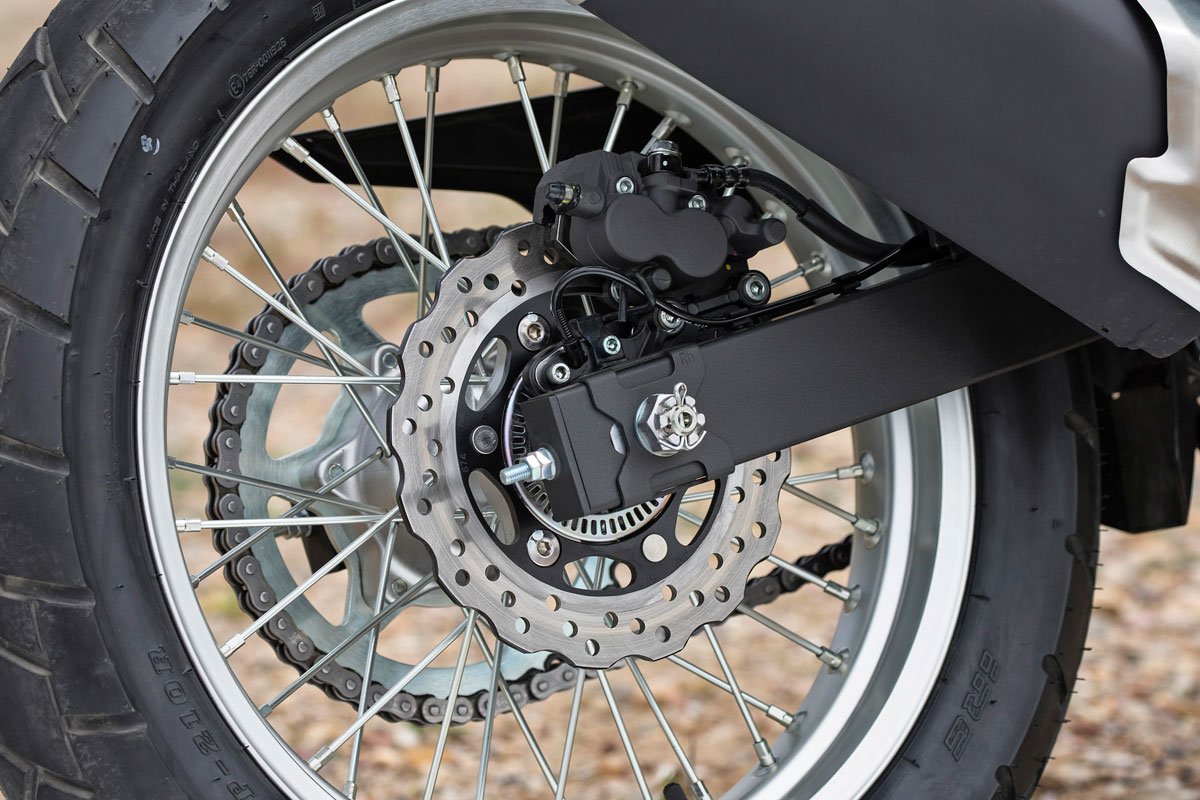 Spoked 19 and 17 inch wheels set the Versys-X 300 apart in the market.
We’ve long been an advocate of the 19/17 combination as a balance between maintaining fun on and off road handling and manners. The industry has recognized this and 19/17 dual-sport tire selection has exploded over the last three years, giving us lots of options to tackle whatever terrain we like.
• SUSPENSION
Forks and shocks are almost always the worst components on budget bikes. The engine may be great and the bike may look cool but nothing sucks more than throwing all that coolness into a turn and having it bounce and wallow like an ocean buoy in a storm. Even some rather expensive adventure and dual-sport bikes fall victim to this irritating and, quite frankly, dangerous design flaw.
Thankfully we’ve seen an improvement in that over the last few years, most notably with Suzuki’s V-Strom 650 upgrade in 2013. The Versys-X 300 has followed close suit in that despite the budget price tag, suspension has not been filed away to the afterthought shelf. Externally, the forks and rear shocks do not look like much, but there’s some magic inside.
Both front and rear handled beautifully across a variety of terrain. On pavement, there was very little diving under hard braking and no wallowing in corners thanks to proper dampening, spring rates and a very rigid frame. I was initially a little disappointed that it lacked upside down forks, but after a hundred miles of Southwestern mountain twisties, began to understand it didn’t really need them.
Other improvements were made to help reduce fork flex and twisting. The fork legs are a healthy 41mm in diameter and lowers are cast with a beefier section at the bottom. Even the front axle is oversized and hollowed out to not only increase stiffness, but help keep weight down.
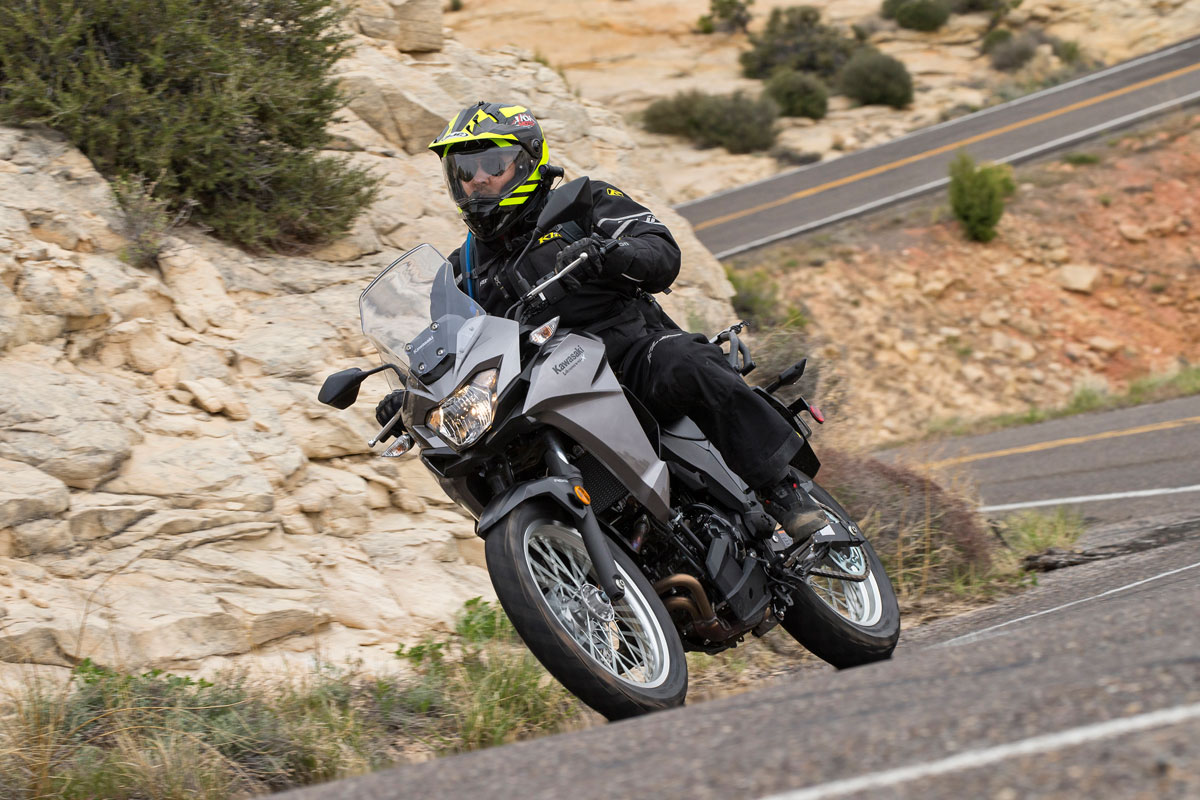 On the street, the suspension needs almost no adjustment ..even for a heavier rider.
Dips in the road were handled gracefully and washboard just about disappeared underneath the tires. Even the rumble strips on road edges and centerlines were easy to cross back and forth over with complete control.
Naturally there are limitations. The front suspension travel only comes in at around 130mm (5.1 inches) and rear at around 148mm (5.8 inches). Those looking for 8 to 10 inches of travel won’t be happy with this, but at the same time this configuration allows for a relatively friendly seat height of 32 inches. The forks bottomed out coming off a rock at 30 MPH but still held composure and nothing broke. With around 7 inches of ground clearance the Versys-X 300 will clear most gravel road obstacles but some clever custom exhaust re-routing would easily add another very welcome 4 inches of room underneath.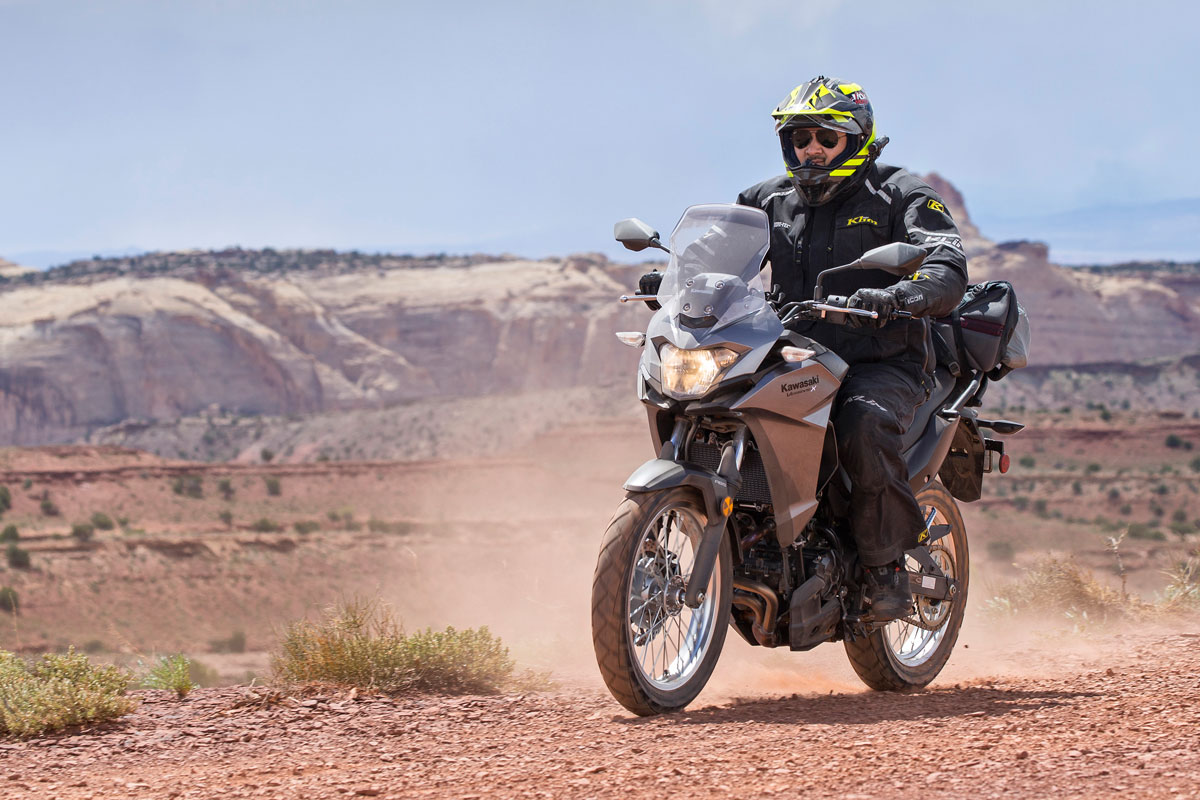 Moderate off-road riding is easy without any surprises...even with street biased tires.
Riding brand new bikes we could expect springs to sag down the road. Despite this, there’s strong reason to believe a spring and/or fluid weight swap could yield something even better than the original with the confidence that it had close to spot-on compression and rebound valving from the factory.
This is a huge boost to not only the comfort and fun, but safety. The suspension quality is probably the most important and pleasant surprise of the test ride. You would traditionally have to spend hundreds of dollars to get a suspension that behaves the same way as this off the show room floor. ig ol’ thumbs up to Kawasaki in this department and we hope it’s a trend we’ll see continue across all bikes in the future... budget or not.
• OFF-ROAD CAPABILITY
So, is it off-road capable? Yes, but we would make some changes to help get more bite. First, we’d swap out the tires. The stock IRC Trail Winner tires do very well on pavement and didn’t drop any surprises on test riders even on cold pavement with cold rubber at high speeds in sharp turns. A more dirt-oriented 60/40 or 50/50 tire would help tremendously in off-road conditions. Front fender clearance is also a bit tight, but only time will tell. We’d also likely add a wider footpegs since the street-style pegs are too narrow and focus pressure on your feet when standing.
For taller riders, handle bar and seat adjustments are mentioned above, as well as the need to swap out the mirrors. Aside from the addition of already available crash bars, the Versys-X 300 is ready for any rider to explore their favorite dirt roads.
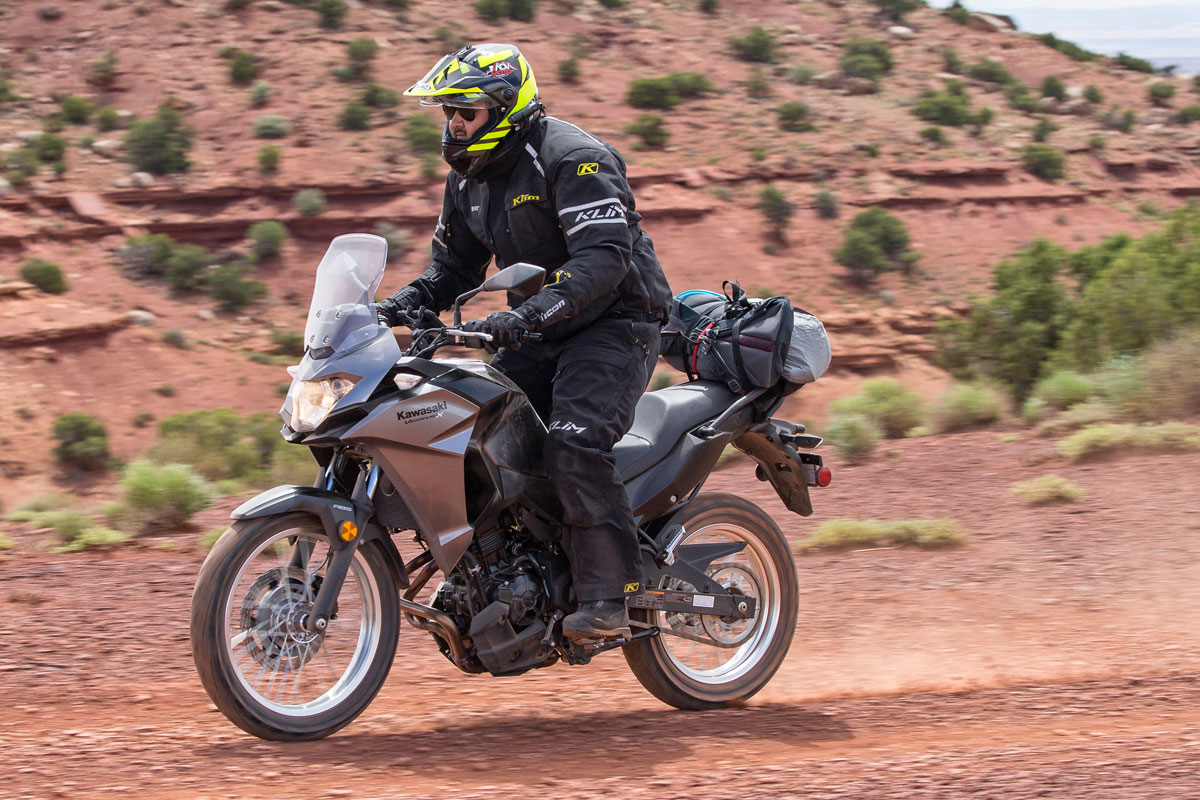 Even when hitting an obstacle at speed going downhill which caused the forks to bottom out, the Versys-X 300 kept it's composure.
• SUMMARY
Starting at around $5,400 for non-ABS you can add another $300 to get Bosch’s new lightweight ABS system. For the price, it’s hard to go wrong with a bike like this which lives up to the “Versatile System” name even better than its older and larger 650cc and 1000cc siblings.
The adventure/dual-sport community is full of passionate riders who want their dream bike right now. Big displacement guys won’t be happy with a high revving small engine, while the off-road riders won’t like the street-oriented wheel sizes and limited ground clearance. No bike, like any machine, is perfect. What’s important to remember is the Versys-X 300 is not intended to be, or compete with, any bikes in those categories.
Bikes like these largely serve as an introductory platform to launch riders into whatever they may find enjoyable later. As such, these are critical models in the North American market to expand what many see as a shrinking rider base. Without an increased rider base many of the models we anxiously dream about having will never come to fruition.
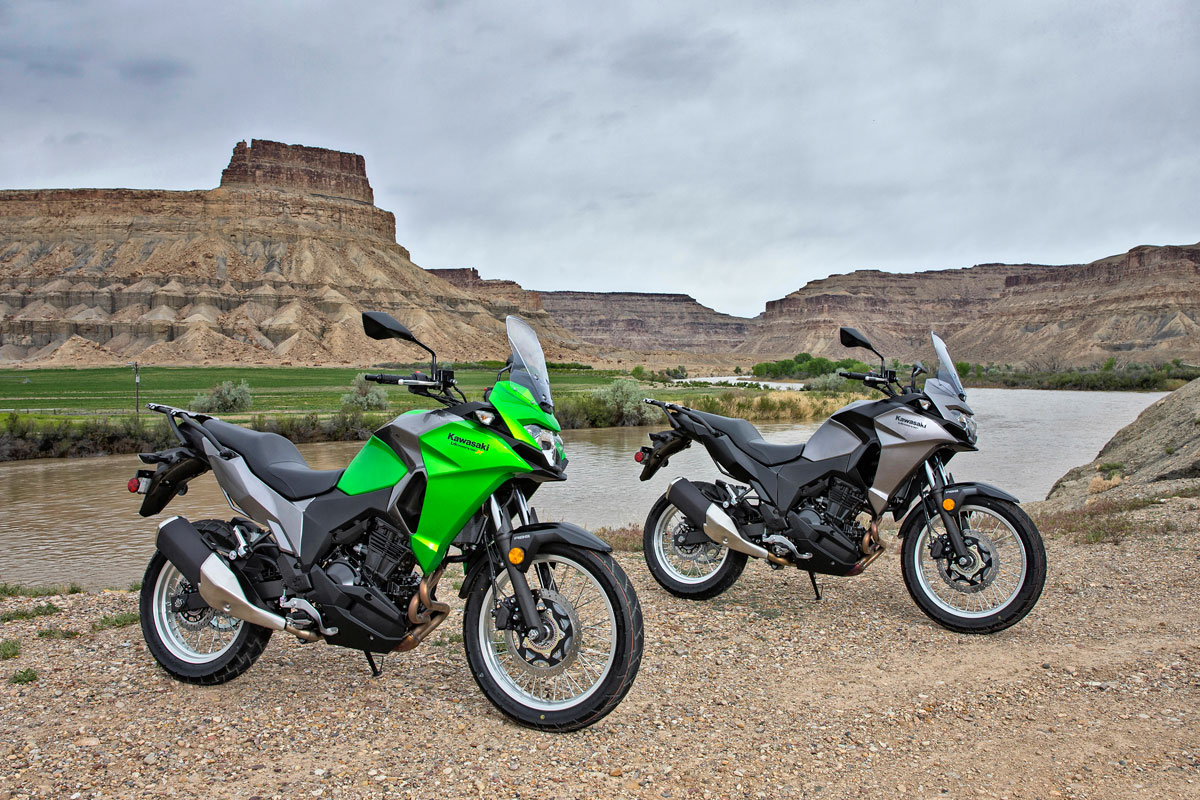 With so much going for it, the Versys-X 300 is going to be a very attractive model to a wide range of riders.
Kawasaki has produced a "gateway" bike that’s nearly perfect for the newer rider who wants to get a user-friendly, but still exciting ride which will take them from pavement to gravel and dirt roads.
You can learn your basics on the Versys-X 300 before moving onto a more trail-oriented bike with a larger motor. If you decide dirt isn’t your thing, the Versys-X 300 will give you years of crazy high RPM screaming pavement fun until you decide to move to a more powerful street-oriented sport or touring bike. At around 70 mpg, you'll have no problems with long range touring.
To say the new Versys platform is only for new riders would also be a mistake. We know plenty of riders with large displacement bikes that remember how fun and easy a light bike can be as a supplement to their larger steeds. The Versys-X 300 would also be a great bike to teach someone the fundamentals of riding, or loan to a buddy, without worry of it being either too much power or expensive to repair or replace.
Dealers are already selling units and some are taking orders, so the demand is already there. As the wave of practical riding grows in North America, the Versys-X 300 will be leading the charge on simply getting people into saddles without limiting where and how long they can ride.
Any way you slice it, bikes like the Versys-X 300 make a lot of sense to a lot of people. Taken for what it is — a lightweight, affordable and fun ride which can do a little of everything — Kawasaki has knocked it out of the park. Future generations of the model can only promise to be more exciting. Much thanks goes out to the Kawasaki USA staff and the Utah Department of Natural Resources for assembling two great days of scenic, fun and challenging riding through some of the most beautiful parts of the country. Stay tuned to ADVMoto for the latest Versys-X 300 news and info.
PROS |
CONS |
| ▲ Amazingly well rounded bike at a good price | ▼ Rock hard standard seat |
| ▲ Surprisingly well dialed in stock suspension | ▼ Not a lot of low-end torque for off-road riding |
| ▲ Not much geometry changes for mid-sized riders | ▼ Mirrors likely to break on first drop |
| ▲ Lots of info on the gauges to maximize feul economy | |
| ▲ Bulletproof high-rpm motor can cruise all day long at 80mph | |
| ▲ Will stand alone in it's class, even with models not yet available in North America |
Photo credits: Kevin Wing - Check out more of Kevin's images at: kevinwingphotography.com
{gallery}ARTICLES/Bikes/Kawasaki-Versys-X-300-2017/Gallery{/gallery}