 Sticky logo
 Search


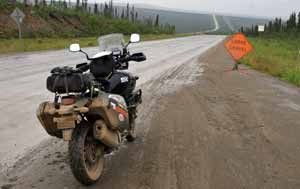
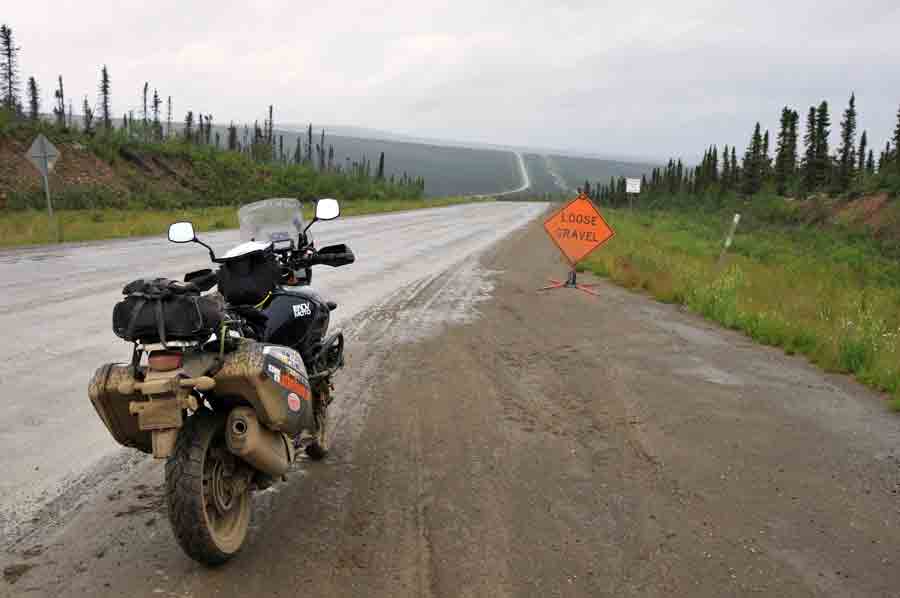 The photo with the ironic "Loose Gravel" (ha-ha-ha!) sign was located on one of the tiny quasi-paved sections of the Dalton.
There’s an uncommon sense of freedom associated with not having to ride anywhere in particular. In search of that feeling, I set off on a 20,000-mile meandering journey around our fair continent—a journey that included the crown jewel, a run to the Arctic Circle. Before my departure, Suzuki HQ happened to be in contact with us about the release of their stem-to-stern redesign of the V-Strom 1000, and offered up the “first one off the boat” Adventure model for an extended test. How could I refuse?
“Thataway!”
I planned to ride the Dalton Highway, essentially a desolate, mostly dirt road, from just north of Fairbanks to the Arctic Circle. Though I hail from sunny (and drought-ridden) SoCal, I left prepared for almost anything. My gear included KLIM’s Overland suit and Element Long gloves, electric jacket and glove liners from Venture Heat, a tried ’n true hi-viz rain suit from Tourmaster, Sidi Adventure Rain waterproof boots, and the remarkably fog-free LS2 FF386 flip-front helmet. For luggage, a rugged set of dry bags from Enduristan did the honors. But as I approached Alaska along the Alcan Highway from “Mile Zero” at Dawson Creek, Canada, fast-changing weather and road conditions created concern about what lay ahead.
At this point, let me interrupt my tale to state that I’m hardly a dirt rider, at least not on big ADV bikes. It’s a skill I keep promising to acquire, but haven’t fulfilled. Already unqualified for that sort of thing, I had a mounting, morbid fear that I might be facing something worse—mud! Fully aware that we often get what we resist, I kept an eye on weather reports in an attempt to nail the “perfect day” for the ride. I was, however, on a limited budget and other obligations leaned heavily on the schedule. By the time I arrived in Fairbanks, I had only a one-day window to make the ride or not—would the weather gods smile on me?
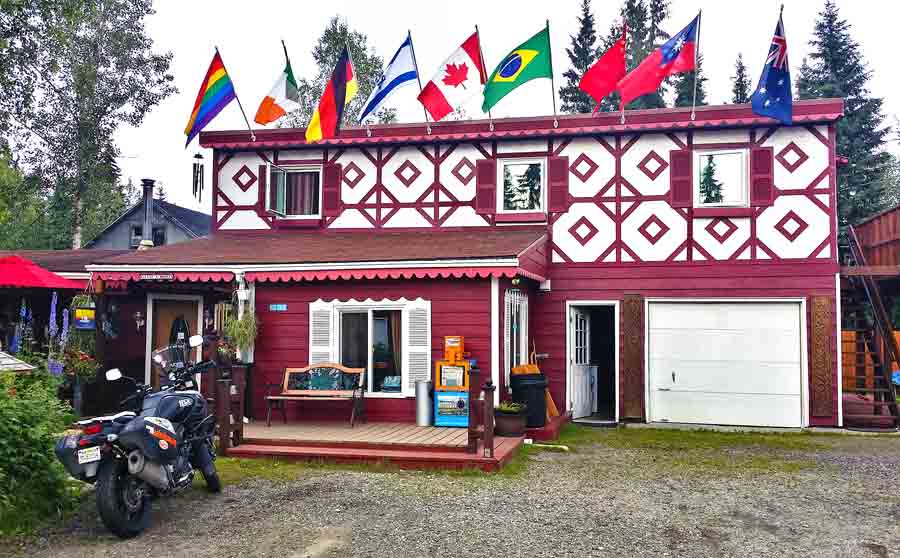 Needy a great place to stay in Fairbanks to meet other travelers that's super economical? Billie's Backpacker Hostel provided the perfect jumping off point to explore the area while preparing for the Arctic Circle run. Just say "no" to hotels....
I found a great place to stay at Billie’s Backpackers Hostel in Fairbanks. When not camping, I prefer hostels and recommend them highly, worldwide. Most are havens for travelers on a budget and outstanding resources for making friends and discovering unique details about their locales. Billie’s is no exception, and there I met several riders who’d tackled the Dalton with varying degrees of 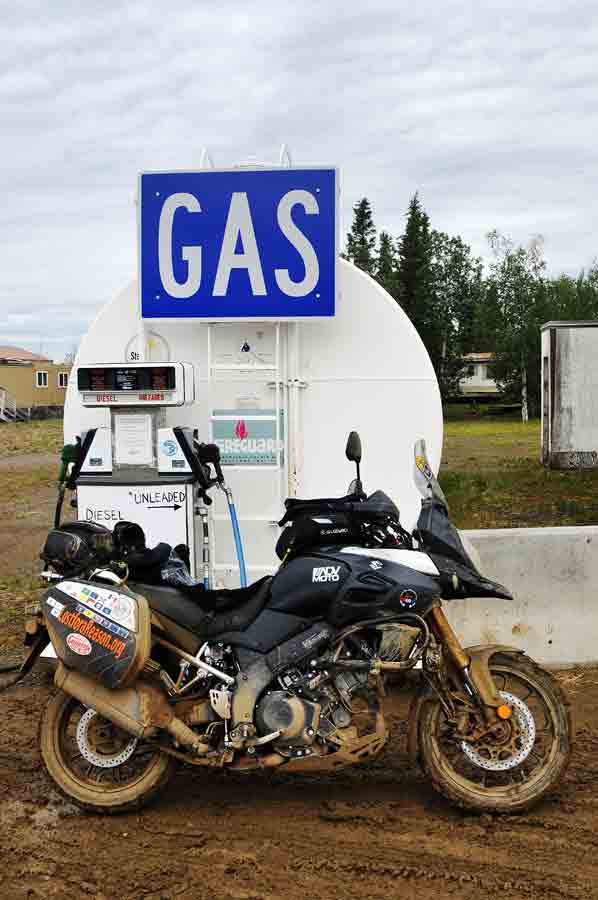 The gas pump mentioned in this story was located at least 100 yards from the office that was already about a quarter mile from the road. Slogging back and forth through mud in a raging downpour, I had to make three trips to get it working. The average wait time between users of this one and only contraption was about 15 minutes. Want mroe irony? The Trans-Alaska Pipeline serving the entirety of North America ran next to it.success. They provided good information about what to expect, conditions and expenses, as well as the all-important incidentals—like where to acquire a rare Arctic Circle sticker.
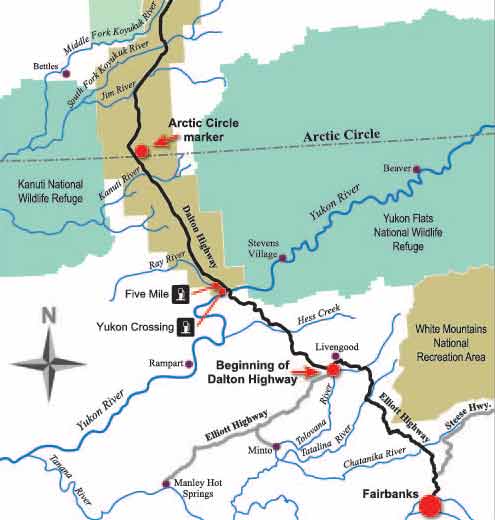
Most have heard of the Dalton Highway. It starts about an hour north of Fairbanks and runs a tad over 400 miles to an oil town, affectionately known as “Deadhorse,” which kisses Prudhoe Bay on the Arctic Ocean. The road exists for the sole purpose of supporting the Trans-Alaska Pipeline, even though in recent years riding it seems to appear on many bucket lists. Although there are a few random and short patches of pavement, it’s mostly a dirt and gravel road with precious few resources along the way. The Arctic Circle marker is some 115 miles from the beginning with a poorly marked, easy-to-miss, important refueling stop about half way.
This is Alaska, where in August the sun never truly sets, making it an ideal time to “do” the Dalton because conditions are as close to ideal as they ever get. If skies are clear, a ride to the Arctic Circle and back can be accomplished in a day with almost any vehicle. The roads are often like a roller coaster, with long and sometimes very steep drops and inclines that make their winding way through the mountainous tundra. At that time of year, count on a mother lode of mosquitos; it’s wise to go heavy on the DEET and have a head net handy. If you stop, the mossies will find you and eat you alive!
No matter the conditions, due to the road’s mostly dirt surface it’s not a leisurely ride, and can be anything from mildly technical to a serious trial keeping a bike upright. Especially for motorcyclists, there are significant risks, and crashes are common. Breakdowns can be both dangerous and expensive, with towing charges reportedly in the $1,200 range. And it’s very definitely bear country—both black and grizzly!
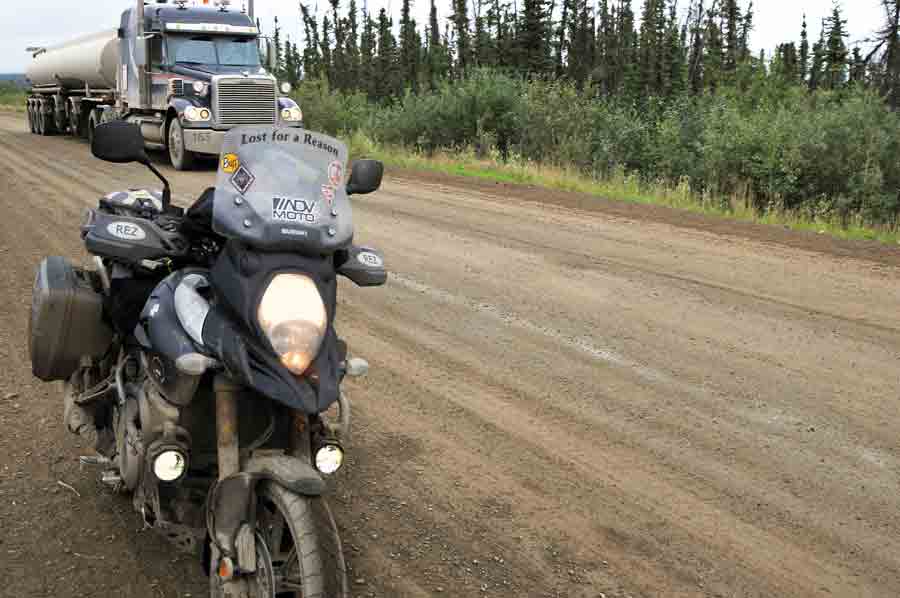 I managed to grab a couple of shots of passing trucks just before the camera became painted in mud. I'd heard that the truckers could be nasty, but nothing could have been further from the truth; a misunderstanding likely originating with riders not fully appreciating what truckers are up against on this precarious road.It's fair to say that the road is a challenge without rain, but when the skies open up it quickly becomes a mud fest prone to flash floods. As I arose on the fateful day at 3:30 a.m., it was (of cours!) coming down in buckets. On this trip I'd already ridden something like 5,000 miles in the wet stuff, but this was icing on the cake. And knowing what was ahead filled me with a family-sized dose of a-n-x-i-e-t-y.
To Infinity and Beyond!
The V-Strom was stripped of all but the essentials, with a trusty KLIM Krew Pak that carried food, extra water and my secret weapon, a large spray bottle of Windex. The ride on the Elliot Highway into the maw of the Dalton was indistinguishable from the inside of a car wash, and becoming increasingly colder, too. About an hour out, and just outside of a station called “Livengood,” I rounded the final turn onto the “Ice Road Truckers” utopia.
Within moments my anxiety turned inside out to be replaced with a certain knowingness that I was about to: A. Wreck the bike; B. Break some bones; C. Possibly not make it out alive; or D. All of the above. The road’s entrance and especially the first few miles were nothing but mud, uneven and chewed up surfaces, hard twists and turns, and mile-long, slippery, sheer hilly descents and ascents. There’s a rumor that they keep it that way to scare off would-be riders—a tactic that nearly worked for me!
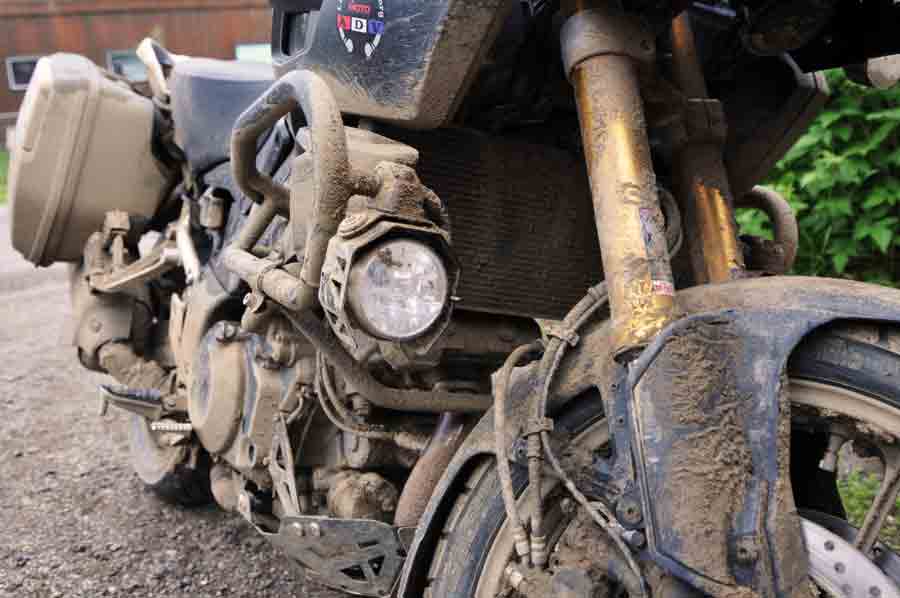 One of the most important things to remember after riding calcium chloride is to thoroughly wash the bike immediately afterwards. When it dries, it sticks to bike and engine parts like there's no tomorrow, and eventually won't come off! Many bikes have been permanently ruined by failure to heed this advice. Due to all the rain, my bike wasn't as caked as some, but it still required a whopping $20 at the Fairbanks "Spray 'n Wash" to hose the clinging crud off the bike.
To make matters worse, I’d been so confident that the weather would hold, the bike still had street tires. I now knew without a doubt it was crazy to be out there. Reassessing the situation I struck a pact with myself—give it a go or get out if I dumped the bike more than five times.
The Dalton has a top layer of calcium chloride used to keep the surface dust down when it’s dry. When wet, the stuff becomes goo and sticks to the bike in a far worse way than ordinary mud. Sink or swim (literally), the game was afoot. And there wasn’t a moment I didn’t contemplate tucking tail and getting the heck out of there.
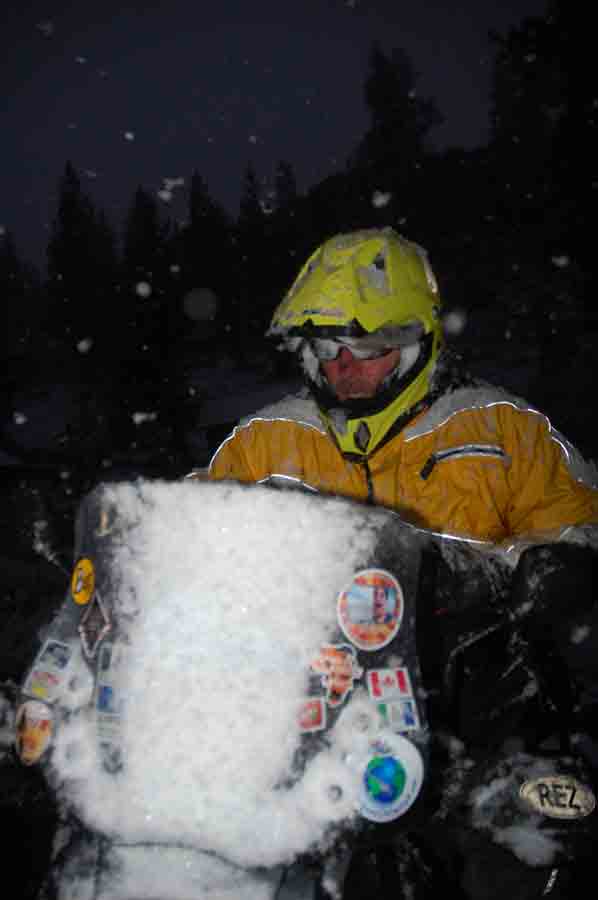 So that's what the "Snowflake" LED on the V-Strom's instrument panel is for! A freak snowstorm at the eastern exit of Yosemite resulted in a brush with hypthermia and temporarily abandoning the bike towards the end of my 20,000 mile ride around North America.
This trial by fire provided an interesting learning curve. Although rarely stable, riding mile upon mile of mud on varying and unpredictable surfaces often set the bike into uncontrollable slides. Braking was near impossible, and some turns were a little too close to sudden or boggy drop-offs. Speeds were usually slow but I experimented a lot, attempting to find a MPH sweet spot (never did), while preparing for the seemingly inevitable crash.
The driving rain continued and, although other vehicles were infrequent, there were instances when truckers provided, let’s call them “pucker” moments. Some of the inclines were extremely steep and at least a mile long. These guys were hauling heavy freight and even without the rain and mud the strategy was simple: hit a hill as fast as possible, using momentum to make it up the grade. At those speeds, when a truck passed—often inches away—there’d be a spray of mud that darkened the skies, coating my visor so thoroughly I’d have to stop and clean it.
It took about four hours of slogging through muck to make it to the Yukon Crossing outpost, where I enjoyed a brief respite with a little damp warmth, hot coffee, and some very expensive mystery gas from the world’s only pump designed by Rube Goldberg. What I didn’t count on was the facility being a quarter of a mile off the dirt road, with a substantially heavier, thicker lake of mud to torture me. The sludge was so thick and gooey that the bike’s wheels continually seized—the only remedy was to get off and hand-scrape them. Oddly enough, it was kind of gratifying!
The Grand Finale
Here I met a fellow nutcase, John Maddock, riding a Triumph Tiger 800 and also on his way up the Dalton. John is one of those guys you like immediately, so we teamed up to watch each other’s backs for the wet and muddy “slide” to the Circle. And a mere couple hours later, just as we approached our destination’s turnoff, and right on cue, the rain finally let up… oh, the irony!
The Arctic Circle marker, at its beautifully round-numbered latitude of 66° 33′, is one of those iconic “must photograph” landmarks, mostly because so few make it there. We certainly took advantage of that moment. But like so many of the world’s legendary destinations, no matter what the cost or effort to make it there the result is often anticlimactic—in other words, the journey, not the destination, is the reward. As this was the northern terminus of my journey I did the natural thing and immediately set about planning what was next. And when John voiced his decision that the ride was too precarious to continue, we saddled up, pointed our bikes south, and headed for Fairbanks.
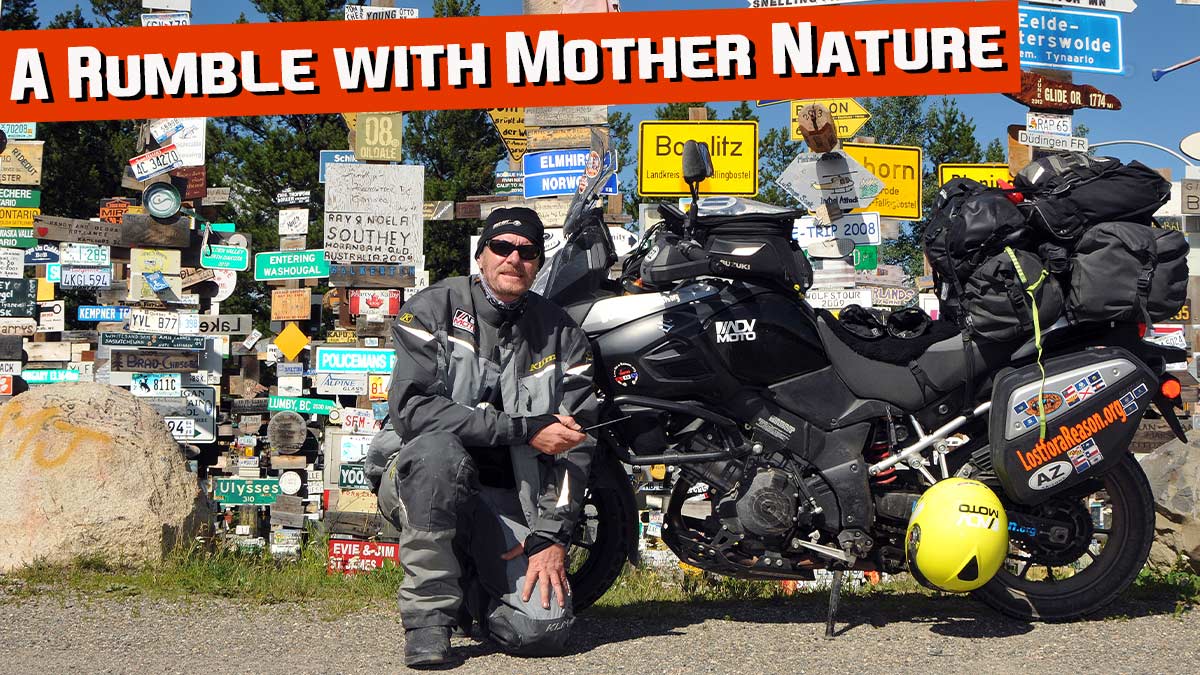
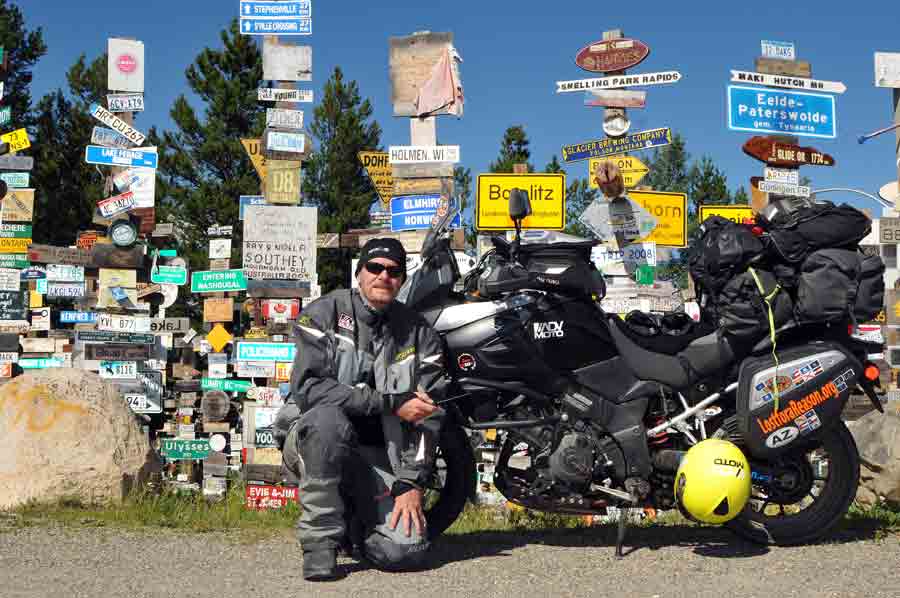 An obligatory selfie at the "signpost forest" in Watson Lake, Yukon.
The storm had pretty much subsided for the ride back. By then my skills were catching up to the conditions and, to my surprise, I was even pushing the limits and having fun with it. Being more relaxed also afforded a little free-thinking “helmet time” rather than the panic-stricken survival mode of the way up. In some ways, the ride had fulfilled an aspect of what life is all about: facing a challenge and seeing it through. But a single nagging thought persisted—I’d almost given up—and I couldn’t help but wonder how the accumulation of all those “given up” moments played out in one’s psyche.
Adventure certainly can mean many different things, but in the end, it’s that inner journey we face. Run and we become weaker… take on a demon and become stronger. Hummm, curious how it now seems so simple afterwards….

The original V-Strom 1000 debuted in 2002 and remained relatively unchanged until last year. Unlike its baby brother, the V-Strom 650, the 1000 was never given the official “adventure” treatment until this release.
There’s a lot to like about the new V, especially with ABS and traction control standard. It’s a nice package with a surprisingly sportbike-like feel. The redesigned 1037cc engine is more bulletproof than ever—smooth and powerful with a flawless transmission that delivers just the right amount of torque in any gear. And not so subtle refinements to the frame, suspension and ergos make it the most comfortable and controllable bike I’ve ridden in its class. Options like crashbars, wing lights, handguards and heated grips are a must. Same with the factory tank bag that rigidly locks into place. Indeed, the only thing I didn’t care for were the plastic panniers. They’re too small for anything but a weekender—an opportunity the aftermarket will no doubt resolve.
It may also be important to delineate which definition of “adventure” the new V subscribes to. I’d place it in the adventure touring class, mostly because it’s configured with a bias toward long hauls that include dirt ’n’ gravel roads without anything too hairy. That said, our friends at the celebrated RawHyde off-road training center recently put a couple of these bikes through their paces and other than the requisite scrapped skid plates, it was all smiles. For off-roading, both bikes had ABS kill switches installed, because for whatever reason Suzuki doesn’t include that option. But it’s a quick and easy mod, or there’s a dedicated fuse to yank that’ll do the job, too.
If you like the idea of an ADV touring machine that requires practically zero maintenance while saving a few thou off the showroom floor, then the new V-Strom 1000 Adventure deserves serious consideration.
LostforaReason.org | KLIM.com | VentureHeat.com | BlackDogCW.com | Touratech-USA.com | SidiSport.com | LS2Helmets.us | Hostels.com | SuzukiCycles.com