 Sticky logo
 Search


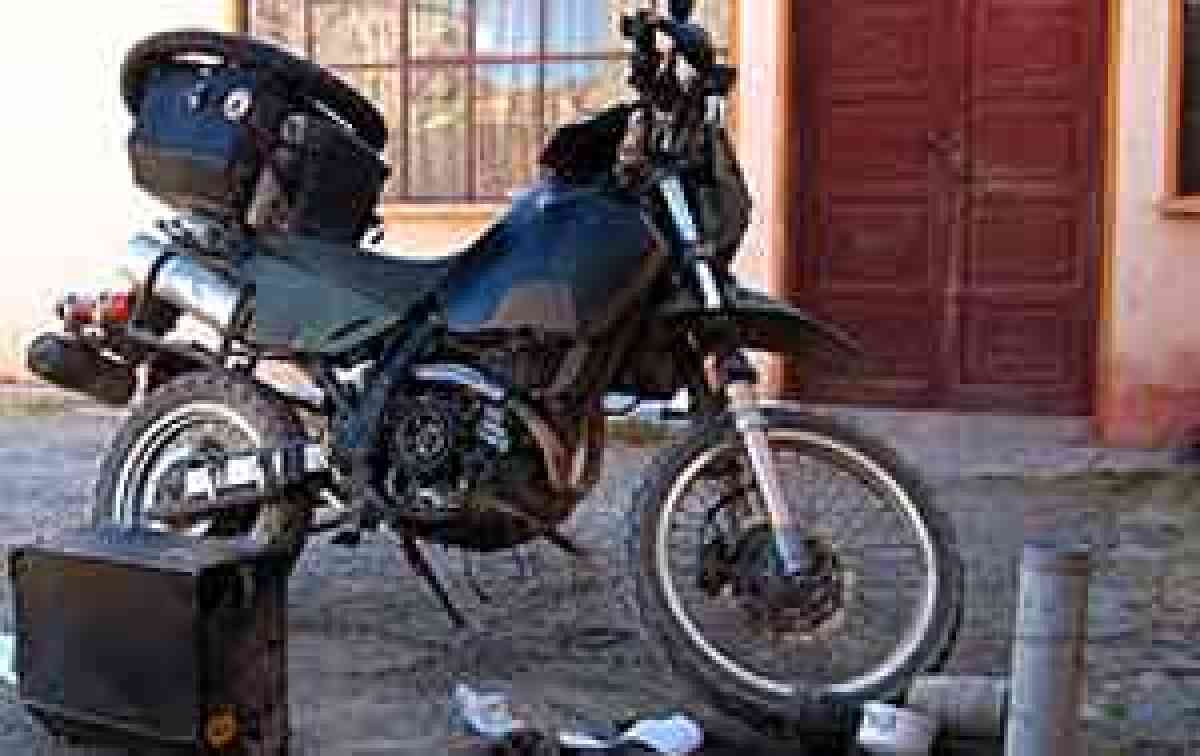
SanDRina gives me the bad news. She can’t go faster than 20 mph. I had just freed myself and my trusty Suzuki DR650 from a sandy embankment. We’re at 12,000 ft. in remote southwestern Bolivia, riding the Altiplano… clutchless. I smile, because this is where the adventure begins….
Four months earlier, I left Chicago with a goal of riding on the Salar de Uyuni. It looked to be the most strange and out-of-the-normal experience for a motorcyclist anywhere on the planet, a salt flat, the largest of its kind in the world and up high in the Andes. I wanted to experience that feeling of standing on my pegs and cruising at a high speed with my eyes closed.
I left the capital city, La Paz, after a few days stay at Alfonso’s house. He’s a Kawasaki KLR650 rider and provides support to bike travelers passing through his country. I made it to Oruro on the first night and enjoyed a meal on the streets with local residents. We huddled together to keep warm. It was winter after all on the Altiplano, a flat high-plain sandwiched by the Andes, where the temperatures fluctuate from a high of 50°F to a low of 0°F. Oruro is the last big town in this remote corner of Bolivia and I was looking forward to the vast expanse that lay south of here.
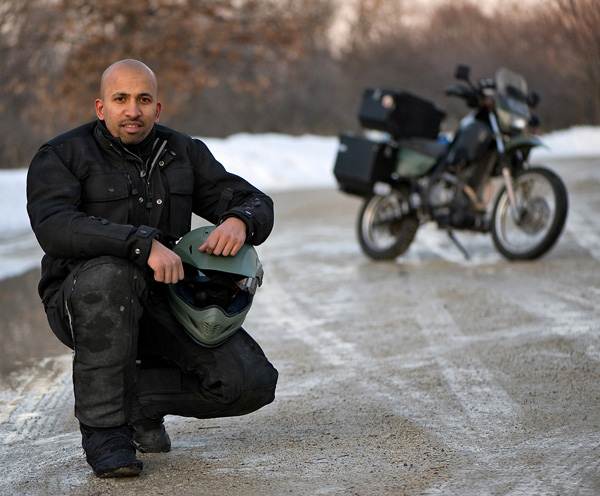
My early start revealed that the tarmac ended at the small town of Huari. I topped up my Safari Aqualine tank to a full brim of 10 gallons of petrol. From there, I headed west to the town of Jirere, with the intention of making a loop through the Salar and exiting at Uyuni. The route to Jirere was being paved to develop it as a commercial link between Bolivia and Chile’s northern coast. It wasn’t finished yet and the diversion for the construction was a dusty, sandy surface.
At this point in the trip, my off-road riding skills were not up to par. I wasn’t at the level where I could enjoy it when the front wheel wobbled, or the rear tire slid. Most of my motorcycle miles had come from street riding, yet I knew that the ultimate experience on an enduro was riding at high speed over an uneven surface and letting the bike dance under you. SanDRina wasn’t dancing and I was getting tired. The sand was slowing me down and my minimal camping gear wasn’t up to snuff for a night out in the Andean winter. As I mulled over these thoughts, I saw a local rider on a small Chinese motorcycle zip by up on the barricaded tarmac section and I thought, “Hey, if he can ride there, I can ride there, too!”
The tarmac section was elevated from the diversion by a few feet, and it had a sandy embankment on either side. I was riding in the deep, sandy ruts of the diversion and soon spotted a path out of the ruts, deciding to go for it and climb this embankment. I got some good revs, I had momentum, planted the front wheel where I aimed it, and got over a small sand berm at the bottom of the embankment. Just as my front wheel made it, my lower tool tube got stuck on the berm. This is where I cursed myself for the “brilliant idea” of placing a large tool tube below my skid plate. It was a great location for carrying heavy tools such as tire irons and my bead breaker, but any seasoned dirt-rider would know not to do anything to the bike that would reduce its ground clearance. We live and we learn…
My bike is heavily-loaded as I carry everything I think I need to be sane on the road for years to come. Now I was stuck on this berm, with my bike at an incline… and I couldn’t get the side stand down. I only had the throttle to free myself. But the rear tire was now slightly lifted off the surface and it wasn’t gripping, so with every turn of the wheel, it was digging itself a deeper hole. It was on a fairly fresh Metzeler Tourance tire, which rides better on pavement than dirt—not an ideal tread for riding sandy inclines. I kept spinning the rear wheel and rocking the bike back and forth in the hope that it would catch enough grip to climb over the berm. And it slowly did. I kept my elation in check and told myself to keep climbing this embankment. More throttle, more rear wheel slip, keep the balance and yes, I finally made it to the tarmac! Now I let my emotions flood forward and, as any biker would do, I gave it more throttle to get some speed. But, alas, she would not go faster than 20 mph. Uh oh….
It was then that I had that sinking feeling that I had just done something terribly wrong to sanDRina. Her engine case cover was extremely hot to touch, and I knew there was an issue with the clutch. So, I took stock of where I was: there was a hill ahead, on the flat Altiplano, with a village on top of it and 10 miles of sand behind me and a further 100 miles to Oruro. It was close to noon and I decided there was enough time to take a look in the engine and see how severe the damage was, and to determine whether I could fix it.
I taught myself not to panic in situations like this and instead just to have all the necessary tools to allow me to make it through. These tools include a full set of wrenches, music to keep my mood light and a network of contacts to call for advice. I set about going into the engine in the middle of the starkest landscape that I’ve ridden through, with my garage playlist on. I soon realized that I’d completely fried one of the eight clutch fiber plates. I was not carrying any spare fibre plates. I knew I had to somehow get compression on the remaining fiber plates for the clutch to engage. So, I tried to fix it by putting washers under the spring-loaded bolts of the clutch basket. However, that did nothing and I still couldn’t go faster than 20 mph.
It was late afternoon and time to think about shelter. Passing locals told me that this road was rife with banditry at night as cartels smuggled in old Toyotas from the porous border with Chile. I removed the panniers and started pushing my sturdy lady up the hill to the village of Quillacas. I could only move a few feet at this altitude before becoming completely out of breath. The sun was setting and I felt the chill settling in, but it was actually rewarding for my sweat. I started to drain the fuel tank in hopes of lightening the load, but the trickle was no match for my remaining nine gallons. As other riders often do, I talked openly to my bike telling her that I would get her up this hill even if it took all night.
As chance would have it, a local Quechua family was returning to the village after a day of herding llamas on the Altiplano, and they offered to help me. Their adult daughter was a strong woman who helped push sanDRina up the hill. The father took my panniers on his bicycle and we made it to the village in half an hour! Then they took me even further up the hill to the mission of Santuario de Quillacas, refusing any kind of payment for their assistance. I’ve seen this happen throughout my travels and it reinforces my faith in the compassion of Homo sapiens, whatever our cultural and geographic differences may be.
I was delighted to find a safe place for sanDRina and they had a bed with warm blankets for me for 20 Bolivianos ($2.90)—feeding me for another ten. During dinner I noticed their phone and asked if I could make a call to the United States. Who would I call in a situation like this? None other than my mechanic mentor, Gus Gans, in the southern suburbs of Chicago. He rebuilt my engine and suspension before I left and taught me through the whole process. Gus told me that I had to cut some metal discs and put them in the clutch stack to increase the compression. That $5 phone call was all I needed.
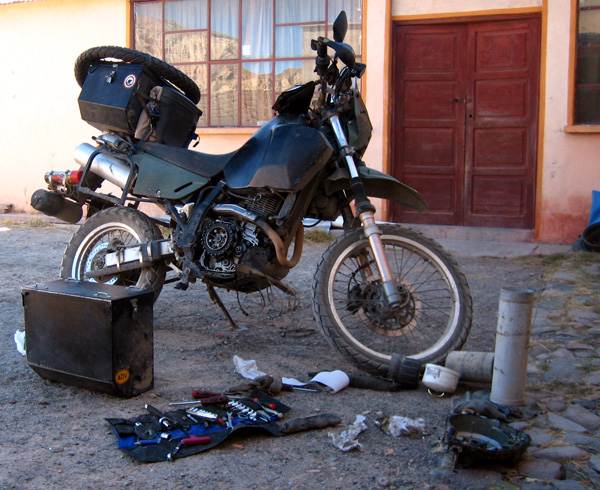
Gus said to use old coffee cans for the metal, but there wasn’t anything appropriate at the mission or in the village. The next morning, I put the ruined disc back in and decided to make the push back to Oruro. With the washers in place, I could now go 25 mph, so grateful for the relatively easy riding on the flatlands of the Altiplano. It took me the whole day to cover the 100 miles to Oruro, arriving just as shops were shutting down. Despite that, it was fantastic to be back in civilization, and come early morning I was at the mechanic’s to help restore sanDRina. Fernando, the shop owner, found some sheet metal and tin snips to sue. I traced the fiber disc and meticulously cut two steel discs and was ecstatic when sanDRina’s clutch gripped and went faster than 25 mph—all the way through the gears to 60!
Once again, I was ready and willing to pay Fernando whatever he asked but he refused payment and said he was happy to help a traveler. I am truly humbled on this journey for all the help that I’ve received.
With spirits rolling in the right direction, I headed out on the highway and rode the last 140 miles back to La Paz and the comfort of Alfonso’s home. There we managed to find a few replacement clutch discs from a Kawasaki KLX650 that had similar dimensions, and I was now set to continue north to cross the TransAmazonica of Brazil.
I didn’t get to ride on the Salar de Uyuni that time around, but was lucky enough to have the opportunity to return to Bolivia in a few months’ time, and I did indeed complete that journey on the Salar. I stood on the pegs, cruised at 70 mph and shut my eyes, sensing the flatness of the white earth under me and the expanse of the blue sky above. sanDRina and me… we lived the dream.