 Sticky logo
 Search


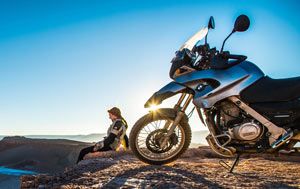
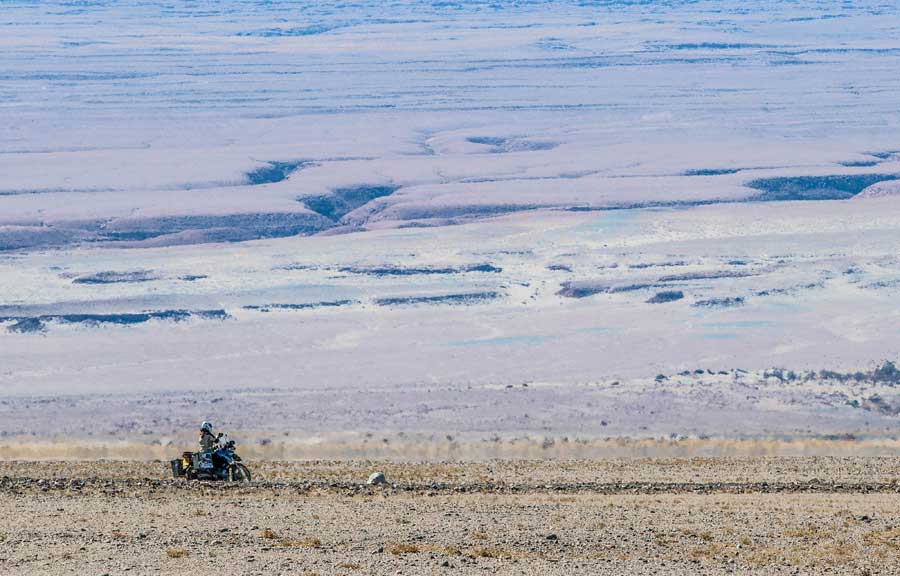
My motorcycle is many things. She’s so much more than my trusty steed—she’s my home, an unbelievable icebreaker, a “Get out of Jail Free Card” and sometimes a swift little lifesaver. She is decidedly my ticket to travel, enlightenment, and empowerment. Without her, I’d have a gaping hole in my soul—a chunk eaten away like the hungry bite from of a sandwich.
The beauty of having my own wheels meant my partner, Jason, and I could better execute our own daily sorties into Chile’s Atacama Desert while using San Pedro as a base. We’d timed our ride around the coaches that carted the day-trippers in and out of the park, which thankfully was big enough to adequately disperse everyone.
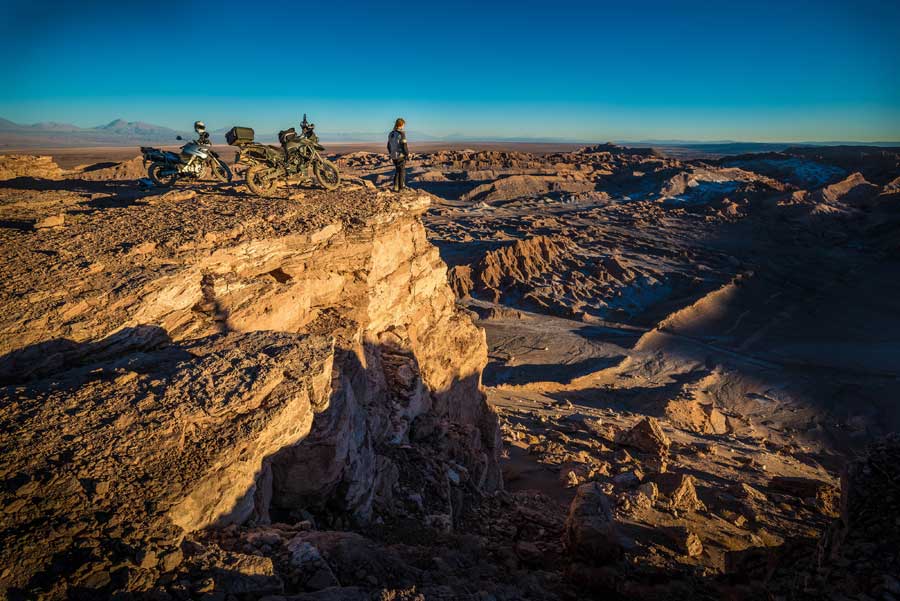
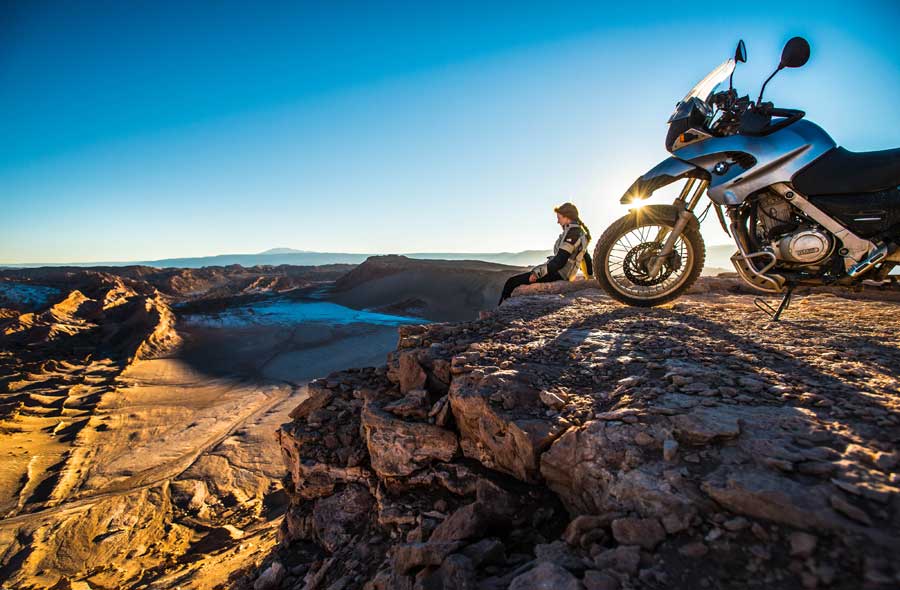
Our first foray into Atacama’s sandpit took us to Valle de la Luna (Valley of the Moon). Owing to its different stratifications and salt formations, its resemblance to the surface of our planet’s biggest satellite is uncanny.
We rode on a cruisy circuit, stopping whenever the urge took us—scaling the odd sand dune, bobbling across the bumpiest salt-stiffened road to date, and siesta’ing in the sun after sandwiches to indulge in a little light reading. It was motorbiking bliss. I overheard one young woman who, after completing a guided walk, faced her tour guide and exclaimed, “Well that was absolutely not boring!”
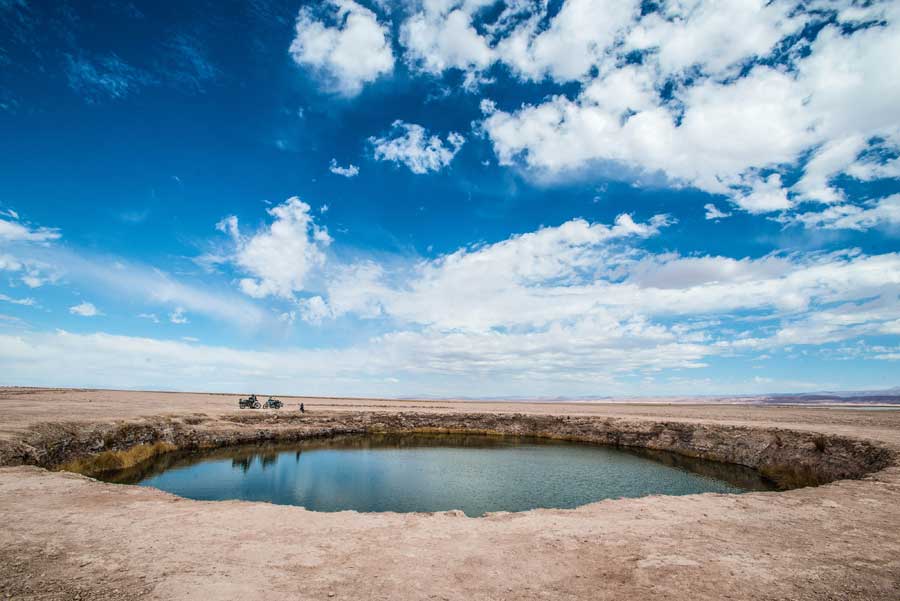
A bit deeper in the Desierto de Atacama took us to Laguna Cejar and Laguna Tebinquiche. The first was located near Ojos del Salar, a pair of sinkholes whose circular outlines were crystallized in salt a bit like a sugar-frosted cocktail glass puzzlingly positioned in the expanse of a vast volcano-lined desert.
It was like looking down into two pools of mint green liqueur. Laguna Tebinquiche is a lagoon whose typically resident flamingoes had taken flight elsewhere, although the puna plover birds were in attendance. I’d packed a swimsuit to see if I had the backbone to float in these salt-dense waters; it turned out only my big toe wanted to make the plunge while the rest of my body was content to stay bone-dry and salt-free.
By luck, an unplanned route led us to Salar de Atacama on a ride farther north. This in turn took us to Laguna Chaxa, which is about 65 kilometers from San Pedro de Atacama—a location we’d previously sought with a fine-tooth comb to no avail.
Laguna Chaxa was home to a flamingo-breeding site. Although three of five known species—James, Chilean, and Andean—come to feed and breed here, I was content simply knowing the wading birds were there at all. They were feathered in signature coral pink plumage with protruding bent bills, filter-feeding in the lagoon.
It was a day for the zoom lens and snappy reflexes alongside a first—seeing a flock of flamingos taking flight in an awe-inspiring arc to a neighboring sister pool. We lingered for as long as possible, absorbing the setting like a soothing salve to an itch.
In weaving around the potholes and patches of sand, we glimpsed dust devils dancing to their own tune while our bikes sped us back to the hostel. That evening’s supermoon was about a third bigger and brighter than usual thanks to our mountainous proximity.
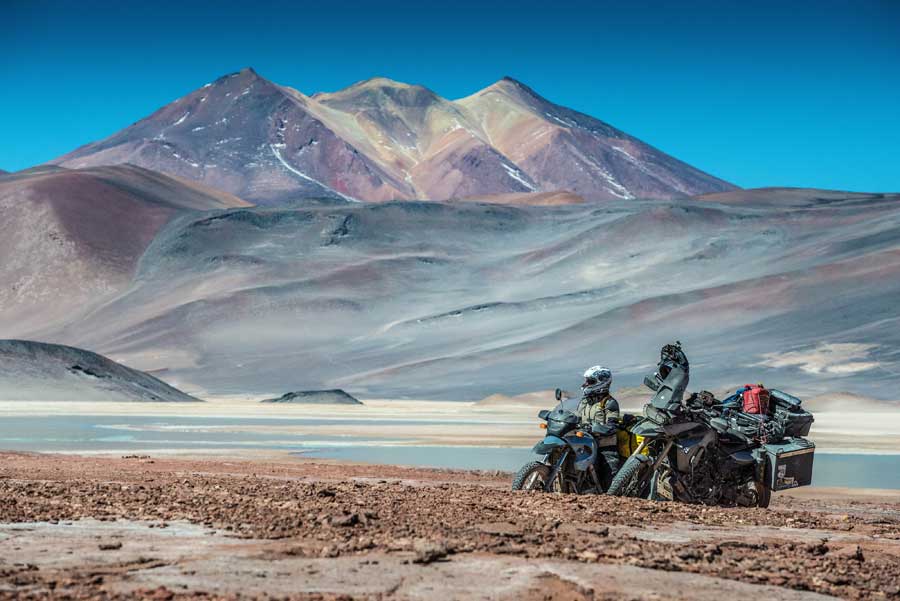
Our next sortie’s destination was the ALMA (Atacama Large Millimeter/Sub-millimeter Array). Located on the Chajnantor Plateau, it’s one of the world’s most important international observatories ever built—and still under construction. ALMA is a vast antenna array, whose surfaces have been smoothed to within the thickness of a human hair! Jason’s inner astro-geek was determined to find this revolutionary telescope no matter what.
But the security guy on the main road in, who was about as much fun as a funeral, insisted we wouldn’t be going anywhere near his highly protected pride and joy. So Jason gleaned an alternative route from Google Maps that essentially required us to scale a volcano to get there—according to a sketchy line on the SATNAV, anyway. As no road as such is marked on the map, we proceeded to scramble up the sandy tracks that “suggested” a route over the summit leading to the ALMA.
My bike conked out ascending the first sandy hurdle. Then the front wheel sank in without solace. From there on it was a battle against my lack of skill to tackle this sandy travail. But once I got going, I was flooded with a buzz, albeit an adrenaline-laced, shaky one.
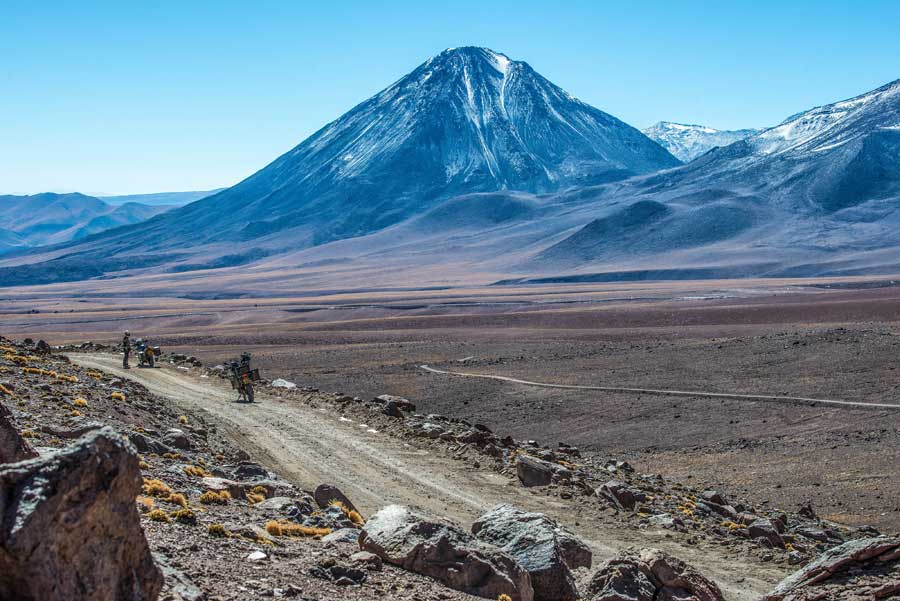
We carefully picked our way around the volcano’s rough and tortuous edges, treaded over patches of snow and eventually reaching a height on par with Everest’s base camp. Over 5,200 meters in sub-zero temperatures… but although I felt vulnerable and dizzy from the torturous altitude, it was so beautiful up there!
Then, just a few hundred meters from reaching the observatory, we encountered a barricade of sand. As I’m not a seasoned sand rider, we were forced to turn around. On the return trail, however, a smattering of smugness seeped in as my wheels somehow managed to avoid going down in the sand, apparently to the chagrin of my partner, who was filming me in anticipation that I would! Alas, we didn’t quite make it to the ALMA, but getting as far as we had was good enough for me.
From this experience a new mantra emerged: Wring as much fun from life, in the most gutsy, earthy, rollicking, lip-licking way possible. Philosopher Alan Watts said it another way, “Let go and be hung up on nothing.” To that, I’d add “and by nobody.”
About The Author:
Lisa Morris’ love for two-wheeled travel is parallel to a soft spot held for scuba diving. Born and bred in Britain, from the age of 16 she travelled extensively worldwide for 15 years in between getting a degree, a career as a civil servant in the education sector, becoming a diving instructor and running Red Sea live-aboard trips.
Lisa is currently riding the Americas on her F650GS (more affectionately known as Pearl) and relishes sharing tales on the trails as a freelance travel writer. Motorcycling from Argentina to Alaska bestows the best of both worlds; topside exploration and fun’derwater. TwoWheeledNomad.com