 Sticky logo
 Search


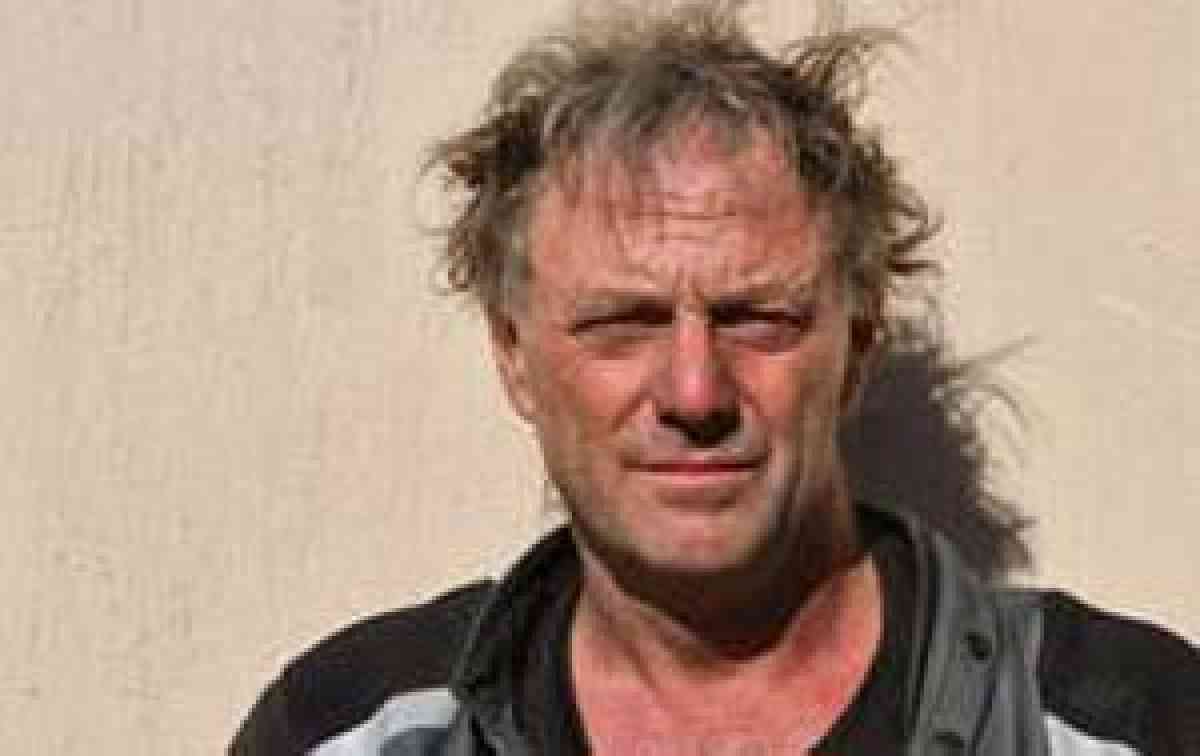
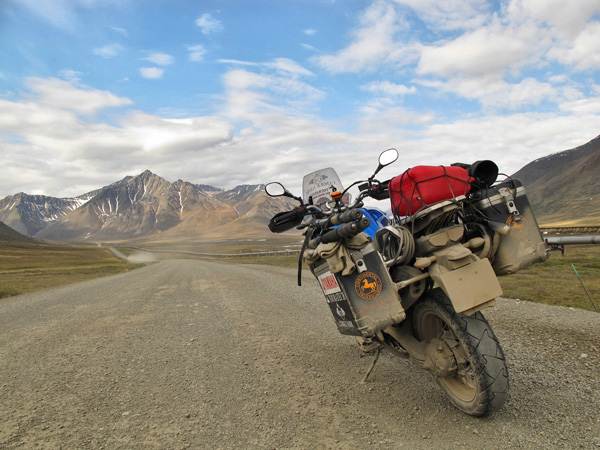 It is approximately 23,400 kilometers from Prudhoe Bay, Alaska’s northern tip, to Ushuaia, the Argentinian city regarded to be the southernmost of the world. Riding back to Alaska doubles this distance, totaling 46,800 kilometers. In 2011, Nick Sanders rode this distance with the goal of setting a record time.
The journey starts in the cold at 6 a.m. in Prudhoe Bay. With the receptionist and chef’s signatures in my witness book, I head for the Dalton Highway to ride south for 24,000 kilometers. The Guinness record for this one-way journey is 35 days; I intend to cover it in 21. On my way out of town, the sea is frozen, the wind is still, and I’m surrounded by silence. I suddenly feel overwhelmed by the freedom of being alone.
My motorcycle, a Yamaha Super Tenere, will handle whatever road I need it to, and that’s a good thing; most of the route to the first settlement of Coldfoot is not surfaced.
Before then, straddling the North Slope Haul Road on the Dalton, the famous Brookes Range is bisected by the Atigun Pass, a steep-sided treeless valley. This is the ice road truckers’ route, spectacular, wild, spacious, raw, and inaccessible to most travelers throughout the year, especially motorcyclists.
The sights around me as I travel through Alaska are beautiful. The twisting Dalton Highway is lined with berry bushes everywhere; blueberries, little red cranberries and salmonberries that look like raspberries. The roadside is hemmed in by tall black spruce and aspen standing next to slender willow and birch, whilst mountain ash pops up in clusters. Bald eagles compete with bears for trout. Black bears come out onto the road, then run away. I watch closely for moose as they shoot out of dense thicket, usually in pairs. High up in a starkly blue sky, clouds hang in a windless day.
Beyond the Dalton and half way down the Alaskan Highway, I fuel at a 24-hour gas station at Fort Nelson, and check into the cheapest motel, eat supper and go to sleep inside 30 minutes; I have not slept for 30 hours. Despite bitter cold, I’ve ridden 2,840 kilometers of gravel in 48 hours and am at the end of Day 2. Four hours later I’m awake and on the road again.
This is a journey that will require mental and physical toughness to complete. In 1996, I attempted this record and failed, recording 30 days from Ushuaia to Fairbanks, and went home, disgusted with my poor show. In 2010 I tried again and retired three days from Ushuaia; mishaps, cold, and exhaustion had sapped my will to complete the ride.
This time I’m ready, with my heated vest and gloves beating off the cold. I’m confident in my motorcycle’s abilities, but my battle with fatigue is just beginning. As I race south I sleep for two-and-a-half hours in Calgary and then the same in Salt Lake City. I have completed five full days, each 24-hour period covering 1,440 kilometers with two hours sleep each night. I wake up shaking, unable to control the transition into wakefulness. And by the end of the day, when I step off the bike to eat and drink, I have to steal a few extra minutes’ sleep by putting my head down on the tank.
I ride across Mexico in three days, just riding and refuelling - sometimes I look around, but it’s too quick to take anything in. I focus on the riding, not sideways glances. All day long, I ride a prescribed route, invisibly marked to the nearest inch. The fast riding isn’t always on a conscious level. I’ve spent so much time in the saddle, that riding becomes like breathing, and the separation of man and machine blurs.
But even though I’m focused on the road, I know Mexico can be dangerous, with 40,000 people killed by drug gangs in the last four years. Even the driver for my client tour was kidnapped by bandits at high speed and held overnight at gunpoint. But instead of worrying, I push on.
A short distance from the Mexican and Guatemalan border, an army vehicle stops me; six soldiers search my bike and go over my paperwork. Without saying anything, they search the open pannier while their leader asks me if I am carrying drugs or guns, asking if I have drugs in my pocket, did I know that there are men around here with guns and masks and that it is dangerous to be here? But they don’t cause any trouble for me, and I ride on to the border.
By Honduras I check the oil and set off again. Some riders spend their time in the saddle worrying about every little noise their machine makes, but I never had any reservations about the Tenere. I just didn’t know of what it was capable of. It is taut, like a piano string. It is a thoroughbred of a bike dressed in quiet clothing.
I ride across Colombia, Ecuador and Peru almost effortlessly. As the countries changes, so do the risks—there is danger of kidnapping in the south of Colombia, or a slide on the oil on the roundabouts. Ecuador is calm but traffic has quadrupled in Peru. Construction has increased and there has been a rise in banditry in the north. I cross Lima at night, ready to drop the clutch in case I get jumped at the traffic lights.
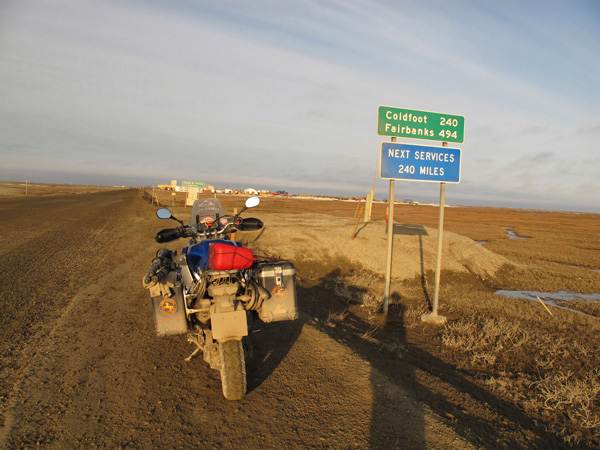 Along with dangers from bandits and kidnappers, fatigue catches up again. In the Atacama Desert, there are momentary lapses of reason and actual periods where I am no longer conscious as I ride, but when I start to veer off the road I somehow awake.
I cross the Andes, then ride across Patagonia, enjoying the last embers of warm days. Sleeping on the tank in truck stops I get a little rest, but not enough. Still, I am an adventurer. This is what I do. With the first part of my journey completed, I am eight hours ahead of Dick Fish’s record until I hit a major snag.
With only 297 kilometers to go, I miss the 10 p.m. close of the Argentine border at San Sebastian. This is a heartbreaking turn of events; Tierra del Fuego is so close, but everything feels lost. The border does not re-open until 9 a.m. the next day. I lose my advantage, and trail in behind Fish’s record-setting pace, not ahead. Still, to achieve my goal, I must plan to take these things into account.
As I cross the snowy Pass de Garibaldi, my luck begins to run out, riding alone through white-out conditions at midnight. My Conti Trail Attack tyres cope well with the conditions but several times I slide off. Eventually, my foot gets trapped under the bike, breaking a bone,and I end up face-down on the ground. The snow continues to fall on top of me and starts to freeze as I shake with the cold. After a few minutes I wiggle out and slowly lift the bike to carry on. At 4 a.m. I arrive in Ushuaia, and at the police post I record a time of 21 days and 19 hours, Skaging with fatigue, I find a hotel and sleep. After riding the Americas seven times on my motorcycling life, and once by bicycle, possibly more than anyone alive, this journey has hurt the most. I hurt so much it’s difficult to describe.
Northward…
After resting, it’s time to prepare for the return journey. A back street motorcycle shop examines my motorcycle but tell me it needs little maintenance. They fit snow tires with studs and I leave for the journey northward.
The Pass de Garibaldi, scene of the previous night’s near-disaster, is still covered in six inches of snow, but the studs on my tires hold firm. What took five hours traveling south is done in half the time. I ride northward night and day, helped on by my warm Touratech Campanero suit.
On my journey south through the Andes it was the end of summer and the mountains were warm, but on the way back, the summit of this mighty range is a frozen waste. There’s ice everywhere, and freezing wind. The cold cuts through my hands. My body is warm but my lips are blue. Everywhere is white, silent, alone.
When I descend the other side the sun shines and it is warm again, so I make up time. I have a clear run along Chile, no interruptions in the Atacama, a desert I know well, and decide to ride non-stop to Peru.
My route through Peru would be extraordinary if the sun was up. The Panamericana Sur clings onto cliff edges past Pedregal, Pescadores, Chiguay and Chala. But I don’t take in the scenery; instead, I hold on through the night, deeply tired. I eat at late night street stalls, and sleep for a while on my bike, wondering to myself about the meaning of life, wondering why the dark makes me reflect. I nearly had a sleep on a bench in the small plaza des armas, but unsavory characters were around, so I carried on. I have a last chance to stay on the 21-day schedule if I make Nazca by 6 a.m., Lima by noon and Chiclayo by midnight today. I can get three hours sleep there, then make for the Ecuadorian border at Tumbes, ready for when it opens at 8 a.m. on Thursday.
Passing through Nazca I spend a few moments in a hotel I know, collecting my emails whilst sipping a small coffee. Then I bolt through this country as if my life depended on it, riding through Lima at midnight, piling on the pressure by filming and writing when I can until the morning.
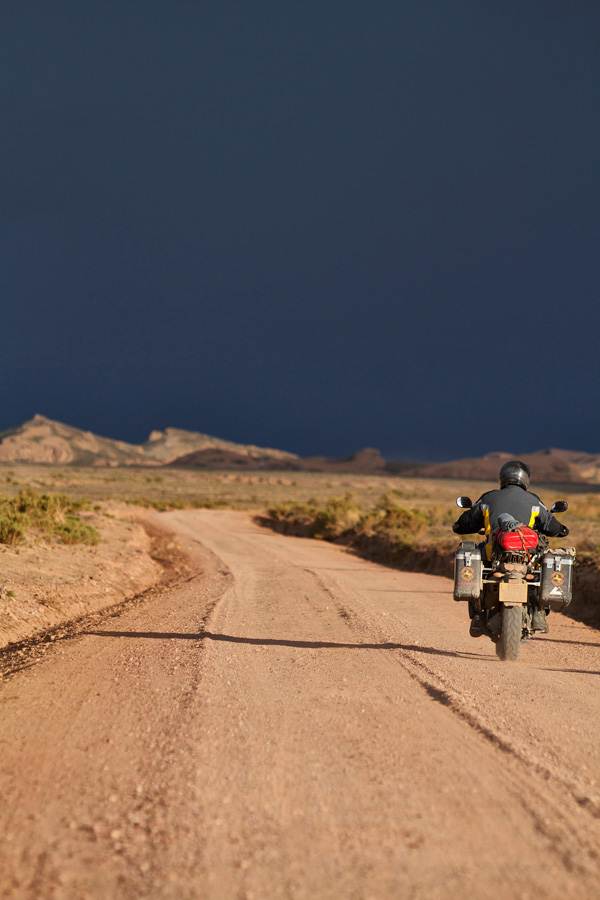 Suddenly, as I ride a long sweeping left-hand bend, a bus comes towards me with a pickup overtaking—on a collision course with me. Looking around quickly, I see the desert is level with the road - the run-off is survivable. He sees me… I have already started to brake and give him a moment to react. In these split seconds, I wonder if he’ll force me off the road, or allow me to pass. He slows… we have a mere two seconds before impact. I see his face as he keeps traction and nudges back behind the bus. The moment passes—and it was close.
Then I notice the sea is on my right, and unless this is an inlet, I have turned back on myself—I have gone the wrong way. Road signs confirm I am returning to Lima. So, I turn around and go back the way I’d ridden that morning. As I make it to the pass where I should have been riding, I spot a group of people surrounding a white emergency services van. A young motorcyclist has been killed at precisely the time I should have been here. And I can’t help but wonder if perhaps there is a way to become invisible, a way to delay the inevitable, when you have to be called in by the Great Accounter. Perhaps absent-mindedness acts as a screen and is a time when your God, or whoever it is who looks after you, looks into your eyes and has no way of knowing what you are thinking.
I see a sign that reads “Trujillo 268 kilometers” and head in that direction. By 3 p.m. the cloud dissipates and the sun shines. The chilblains on my hands and feet have begun to feel better, and my spirits have lifted. I am ambling through a 960-kilometer day without trying too hard, but it took 64,000 training kilometers to get to a riding fitness state where 1,000 kilometers is easy.
As I ride, I plan the rest of my record-breaking effort. At this point, I’ve got to slow the project down to accommodate the winter schedules of Girag Cargo, the company flying my bike over the Darien Gap from Colombia to Panama. This means the return ride will drop to a 23-day schedule, although I might be able to reduce that time in North America.
After I fly from Bogota to Panama, my return journey across Central America takes two days and nights. Then, I nervously cross Mexico, riding non-stop again again, and enter the U.S.A., still riding hard. Three days later I am in Canada for more rain. The storm I hit around Edmonton is stupendously heavy. At this point, I have not slept for two days and nights, except for brief naps on the bike, lasting only minutes at best. About 113 kilometers south of Calgary I sleep for a half hour again on the bike, forgetting to switch off my heated jacket. When I wake, I am groggy and stagger around the quiet road until I recover what few senses I have left. The bike won’t start and I need to bump the engine by running it against the traffic down the southerly-facing freeway entrance, but considering the service this bike has already given me, this is not a chore.
Four days later I am in Prudhoe Bay once again. The journey has been 46,880 kilometers in 46 days on a Super Tenere that never broke down once. It is a flawless performance by the bike, the Campanero suit superb, the Conti Trail Attack tyres never punctured. The journey is over. I can go home.