 Sticky logo
 Search


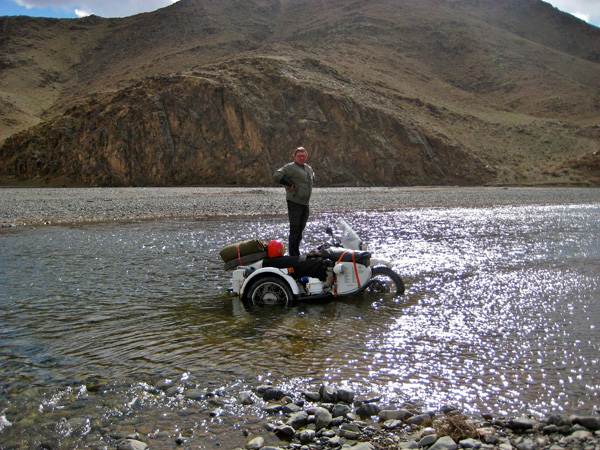 The decision to take to the road came to me in the middle of a cucumber salad at the L’Orange Bleu restaurant in Manhattan, sometime in November, 2004. As I bit down into the deliciously crisp cucumber drenched in herbed vinaigrette, my good friend Jean-Louis posed the most perfect question: “Now that your youngest daughter Jessica is finishing college, what are you going to do?” This question was so obvious and pure that it stopped me in my tracks. A question that had been brewing deep within my soul… but left unanswered. Jean-Louis continued by describing the lifestyle we’d become accustomed to, “… when we live in a city like New York, by the time the end of the year rolls around our pockets are empty. For ordinary people like us it’s our lifestyle to spend all we make.”
During that dinner we established that, if I were to sell everything, there would be enough money to travel in my sidecar for about ten years. By the time the crème brulee was enticingly placed before me, I knew I’d be facing the rest of my life with one of two choices:
1. Keep working for the next ten years and, essentially, be poor afterwards. Or,
2. Sell everything I had, travel for ten years… and essentially be poor after that…. Three months later I set off for the Arctic Circle on the first leg of my “Ten Years on the Road” on a sidecar motorcycle.
It was that first Christmas on the road when my life perspective changed. Not from the challenges that my journey brought me initially, but from a book my wife gave me as a present: Genghis Khan and the Making of the Modern World. The author, Jack Weatherford, knows of what he speaks when painting the image of Genghis Khan and how he transformed the world in 1100 BC. Weatherford traced the progress of the Khan as a visionary leader, and how his conquests joined the then backward Europe with the thriving cultures of Asia. He also described how the Great Khan initiated the subsequent global awakening with an unprecedented explosion of technologies, trade, and innovation. I found it fascinating to learn about Mongol cultural values, accomplishments and the nomadic way of life. Even before the end of the book I knew I must go to Mongolia. Now all I had to do was to make sure that my sidecar would reach that far off destination.
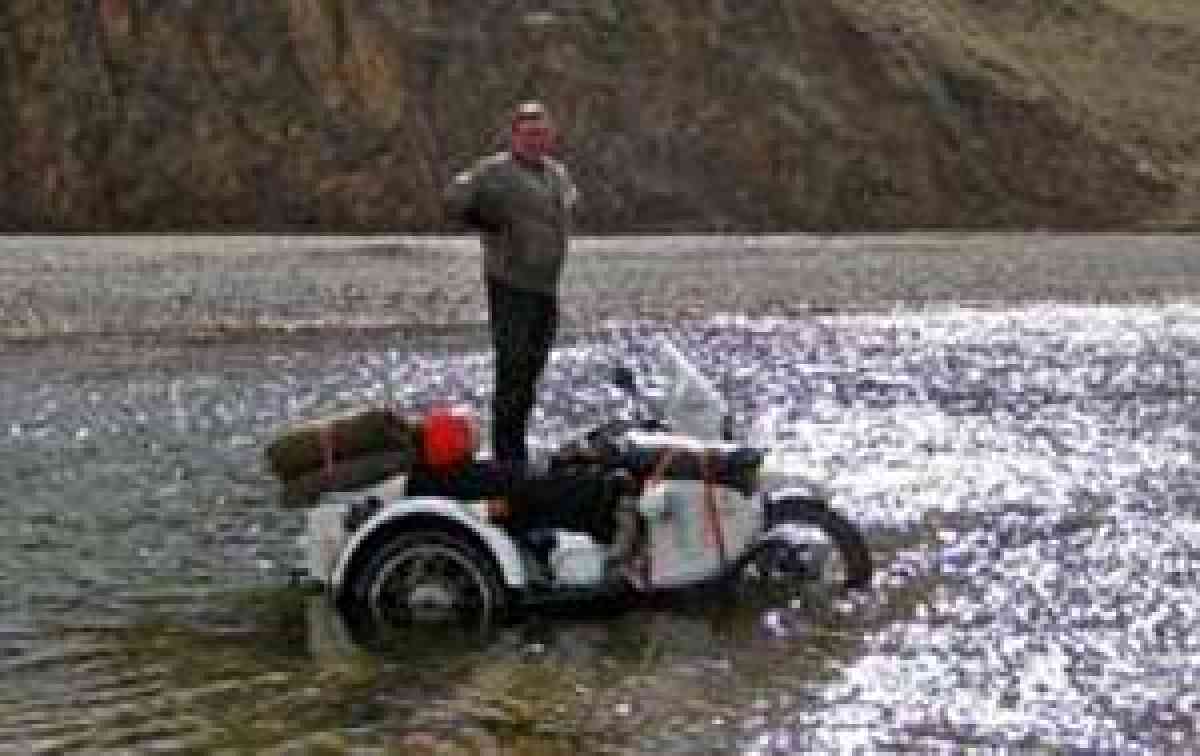
I originally left New York on a BMW R100GSPD/Ural. It was the last carbureted bike BMW made, so it was simple enough to maintain and repair on the road. But during the next three years in South America, there were at least 100 times when I had to U-turn out of an area after realizing the hack just couldn’t make it through sand or mud. That’s why, in 2008, when I was in France to prepare for Mongolia, I switched to a Ural 2WD. It turned out to be a very good decision, because with the Ural I was able to push the limit much further and deeper into the back country. On top of that, after logging 75,000 km on the odometer, I can say the mechanic became as reliable on the Ural as the BMW.
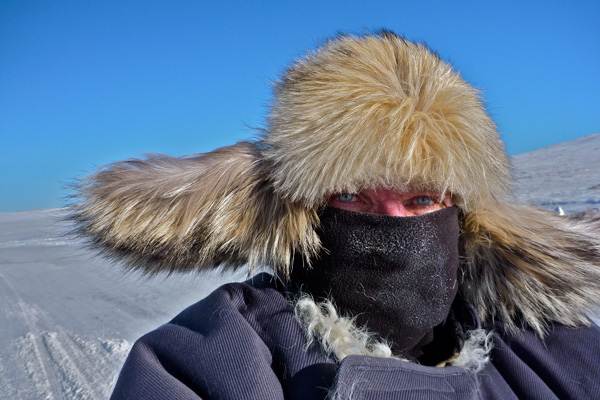
I reached Mongolia late in November 2009, riding the last 1,500 miles of the Trans-Siberian Highway on a winter’s harsh -40 degree F blanket of snow and ice into Ulaanbaatar, the capitol of Mongolia. As I knew that I wanted to spend some reflective time in Mongolia, and to communicate with the people, I found a teacher who could help me learn their language. By the end of a two week intense course I ended up with a phonetic booklet that would allow for basic day-to-day phrases. Quickly, I experienced how useful this booklet would prove to be… but there remained the challenge of understanding anything past my limited vocabulary.
Feeling confident enough to leave the big city of Ulaanbaatar, I set out to ride the duration of the day to the very last ger (a Mongolian yurt or tent home) within reach. But to get there I had to ride a couple of miles off from the main “road” even though there were no visible tracks to follow. The Ural proved successful at navigating the Mongol steppes (Eurasian grassland areas), cutting through the hard and crisp ice and snow. Although I did not have studded tires, I found that the two-wheel-drive and the reverse gear of the Ural could get me out of just about any fix.
Outside the ger I waited for someone to appear. A dog sitting out front gave me hope that it was inhabited. Then, from a distance, in an almost surreal way, a man came trotting up on a “weeping” camel, stopped before me and slid from his perch. I was so overwhelmed by his hospitable gestures that I forgot all of the Mongolian I had learned. The man introduced himself as “Pourou,” and walked me into his ger where he lit a dung fire and served hot tea with dry cookies—a typical Mongol custom. After a short while he gestured that he had to get back to tend his herds about three miles away, but that he would be back a couple of hours after dark. He indicated for me to stay warm by the fire during the time he was gone… however, I couldn’t help but follow him outside with my camera to capture his departure by camel.
Although it was almost exclusively through body language, I was awed by the effortlessness of our communications. As we got to know each other, Pourou offered an invitation to spend the next three months with he and his family. And during that time I got to experience their gypsy-like lifestyle, moving their home to five different locations. Identifying with this nomadic way of life so deeply, I found myself fascinated by their values that had been in place since the time of Genghis Kahn, amidst satellite dishes, cell phones and Chinese motorcycles. I then witnessed the old paternal authoritarian roles and how the strength from this helped the family work together like a well-oiled machine under such harsh conditions.
It was astonishing to witness the supreme authority Pourou had over his entire family, with no one daring to challenge any of his decisions. For example, if a family member caught a fish and brought it home, it was Pourou who decided who would eat it. It was also their custom that the patriarch distribute the meat to each family member during a meal. Likewise, it was he who chose who received the best pieces. And, if the father was not home, the eldest son inherited the authority. Very distinct roles were divided amongst the Mongolian families, with each member contributing to their tightly-woven community.
The family embraced me as one of their own, never asking how long I would stay… or what my next plans were. Even though I seemed to create more work for them when I tried to help with the goats or sheep, I still felt as though they appreciated what I had to offer. With camera in hand, I followed them through their daily chores and documented their nomadic way of life—including when the entire community worked together, loading their belongings onto trucks, during their many moves. One of my proudest contributions was in teaching Pourou’s daughter Monkhtsetseg (age 16), and son Tsolmonbaatar (age 15), how to use my Nikon camera. Through this education, I was able to obtain some beautiful photos of the family as seen through their eyes.
I slept on the ground in the ger along with Pourou and his teenage children, but didn’t meet his wife, Khishigbayr, until after the winter months were over. She lived with their youngest children in a ger in the big city where they went to school. My role was to watch… to bear witness. But I never pretended to be, or tried to act like, a Mongol because I was so incapable of fully integrating into their ancient and wonderful culture. So, I stood off to the side out of respect, and observed the interactions of the family. Monkhtsetseg was responsible for milking the goats at the end of each day, while Tsolmonbaatar’s job was to daily walk three to five miles to find the horses that had been set free to graze. Pourou and I would often use my sidecar to check on his camels, living free on the steppes up to 50 miles away. I had always wanted to live in a family that was so close to one another, and the assimilation was heaven to me.
Why do I identify with this nomadic life of the Mongols so deeply? Maybe it’s because they continuously answer the call to roam from one pasture to the next… without fences to corral them in… with each move building upon their strength and resilience. These qualities are passed along from generation to generation through their tightly knit families. Through the eyes of Pourou’s family, I learned of the roles that keep them dependent upon one another as they lived and worked in unity. This was a culture born of the Genghis Kahn era that not only transformed the world, but miraculously established these strong family values—that continues to survive even in the harshest conditions. Because I draw a parallel of my own deep desire to be on the move without borders, it is of this chalice that I want to drink… and will return to Mongolia to satiate this thirst for adventure.