 Sticky logo
 Search


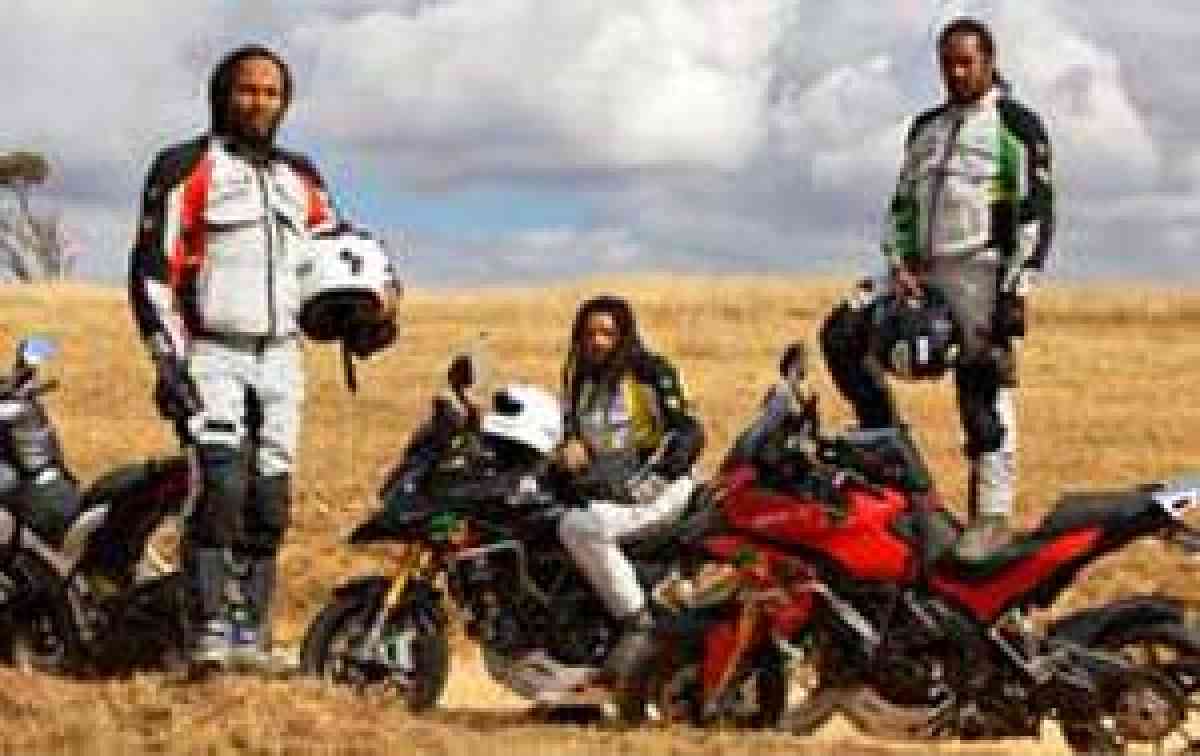
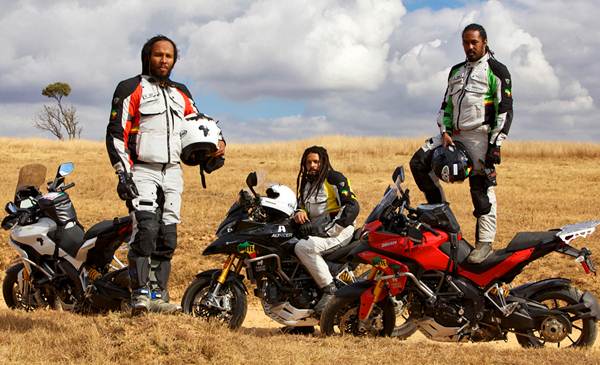 Ziggy Marley, oldest son of the legendary Bob Marley, teamed up with David Alexanian, the producer of perhaps the most prolific video production series about motorcycling yet, “The Long Way Round” and “Long Way Down” with Ewan McGregor and Charley Boorman. Instead of circumnavigating the globe, Ziggy decided to begin exploring the world of adventure riding in a place close to his heart, South Africa. In addition to sustaining some minor injuries, setting up two impromptu charity concerts, and running from a charging giraffe, they visited SA during the 2010 World Cup, like his father did exactly 30 years before.
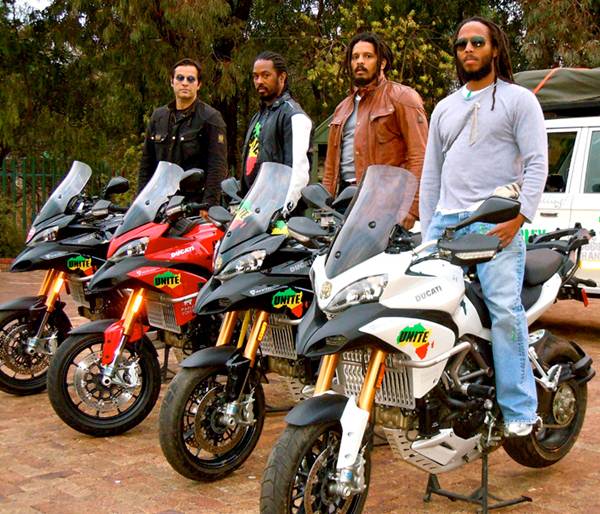
With his two brothers, Robbie and Rohan Marley, the Three Marleyteers saddled up their Ducati Multistradas and rode South Africa to spread the word of African unity into the countryside and commemorate his father’s historic concert there. Robbie “The Ninja” Marley is a stunt bike rider from Miami while Rohan, a former linebacker for the University of Miami, is now back in Jamaica running a coffee farm cranking out one million pounds of world-class beans a year. Given Ziggy and his brothers’ diverse range of talents, passions and philanthropic interests, ADVMoto greatly enjoyed the opportunity to speak with Ziggy and discover that, true to his heritage, he speaks openly and from the heart.
ADVMoto (AM): When did you start riding?
Ziggy (Z): In my early teen years. It began on a bicycle because where I lived was a pretty rural farm in a mountainous setting. I was always an adventurous type of person. Then when I went to visit my grandmother in Miami, my uncles had motorbikes and that’s when we learned.
When I came to visit for Christmas from Jamaica, we’d start messing around with their machines. And in back Jamaica we rode street bikes for a little bit. But I was always interested in utility vehicles. While others were into sports cars and street bikes, for me it was pick-up trucks, four-wheel drives and dirt bikes… vehicles that could take on the terrain and do adventurous things.
AM: What bike do you have now and did you ever get into repairing your bikes?
Z: I actually didn’t get back into riding until recently because up until then it was something I only did occasionally. By the time I was in school, I was doing music, which took up most of my time. I didn’t really get into doing my own stuff on my bike until a few years ago when I got a BMW 800GS.
When I came to LA, I wanted to get back into bikes. Because I hadn’t ridden in a while, I used a Honda 250 to get my riding legs back. So I started with that, then began researching other stuff which lead to my fever for adventure riding.
When I saw the “Long Way Round” and “Long Way Down” with Ewan McGregor by David Alexanian, where they went from England to South Africa on adventure bikes, it really excited me. I’m a survivalist type of person. I want to be able to survive if there’s anything that goes wrong, and I wanted a bike where I could carry gear, water and other necessary items.
When I got a BMW F800GS, I liked it. At first it seemed like a really big bike to me—and I dropped it a few times practicing. I’d take it down to the park and after a while I got used to it. Then came the upgrades: mufflers, pegs, seat and a whole modification to the bike—that’s when I got back into the wrenching.
My bikes are given names, you know, as if they had personalities. It’s a psychological thing where I try to treat my bikes like my horses.
AM: What’s the name of your bike?
Z: The 800GS is called “Samson.” What I did with Samson was play around with it for a few months before hooking up with Jim Hyde of Raw Hyde, an adventure school a little outside of LA. That’s where I really learned to let the bike do what it does naturally. It’s like an animal, a horse; allow it to do what it does without me affecting it too much. During adventure riding you have to let the bike slip around without trying to sit and be stiff on it. It won’t fall if you handle it that way and just keep looking where you need to go. Jim Hyde taught me some pretty cool stuff about adventure riding.
AM: Sounds like you got off to a good start. How’d you end up with Ducati Multistradas on the Marley Africa Road Trip?
Z: When I got together with David Alexanian, we planned to get some bikes and Ducati was interested. I had never ridden a Ducati before but they were putting out these new bikes, the Multistrada. I said, let’s check it out.
On the last day of one of our riding classes, Ducati sent down three Multistradas, brand new, and WOW! they looked beautiful. We took them for a spin and we liked them. I wasn’t sure how well they’d would do off road because we didn’t really get a chance to try them while we were here in LA, but my brother Robbie, a motorcycle stunt rider, came up from Miami to break them in and get familiar. Although we liked them, the real test would be on the South African dirt roads where we’d see what they could do.
AM: How did the bike do with the 17? front wheel?
Z: I was surprised actually. When we took them on some trails in Africa, I was the first one to fall riding down this rocky grade, but it did well. Some of the parts, like the pegs, could be designed better for off-road but the bike itself held up very well. We took it in some deep sand, mud and dirt trails and it did good.
AM: How did motorcycling impact the experience of your trip?
Z: You’re much more aware of your surroundings and what’s going on around you. You’re much more in tune with the environment and more likely to go off the beaten path because it gives you that freedom and the will to do it. I used to ride horses when we were younger and I lived on a farm. This is my iron horse and it gives me the freedom to explore more of the world.
It also gives you much more of a community feeling and the reaction from people is great because they are much more likely to come towards you. It’s open, it’s an open space and you’re not in a box so you’re much more likely to communicate with people, too. That’s true anywhere in the world with motorbikes. Small or large or whatever, you’re a rider with a connection to the world.
AM: Like many adventure riders, I found that folks without money weren’t, by any means, the least happy. Did you have a similar experience in the villages of Africa?
Z: Oh yes. When we were growing up in Jamaica, we didn’t have a lot of things, but we didn’t know any better and were happy. It was poverty by the American standard—but for us it was okay. We weren’t starving, we had somewhere to sleep, and chores to do, but we could survive very easily and were very happy.
AM: What do you like most about adventure riding?
Z: There’s something about it that strengthens my mind. It has developed my brain and thinking. Being in that state, I think really develops a part of me that hasn’t been touched before.
 That skill, that part of the brain motorcycling has developed, has me writing more songs in my life in general and affects how I look at everyday things. Even when I’m driving a car, now my “motorcycle brain” doesn’t turn off. It’s like you’re looking ahead… what’s going on there? Looking into the future in a way, seeing what moves other people are making. I like that idea, to be able to look ahead. Look beyond what’s right in front of you to see how lies this ship, who’s coming next and being prepared… more aware.
It really impacted my whole life. I love that it stimulates your senses, mind heart and spirit. It’s all of that. It’s everything—all of that stuff intertwined.
AM: Did you have any difficulties or challenges to overcome on the trip?
Z: We never really faced anything that we couldn’t overcome. I had an injury when I fell off the bike and my wrist got sprained so had to get an X-ray but other than that, the challenges were there, but nothing we couldn’t handle by being persistent and focusing on what we wanted to do.
AM: How was the hospital experience?
Z: It was good and very professional. The X-ray went well and everything was very smooth. I did ask them to take me to the best clinic, though!
AM: I saw the video of you and your brothers being chased by the charging giraffe. Was that your most frightening moment?
Z: I would say the most frightening part of the trip was actually being on the road. We had to drive from Johannesburg to another city and take the freeways to get there. I’d rather ride off road than on road, that’s me.
It was such a long ride on that road. It was endless for as far as the eyes could see. And that was scary for me, being on this road for hours without any end in sight. I don’t like it. It was so much more fatiguing, riding as fast we were going. It’s was so monotonous that it gets scary after a while. When you’re off road you see stuff, do stuff and you’re active in this environment. The giraffes and animals and other things weren’t as scary as being on that road.
AM: Did you meet any interesting or memorable people along the way?
Z: Back in the ’80s when I was doing the Conscious Party album in NY there was an acting group from South Africa who were there to do the play, Sarafina, about apartheid. We were kids in those days, well not really kids, but we were young. They had experienced apartheid and I was singing about apartheid and meeting them back then gave more inspiration to write songs.
I went to see the play, met the cast, and they stayed in my hotel. We cooked food and became really good friends.
Around 1986 I left New York. So when I went back to South Africa last year, although we hadn’t seen each other for 20 years, I searched them out. One of them in particular, Dumsani, came along with us on the trip. He’s from South Africa so we talked about apartheid and how things had changed over the years. We were having a meal together, when we saw the rest of the cast by coincidence—it was an emotional meeting. They have the full experience of what it was like before and after apartheid.
Having Dumsani as our guide during this trip was cool. We didn’t lose our step, you know the African people are so friendly, our meeting still feels like yesterday. There was nothing missing… right away we were laughing and joking and back to the way we were 20 years before.
AM: What do you think that says about people, friendships and time?
Z: For the friendship that we have, time really didn’t mean anything. All that time not seeing or talking to each other had no meaning to us. It’s something so true, it never falls off. The friendships kept going even though we didn’t talk for 20 years. When we saw each other again, it was right there, immediately. There’s no hitches, no glitches… it just starts right back in.
AM: Would you do it again?
Z: Yeah I’d do it again. I like Africa. One of the main reasons why we went was to try and communicate the idea of African unity to the people. I think being on the motorcycle gives you a chance to express that directly to everyday people you see on the streets.
I would love to do this again in a different part of Africa, maybe Ghana, because it’s all around the premise of spreading an idea—spreading the message of African unity on a motorcycle. That gives us the openness to interact with everyday people, people on the streets and in the countryside, so being on a motorcycle I think is one of the best tools to get this message out.
AM: I’m sure we’ll find out more about your trip on the television or DVD, but in the meantime do you have any parting words to riders out there?
Z: Do it. It is an experience that can change your life. These are the experiences that bring humanity closer together. Having an adventure like this and being on a motorcycle… doing it is good for humanity. It’s good for our knowing about each other, learning about each other and becoming closer together with each other has a human family. I would tell people, do it. Be serious. Be prepared. Be aware, but don’t be afraid to do it. Have fun and enjoy.
For more info and videos, visit: marleyafricaroadtrip.com.
If you’re looking to groove at a show near you, check out: ziggymarley.com.
The Marley Africa Road Trip will air November 2011 in Europe, Africa and the Middle East. North American dates have not been announced but we’ll keep you posted.