 Sticky logo
 Search



Modular helmets have mushroomed in growth over the past 10 years with a huge host of great features most adventure travelers shouldn’t ignore. Although some complain about the extra safety issues, weight and complexity of hinges, being able to expose your face without removing the whole helmet yields worthy benefits. Being able to see a person’s face goes a long way in establishing good connections with folks you meet on the road. Pretty much everything you do during the day, from eating to putting on glasses and using some electronics, is made easier by simply getting that chin bar out of your face. But why stop there? Modular helmets have quickly evolved into some of the most complex and comprehensive head protection systems on the market, offering everything from retractable sun visors to integrated Bluetooth communicators.
Bell and whistles are great, but a helmet also has to be safe and comfortable to wear. Fitting all of these qualities into an affordable package isn’t easy, but now with so many models available, you can find a safe, comfortable and practical modular lid in nearly any price range. ADVMoto rounded up six of some of the best currently available options for a close look.
Helmets Under $300:
HJC CL-MAX II
Weight: 3lb 12oz
MSRP: $139.99
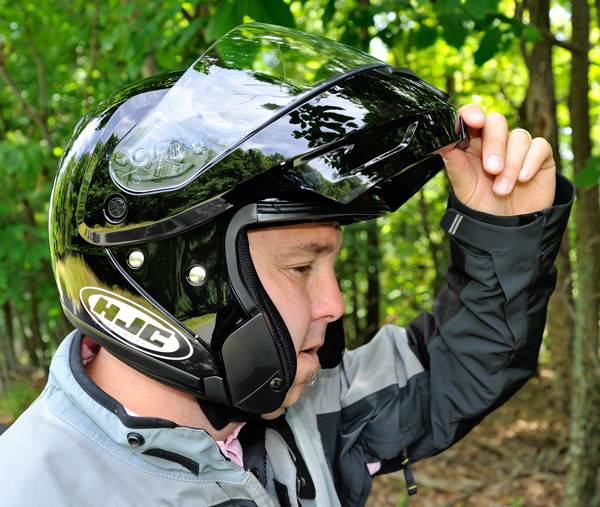 A killer bargain for anyone looking to try out modular systems or get a spare helmet, the HJC CL-MAX II provides you with most the modular basics you could ask for in a very budget friendly manner. At this price-point, overall fit and finish for the CL-MAX II is very nice. The shell shape on the HJCs, and many of the Asian manufacturers, tend to be a rounder which fits “most” heads. Its wicking removable interior liner is comfortable and doesn’t feel clammy in the heat while the chin-bar release mechanism works smoothly and clicks positively into place.
As good as the CL-MAX II is, we noticed the polycarbonate shell tended to flex quite a bit at the cheeks, sometimes pushing out and not lining up with the chin-bar latches. If you have a rather narrow, or long, head, this may not be an issue but chubby cheeked riders should take note. Once the visor is down and you’re underway, the helmet’s chin ventilation works well and we especially appreciated it’s easy to use pop-open type chin vent. The CL-MAX II’s chin vent actuates with a solid feel and clicks firmly into place without any slop or flexing. The same, unfortunately, could not be said of the Sy-Max III, its more expensive brother. We’re seeing more of this vent type in the newer models, replacing the standard sliding mechanisms which are more complex to maintain, manufacture and assemble.
The top vents on the CL-MAX II however are another matter. Although the external vents are designed and manufactured well enough, we found the interior molding to be air restrictive, offering only a couple tiny ports/channels through the inner shell. Effective ventilation is one of the key differences you get when buying a more premium helmet as more resources are spent on more complex design and component integration. Thoughtful engineering and product planning makes sure where plastics, Styrofoam and fabric meet, air is moving through every air channel in the helmet. Often times you’ll see a fabric liner which entirely blocks small air passages through the Styrofoam. The good news is with a little minor liner fiddling, you can free up some of the CLMAX II’s air flow and once you get up to speed it stays sufficiently cool.
Aside from the low entry-level price, a unique feature of the CL-MAX II is its incredible range of available sizes. From XS to 5XL, it’s the only model in our line-up to fit nine sizes of noggins! Not only is the CL-MAX II the kings of sizes, but styles too. For only a little more dosh, you can get the sportier “Zader” graphics in five different colors. While more expensive helmets exists, for the less than 150 bucks, anyone can have a full featured lift-face helmet with built in Chatterbox Bluetooth compatibility and a several years of good service.
PROS |
CONS |
| ▲ Awesome price point | ▼ Shell a bit flimsy around cheeks with chin-bar up |
| ▲ Clean design, good finish with optional graphics | ▼ Noisiest helmet of all tested |
| ▲ A whopping nine available sizes | ▼ Ventilation through upper shell needs more thought |
HJC Sy-Max III
Weight: 3lb 8oz
MSRP: $299.99
 Taking it up a notch (actually two) in the HJC lineup, we find the current flagship of HJC’s modular helmets, the Sy-Max III. One critical difference you’ll notice is the fiberglass shell, as opposed to the CL-MAX III’s polycarbonate construction. The fiberglass outer shell is stronger and much quieter as well. Differences between the two are considerable for the effective 100 dollar street price difference. The biggest improvements between these two helmets are the air ventilation, quieter interior, drop down visor, wider viewing angle.
Keeping cool felt much easier on the Sy-Max, and after removing the washable liner, it was easy to tell why. The Sy-Max moves air through numerous deeper channels along the inside shell around the top and back of your head. More than that, we now see 10mm chimney vents through the inner shell which, thankfully, are not obstructed by the inside fabric liner. When coupled to more rear venturi ports, the result is airflow you can feel on your head, even at moderate speeds. The top vent design opened and closed without slop but the angled shape didn’t give much for the glove to grab or find. The chin vent moved sufficient air but tended to flex and creek a little during actuation.
A key feature not found on the CL-MAX II is the drop down inner visor which has not become nearly standard on modular helmets. Compared with the Sy-Max II, HJC really put some effort into rounding out some of the previous model’s deficiencies, notably increasing peripheral vision and making the spring loaded drop-down visor retraction a less violent affair. The Sy-Max II’s drop-down visor would snap quite quickly back into the helmet once the release button was depressed, causing a fair amount of noise and a slight torque on the helmet. The Sy-Max III adds a dampener to the system to make sure the drop-down doesn’t snap back nearly as fast. At the same time, a redesigned Pin-lock compatible main visor offers wider vision rounding out an already sound package. Our HJC test unit unfortunately did not come with a Pinlock insert for testing so fogged a bit on cool days when stopped.
Pinlock equipped visors do a good job of keeping your vision clear but there are drawbacks in optical clarity and maintenance. Adding an extra layer of plastic in front of your eyes can sometimes create a double reflection inside the helmet. Most people wouldn’t get bothered by it, but is especially noticeable when direct sunlight enters the mask. This also increases an optical phenomenon known as lens flare which occurs when light bounces back and forth between two parallel semi-transparent surfaces, “whiting out” your vision. Lastly, the interior surface of Pinlock visors must be very carefully cleaned because they scratch more easily than the standard external visor plastic.
Last, but definitely not least, the combination of all the Sy-Max’s improvements culminates in a great reduction of wind noise. The stronger fiberglass shell, higher quality foam liner and better seals all add up to a unit which rivals the quietness of the other, more expensive, models for considerably less money. If you can scrounge or save up the extra 100 dollars, the Sy-Max III would be a more comfortable helmet, you’d likely want to keep and use longer. It sports all the major features you’d find in models two or three times as much, while giving you the chance to judge if modulars are for you.
For even a few more dollars, HJC will be introducing the new RP-Max at around the $400.00 price range this Fall. The RP-Max will become the new flagship of HJC’s modular line-up and include, amongst other differences, a tri-composite carbon-fiber, aramid and fiberglass shell which really cuts down on the weight. As the world’s largest helmet manufacturer, HJC looks like it’s ready to shake up some competition in this growing and passionately loyal market.
PROS |
CONS |
| ▲ Best bang for the buck ratio | ▼ Needs a stronger chin vent |
| ▲ Full host of features found on more expensive helmets | ▼ Drop-down visor slide on top of helmet can be fidgety to find |
| ▲ Bluetooth ready | |
| ▲ Improved ventilation |
Between $300–$500:
Vemar Jiano EVO TC
Weight: 3lb 15oz
MSRP: $375.00
 The first thing you’ll notice when pulling the Vemar Jiano EVO TC from the box, is the slick and sporty European styled shell. The main shell is made using a tri-composite blend much like the HJC RP-Max is boasting to have. The chin bar is constructed of injection molded plastic which doesn’t feel cramped around the mask of the face. As with most European helmets we’ve tested, the EVO TC has a medium-oval shell shape and is more suited to slightly longer or narrower heads. ADVMoto’s testing crew put the helmet through its paces and discovered some of the model’s highs and lows.
The aero dynamic shell would lead you to believe that it would cut through the wind with very little noise but we oddly found this wasn’t true. At highway speeds the helmet seemed quieter with chin bar open and felt the added interior noise was a direct result of the plastic vents at the center and on both sides of the helmet’s mask. Perhaps a redesign of the vents would reduce the interior wind noise but this may not be an issue for ear-plug wearers. This phenomenon several times to make sure we weren’t hearing things (no pun intended), but came up with the same conclusion every time.
In the all-important cooling department, the interior air flow fell short of the other helmets in the same price range or higher. The high impact EPS liner lacks sufficient chimney holes in the upper regions of the shell to keep fresh outside air moving around the inside. On the upside, we liked the coverage offered by the internal drop-down visor. Although a little flimsy in its action, it provided the best coverage without interfering with your vision. The external face shield also performed well with six tight and precise detent positions keeping the primary visor just where you want it.
On paper, the EVO TC seems light but felt heavy at the rear of the helmet possibly due to the added weight coming from the sporty looking V-shaped rear exhaust vents on both sides of the shell. Although we’re being pretty picky, taking all the pros and cons into consideration, the Vemar Jiano EVO TC is not a bad helmet. With a little more R&D, the Jiano could be a major player but in this price range and down economy, everyone is looking for the most value for their dollars. If you find yourself wanting to check out this lid, consider finding a local dealer to help you make sure your noggin fits properly (likely the most important helmet factor) and check out the unit out for yourself.
PROS |
CONS |
| ▲ 5 year warranty (from manufacturer date) | ▼ Feels heavy |
| ▲ Sleek exterior shell design | ▼ Lack interior ventilation |
| ▲ 6 position face shield | ▼ Noisy interior with mask closed |
Nolan N-104
Weight: 3lb 10oz
MSRP: $449.95
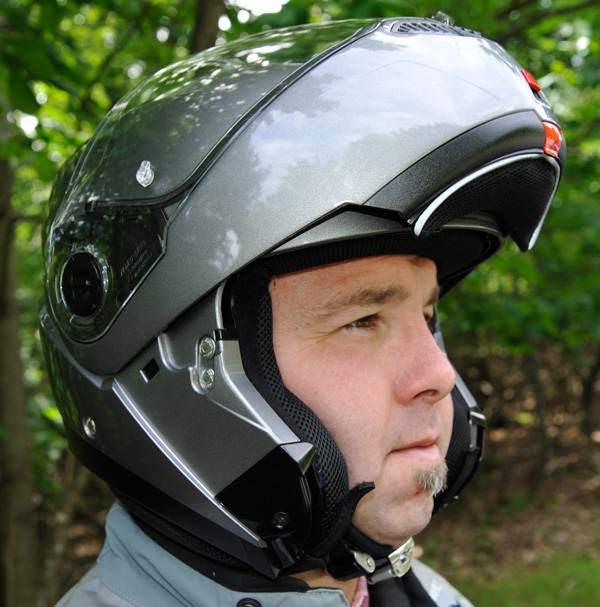 Nolan is no rookie when it comes to the modular helmet category. Produced in Italy since the mid 70’s, Nolan quickly became the European helmet of choice. With over 30 years of innovation, the N-104 is sure to gain some fans in the years to come. Sizing on the new Nolan fits somewhere in the middle of neutral and narrow. Once you sling the helmet over your head you’ll notice its plush removable Clima-Comfort interior liner which is comfortable, completely removable and washable.
Ear pockets are generously sized and accommodate speakers for the made-to-fit N-Com B4 Bluetooth kit available separately. We felt interior noise level is a bit loud for a helmet at this price point, but there are many factors which contribute to interior noise levels and, without using very elaborate measurement equipment, it’s fundamentally a subjective impression.
Vision through the large face shield is top notch, although it took a while to get accustomed to the chin-bar latch release mechanism which requires a thumb to pull out the bottom and top levers. Once out, you pinch them together, releasing the mask, and lift. Keeping the glare down is a smooth working internal drop-down sunshield. The Nolan has probably the easiest to use drop-down visor system of the bunch, with a slider conveniently located at the left hand base of the helmet. We generally like this location because it makes finding the sliding lever much easier since your hand just follow the edge of the shell. Both the Nolan and Schuberth wisely place their drop-down visor switches here but the Nolan takes it one step further by also providing a touch release, spring loaded return which quickly gets the drop-down shield out of your way in a jiffy.
Venting in the N-104 is adequate for a helmet in this price point, and is controlled by a large easy to use two stage top-mounted slider. Slide the vent one click and you instantly feel the rush of air coming in through the trap door like top vent. Slide it a second time and the brow vents open letting even more air around your forehead. As good as the top ventilation was, the chin vent does not seem to make much difference in the volume of air coming into the helmet compared to other models we tested. As such, we recommend installing the included Pinlock anti-fog shield, as the face shield has a tendency to fog quickly without it.
All in all, the new Nolan N-104 is a well-made helmet for narrow or long heads. With decent ventilation, quality construction, solid material choice and just about every technophile feature you could ask for, the Nolan N-104 should be one of the top options on your list if you have the right head shape.
PROS |
CONS |
| ▲ Fantastic upper ventilation | ▼ Chin bar venting is weak |
| ▲ Large eye port for outstanding visibility | ▼ Slightly noisy vents |
| ▲ Italian quality construction and finish |
Over $500:
Shoei Neotec
Weight: 3lb 5oz
MSRP: $649.99
 Having used the Multitec for a few years, we felt there wasn’t much to improve but Shoei showed us wrong and upped the ante across the board. Shoei’s new design and construction method creates the best over the head airflow of any helmet we’ve tried recently. The external sliding vent scoops air into the helmet’s large internal channels which have the most innovative routing seen to date.
Most helmet air channels come from outside ducts into molded grooves in the EPS shell through which air is supposed to move freely. Unfortunately, often times the helmet’s lining itself will either entirely block external passages or get so far pressed into the air channels that not much air is moving, if at all, until you reach high speeds. The Neotec’s two piece EPS shell now has multiple deep air channels sending unobstructed air to the very bottom of the helmet with the help of an impressive amount of 12 large chimney vents in the EPS shell. The pop-open style chin vents a hefty amount of air into the inner visor, so much so that the additional air is audible and, when closed, makes a noticeable increase of air drawn from below the ears. The top vent doesn’t have a switch on it because sliding the entire scoop assembly opens and closes the vent while making it very easy to use, even the heaviest gloves on. The Neotec’s visor is also now Pinlock equipped and, when combined with the super breezy chin vent, does a fantastic job of completely eliminating fogging in all but the most extreme conditions.
To reduce noise and improve the visor seal, the hinge mechanism actually pulls or tightens the visor back against the seal in its closed stage. When you lift the visor, it will first push away from the seal and up. Air leaking in from a loosely sealed visor is a surefire way of making a leaky, noisy helmet and Shoei spared no expense in this department resulting in probably the quietest helmet of the roundup aside from one minor, but noticeable quirk. The small metal coil-spring which keeps the latch under tension makes a very tinny twang sound which resonates through the helmet whenever you close the mask. Actually, you can hear it if you knock on the body or use your “outside” voice while wearing it. Most people may not notice or care, but finding a way to deaden that sound would make a positive, if subtle, impact on the user’s experience.
The NeoTec is a strong evolutionary upgrade from the still very competent Multitec. Shoei claims the Neotec moves over 270% more air than the Multitec and we’re inclined to believe it based on experience. Including the drop-down and Pinlock visors alone adds a lot of functionality to the platform, but when combined with a lighter body, better ventilation and better ease of use, the differences are clear and worthwhile for the rider looking to spend a lot of time on the road.
PROS |
CONS |
| ▲ Quietest helmet of the bunch | ▼ Twangy spring sound from latch mechanism |
| ▲ Tremendous air flow |
▼ Diagonal drop down visor slide under left hinge takes some time getting used to |
| ▲ Easy to operate vents | |
| ▲ Nearly impossible to fog | |
| ▲ Best drop down visor clarity |
Schuberth C3
Weight: 3lb 8oz
MSRP: $699.99
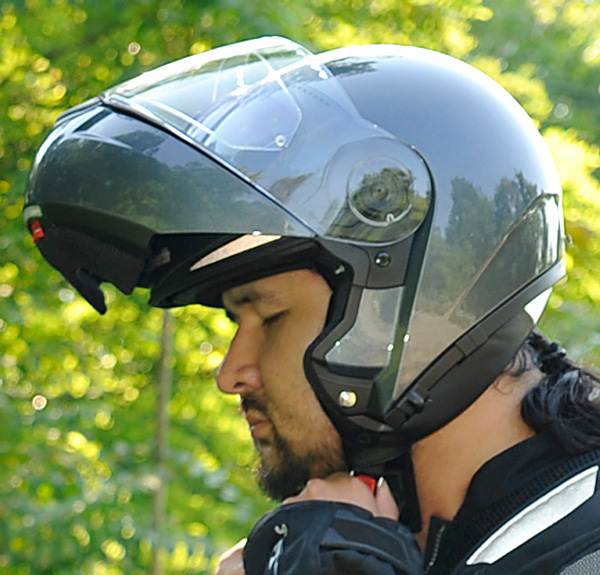 Schuberth is one of the oldest helmet manufacturers in the world and has led the way in many head safety innovations for more industries than motorcycling. We got hold of a C3 model for testing and were very pleased with the fit, finish and choice of materials for the unit. Their integration with technology into the design is so organic that sometimes you’re looking at a feature you think is styling, but actually plays a functional role. The small triangular moldings on top of the visor aren’t there for bling reasons, but help clean the airflow around the helmet. Dozens of little features like this result in an extremely quiet ride on par with the new-comer Neotec.
Ventilation to the crown was not as pronounced as the Neotec’s but still noticeable and very effective. One feature completely lacking from the C3 is rear venturi vents found on almost all the other models. We anticipate the C3’s successor will address this issue. A nicely designed, smooth operating drop down visor also helps keep the inside cool on sunny days while allowing you good full use of better vertical field of view over the Neotec.
The supplied Pinlock visor provided fog free riding, even in cooler temperatures. If you opt not to use the Pinlock visor in the C3, you have nothing to worry about as it even beats the Shoei’s impressive front end throughput. All those little castle shape ridges in the front vent do a great job of getting air into the mask and should defog pretty much anything once you get above a few miles per hour. Like the Neotec and a few others, we’re seeing more pop-panel type vent covers which are easier to use, manufacture and maintain than traditional sliding louvers.
Our test unit came with the optional Bluetooth SRC-System (SRCS) installed which delivered clear audio and integrated well into the C3’s speaker pockets. Although the SRCS is provided by Cardo (Scala Rider), the Schuberth integration is very well thought out. The electronics and battery are placed in the lower side pads along the bottom of the helmet, eliminating the mini transmitter units on the side of the helmet. The downside is the puffier pads stuffed with electronics and the boom-microphone cram what’s already a pretty svelte helmet interior. Opening and closing the mask was sometimes awkward as the pads would interfear with the final latching and the foam pop-guard on the mic pretty much went right into our mouths and needs to be lifted before closing. This may not be a problem for some based on body dimensions, but we felt its impact on the overall experience was worth noting. After removing the SRCS and placing in the standard pads, the C3 was easy to operate and a good bit lighter as well.
Real business know the value of your product isn’t just in what you sell, but how well you support your product after it’s sold and Schuberth takes the cake in this aspect. Their helmet replacement plan really instills confidence in a buyer and offers to replace the unit at 1/3 the MSRP should you ever have the misfortune of testing its protection. Schuberth is also the only company of the list to offer a women’s version—an example we hope to see others eventually offer as well. This type of forward thinking in both the product and business sense makes us eager to see the C3’s replacement.
PROS |
CONS |
| ▲ Quality construction and design | ▼ Missing rear vents |
| ▲ Good visibility | ▼ Stuffy bluetooth |
| ▲ Very quiet |
Conclusion
Helmet purchases are one of those items that rider fixate on, much like saddles or tire choice. Not only can they be expensive, fact is we live in these helmets and need them to perform to whatever demands we may place on them. Thankfully, the options and quality of modular helmets we’re seeing now are improving each year with more models and option at extending price points. Whether you’re looking for a wallet-easy entry level lid or a top of the line Cadillac head-can, all the units we tested would do a good job of keeping you safe and comfortable given a correct fit.
In the under 300 dollar category, we’d strongly recommend going with the HJC Sy-Max III. Although it will run about 100 dollars more than the CL-MAXII, you’re getting a much better helmet suitable for casual or extended riding. The Noland N-104 and Vemar Jiano EVO TC are a closer call. Both of them are European in design, not just visually, but physically as well. The heads they fit may not fit an HJC or Shoei user and vice versa. Nevertheless, we felt the Nolan edges out the Vemar in terms of build quality, ventilation and comfort for longer heads.
With a street price of about 100 dollars less than the Schuberth C3, the Neotec proves to be very challen