 Sticky logo
 Search


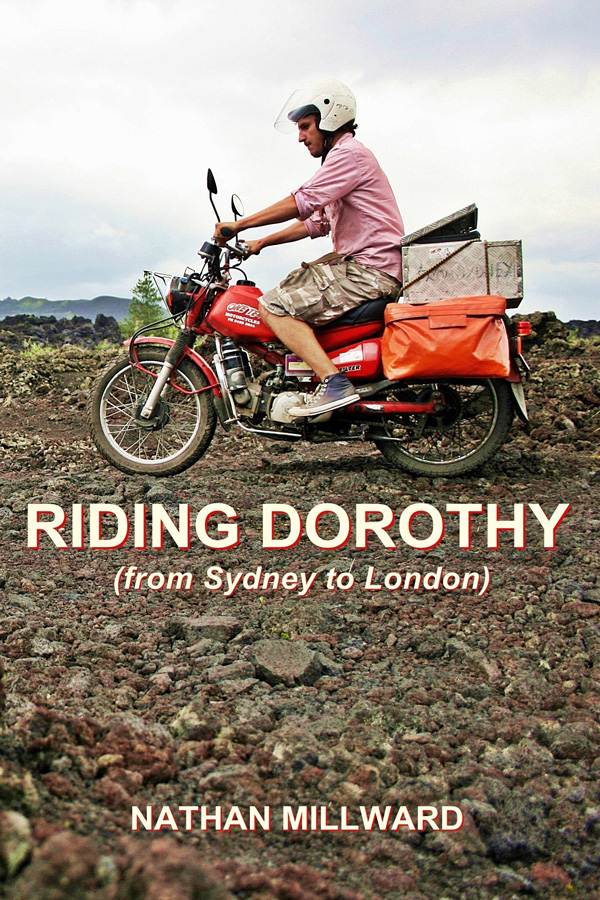 By Nathan Millward, ThePostman.org.uk
Published by Dot Publishing
Paperback: $16.62 (USD; Also available on Kindle)
There’s an underlying aspect to overlanding that can, and often does, transcend any resemblance to being practical. What does one actually need to get out there? Certainly there are many possible ways to hit the road. But what if you don’t have a big budget, or anything approximating one?
Perhaps one of the many reasons why we’re seeing more riders taking to the road on small CC bikes is because they’re so economical. But looking at this strictly from a financial point-of-view will likely miss what it’s really about—immersion. The chance to interact, more directly, with people, cultures and the environment along the way.
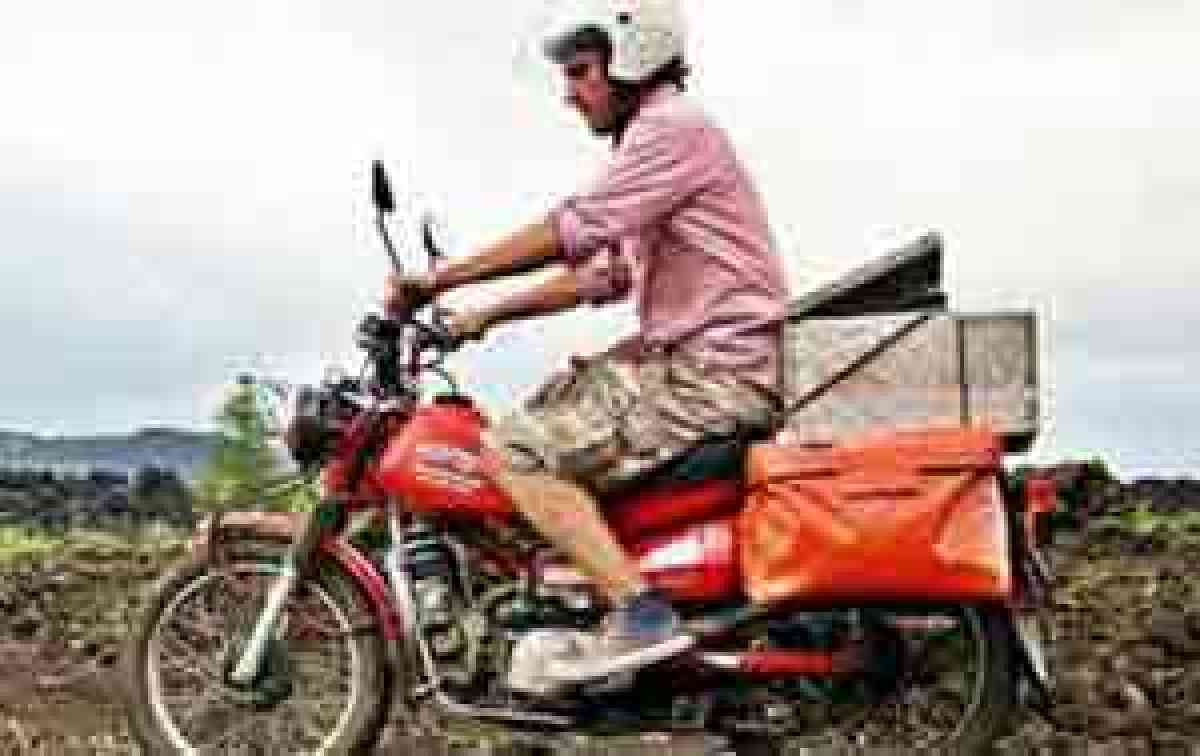
Enter Nathan Millward and his ride from Sydney to London aboard nothing more than a 105cc Honda CT110 “postie bike.”
What the heck is a “postie bike”? Indigenous to Australia, their postal service purchases these modified little workhorses direct from Honda—of which the basic design has been unchanged since 1980. Factory mods include a beefed up frame, soft panniers and a back rack. The Auzzie postal service goes through about 3,000 of these bikes per year. Then, after clocking 30,000 miles on their odometers, they are sold off cheap in public auctions.
Nathan, who affectionately refers to his CT110 as “Dorothy,” also added a few touches, including a motocross gas tank, a tent rack above the headlight and a sheepskin seat cover to aid with what would be many long 14 hour days in the saddle. And according to his report, “…apart from up and over the Himalayas when she really struggled…” the little bike that could held up for the entire journey with only a single minor repair and normal maintenance: a worn out sprocket, oil and air. Remarkable.
The Honda shares the spotlight as a character in Nathan’s recounting. And it’s a great story, too, because he’s so comfortable and natural with word craft. The style is witty, original, engaging and informative as he takes the reader along through all nine months, eighteen countries and 35,000 km of this very personal odyssey.
Nathan Millward is a perfectly normal sort of guy. Far from wealthy… he’s a working Joe with a hankering to see the world, “I had three reasons for thinking this to be a good idea: First, I like motorbikes. Second, I like travelling. Third, a friend once told me how a big motorcycle trip like this can change you. He never said how or why or in what way, just that it happens. And I quite liked the sound of that.”
Setting off with a good dose of paranoia and fear of the unknown, we witness Nathan’s transformation from shaky novice to a sure-footed professional traveler. His account is about the people along the way, myriad personal challenges, and blow-by-blow descriptions of his overlanding adventures. The reader feels him gradually melding with the many and varied environments he encounters… and the change in cadence with the daily routine and rituals as he packs on the miles.
Diving into this book will most certainly pull one away from any lure to a five-star hotel, and throw them right into a romance with the immersion of low-budget motorcycle travel. Whether you want to come along for the ride for the sheer purpose of being entertained, educated, or a combination of the two, there’s no other way to say it than you’re going to enjoy this book.
A short Q&A with the author
AM: What was your favorite country?
NM: “Probably Thailand as it’s the best compromise for interest, ease and cost. It’s just such a perfect place to ride. I also enjoyed the riskier countries such as East Timor and Pakistan, simply because I didn’t know what to expect and actually found them, on the whole, to be really friendly, especially Pakistan. Worst country, or countries, was Europe, simply because of the roads.”
AM: What did you eat?
NM: “I ate whatever I could, really. Sometimes that was just biscuits, other times cheap noodle dishes from a stall. For the most part I didn’t carry any cooking equipment so it was just a case of finding something when I got hungry. I also carried bottled water. I don’t think, if I did it again, I’d take cooking equipment simply because stopping for food at the places local people use is all part of the experience. These were the times I did most of my interaction.”
AM: What did I enjoy the most?
NM: “The freedom but also the simple-ness of my life, for the most part, during that time. Waking up every morning and knowing what I had to do was the best feeling. Just getting up and riding every day. Also meeting people, both the locals and the other travelers. This is perhaps the best part of the experience, because to be honest I wasn’t that interested in the tourist attractions and other sites. I more enjoyed meeting the people.”
Editors Note: Although first self-published in 2010, Nathan Millward's book has been through several iterations, as well as title changes, that include printed and e-book variations. The current e-book version is the best yet, with a cleaner design and plenty of photos. The title has changed to "From Sydney to London: The Long Ride Home".