 Sticky logo
 Search


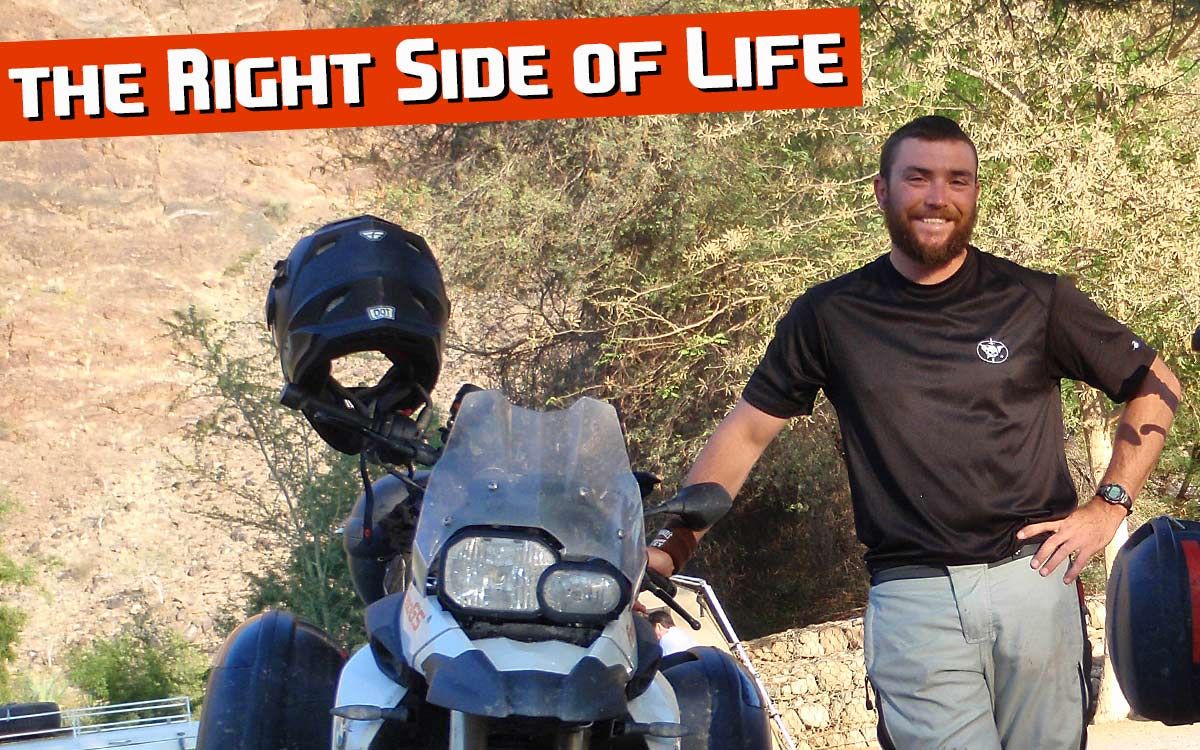
“All is right in the world... coffee, cigars and chocolate cheesecake while I reroute my GPS over Tradouws Pass, then it’s onto the ostrich capitol of the world. The southern-most point of Africa already today, and great white sharks yesterday. I am on the wrong side of the road… but the right side of life.”
I updated my Facebook with these words and attached a picture of my rental BMW F800GS sitting curbside on a shady South African street in the background, the cheesecake of a local coffee shop stealing the spotlight. Day four in Africa—I had just over four more weeks left on my cannon ball run, and am finally adjusting to riding on the left side of the road, and not into incoming traffic.
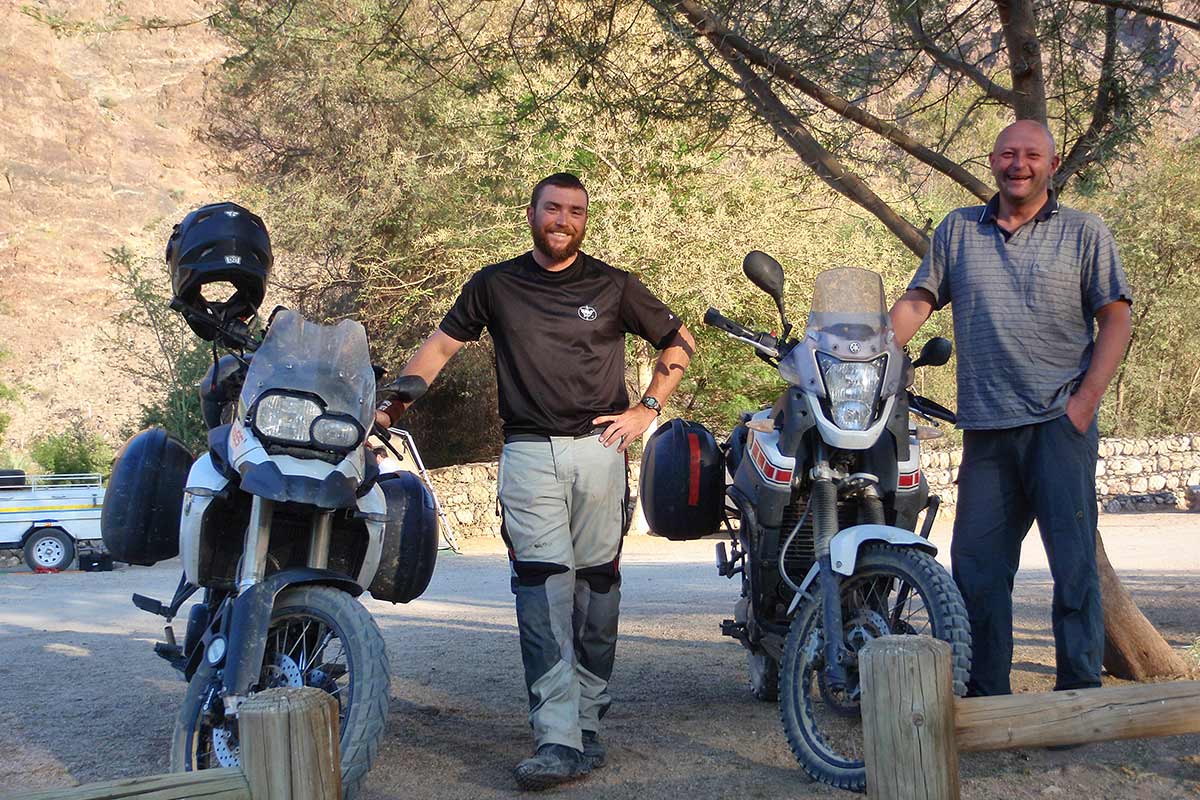 Peter and I, one of the great friends I made, getting ready to part ways once again.
I know nearly nothing about the continent, other than it is massive, suffers from political instability and has wildlife that rivals Jurassic Park. I wanted to get away, but was unable to do it on the scale of the overlanders and the costs of the guided tours I had looked into were too much for my budget. So, I decided to do it economically and brave it on my own thanks to a friendly local company who supplied a bike and a map with various routes and backroads.
My request was simple, “as if sending a friend out to see the best of Africa” in the time allotted. The extent of my planning was to purchase a plane ticket, secure a rental motorcycle, and get the requisite immunizations—just in case. I had started my research, but couldn’t help but be nervous after seeing the poor conditions of a few towns along my proposed route. That’s it, I won’t plan anything else. All I need to know is that I want to hit Victoria Falls by my half-way point.
Out of my comfort zone, maybe, but I was on two wheels, and that is where I belong. The decision to not plan made every moment a complete surprise and I had no expectations of what the next day had in store for me. From sleeping at random local houses, encountering elephants on desolate roads, exploring Namibia’s skeleton coast, speeding by armed men in ski masks hours from any functioning police station, to leaning over the edge of Victoria Falls… the surprises would be endless.
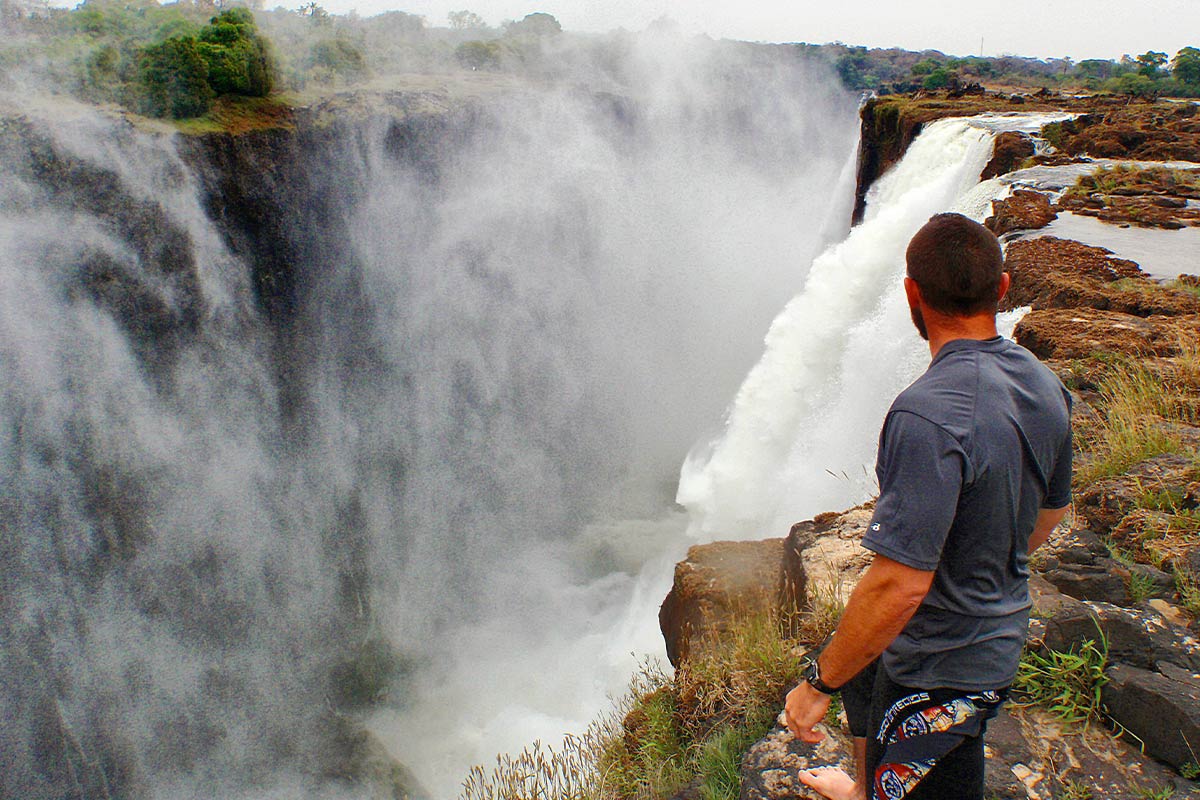 Eyeing Victoria Falls from Livingstone Island in Zambia before taking a swim to the Devil’s Pool, seen in the background.
* * *
“Please start, please start,” I said out loud as I frantically wretched the throttle while in waist deep water—both me and the gear were soaked. It is always the crossings where you can see the bottom that gives you a false sense of security. As soon as the motor turned, I dropped the clutch and shot to the other side, racing as fast as I could away from the group of curious baboons and down the road to the next crossing. I was in the Baviaanskloof, Afrikaans for “Baboon’s Gorge,” in South Africa.
I had straddled an ostrich the day before for a joy ride, cruised the rugged Swartberg Pass, ridden the coasts near Knysna and the heavily-jungled logging trails of Prince Alfred Pass within the last few days. Now I am pulled over, letting my bike idle, as I eye the next crossing and sip brandy to calm my nerves.
Here I was, just over 100 km into the heart of the mountains, exactly halfway between towns. Not helping the situation was that I had just learned, prior to my ride, a Cape buffalo here recently trampled a visitor to death in the protected “mega-reserve.” I guess it’s time to step up—damned if you do, and damned if you don’t.
This will be around my twentieth time crossing this river and I do not know how many more times it snakes across the road ahead; all I do know is that I don’t want to try my luck going back through that last one again.
“Slow down, slow down! Remember this is a rental,” I tell myself, which was hard to do after losing time on today’s journey to Mokhotlong. Lesotho is a unique country; I have only seen a handful of vehicles in the last few hundred miles since departing Maseru for the highlands.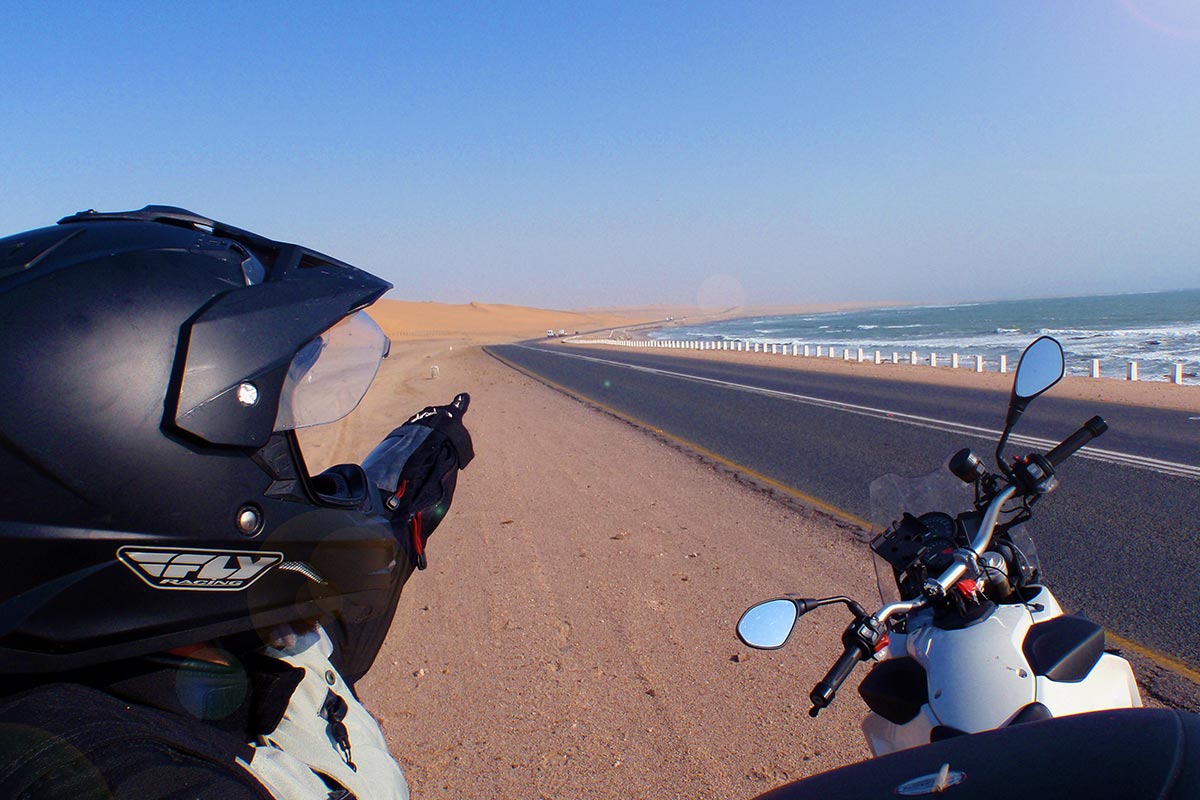 Excited to have made it out of the heat and onto the Skeleton Coast near Swakopmund, Namibia.
It’s mainly been local herders on foot wearing their traditional “ski masks” and Basotho blankets, tending their livestock along the roadside. The “mountain kingdom” switches back and forth from gravel to perfect asphalt in short segments on technical mountain passes reminiscent of a superbike chicane section, begging for the bike to be opened up.
An injury is what I consider my most serious threat while riding through southern Africa. If I am robbed, I am robbed; if my bike breaks, it breaks. I can always ask for support from locals or have money wired from home. If I wreck, however, I am in real trouble. I often think about this between long desolate stretches of road when complacency sets in.
In-between large towns, there are a series of townships—or more traditional mud/stone huts assembled in villages. They may, at best, have cold beer for my injuries. Medical support, such as ambulances or “flight for life” helicopters, is limited to more developed cities, and those are few and far between.
People from back home and across southern Africa frequently called me an “idiot” when I explained I was going to be riding without friends or a tour group. But the simple fact is, when you are alone you are more approachable. At the end of a day of riding with friends, you chat with them over drinks, in a way closed-off from those around you.
One thing that has served me well on this trip is the letting down of my guard and being more receptive to having conversations with those I met. Wrong turns solved by friendly locals, tales of adventures that shadow mine at gas stations, tips on accommodations or an extra room at their home while dining, or more importantly perspectives on life that completely reshape my own views.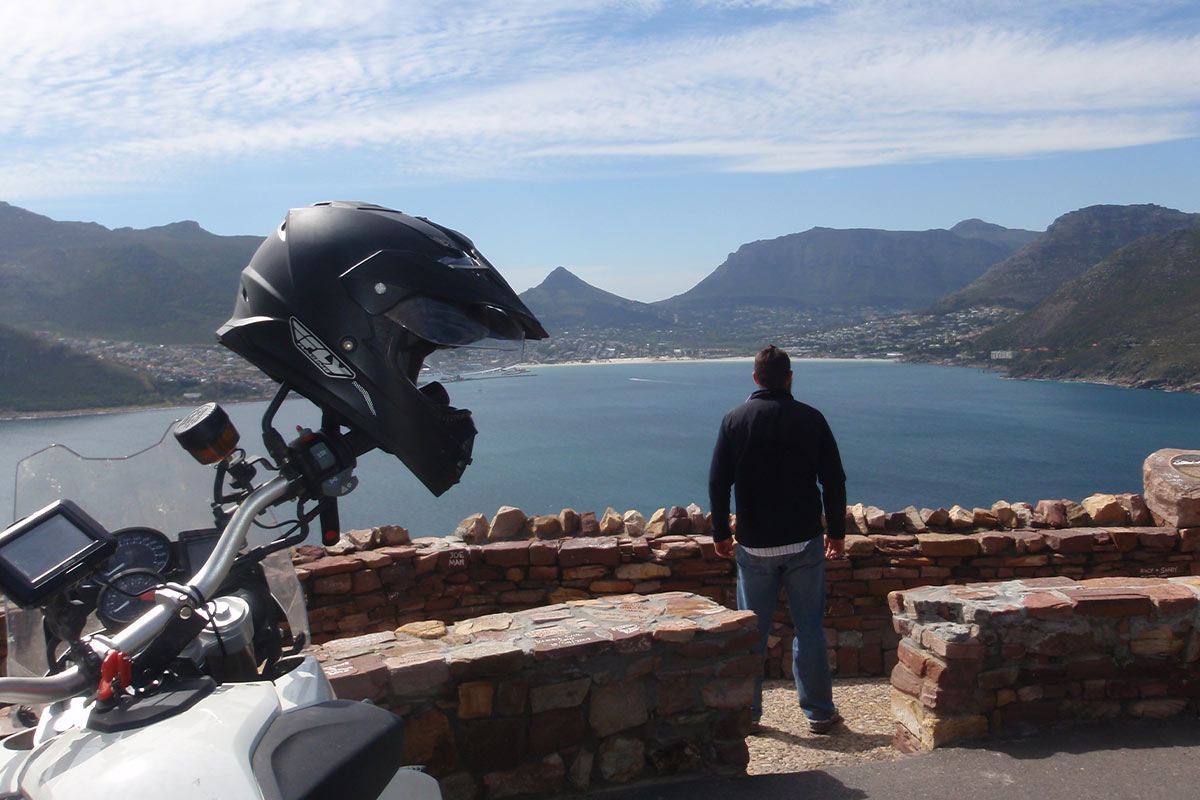 One last stop before returning the bike in Cape Town, and a favorite from Africa, Hout Bay as seen from Chapman’s Peak.
It’s easy to talk to locals while wearing your riding gear. It makes you a magnet for chitchat and they help fill you in about their town’s history, sightseeing expeditions, and the security of walking around at night. One common trait with most Africans is that they are proud of their countries. They are genuinely interested in how westerners are being treated, and if Africa is living up to our expectations.
I can already hear my friends back home, “Tyler was killed by an ass, how ironic.” It is amazing how many donkeys there are in Botswana, which surely has to be the donkey capitol of the world. I am now dodging them at high speeds. For such a lethargic creature it’s surprising that, when spooked, how some have the uncanny ability to nearly jump across one lane sideways.
In hindsight, I may have made a poor decision by setting such a ridiculous pace for myself. After my wildlife safaris in Kruger National Park, I decided to cram three days of riding into two, to free up a day next week.
Apparently there is a place on Namibia’s Okavango Delta headwaters where I can rent a tree house over a river where wild crocodiles and hippos swim freely beneath. The main allure is that I was told there’s a giant floating shark water cage, allowing guests to swim without being attacked.
At this point, I am crossing my fingers that it is worth the risk, fearing my demise from the herds of goats, cows, and Botswana’s infamous donkeys, I am only several hours from what I had originally hoped to be the apex of my trip: Victoria Falls.
This is the life… I am sitting on the deck of the Royal Livingstone Hotel in Zambia, having a beer for breakfast, as two giraffes and several zebra are nibbling on the manicured lawn along the pool, less than 20 feet away at this five-star resort. Of course, I am not staying here, as I have secured a prime spot in a bottom bunk of a hostel across the border in Zimbabwe.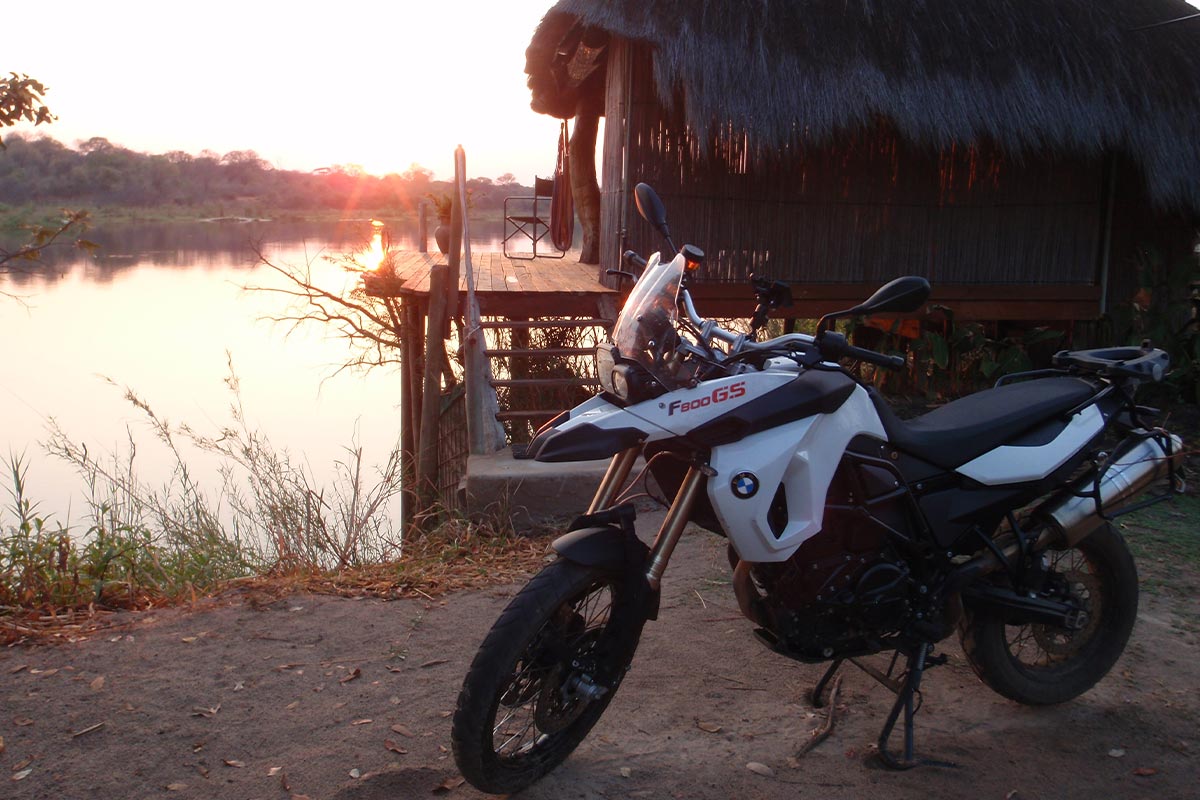 My en-suite tree house across from the Bwabwata National Park along the Caprivi Strip.
Not surprisingly, it wafts of alcohol and sweat, courtesy of my eleven roommates who drank until the wee hours after their overland truck dumped them on the last stop of their tour. I decided not to visit Victoria Falls yesterday, instead, saved my first glimpse of the falls from the Zambezi River itself.
The Livingstone Hotel is the departure point to the famous Devil’s Pool. Up next: a short boat ride, a hike, a swim, and a brave leap to the edge of the falls. There is a point before the summer rains set in, when the water levels are low enough to swim in the aptly named pool on the cliff’s edge, where water spills over and around you before it descends the 100 meter falls.
I missed the grandeur of the mighty river at its highest point, but felt that the expansive view over the edge was a nice tradeoff… even if I did have to ask a local guide to hold my feet tightly to ensure that the current didn’t drag me away. The view and the thunderous sounds of the falls, as seen from Zimbabwe, give precedence to the fact it was chosen as one of the Seven Natural Wonders of the World.
Each day is better than the last. The previous four weeks hardly seem believable. I stayed in my en suite tree house last week, showering with river water in open view along the banks, as Cape buffalo grazed across from me in the Bwabwata National Park. From the Caprivi Strip, I re-entered Botswana and spent a few days exploring the Okavango Delta.
By air, the wildlife appears limitless as predators and prey still live without the influence of man in the vast region of islands within the flood plains. When I reached Windhoek, Namibia, I phoned the rental company in Cape Town and told them I am not coming back when scheduled, but will pay for the additional rental when I decide to return.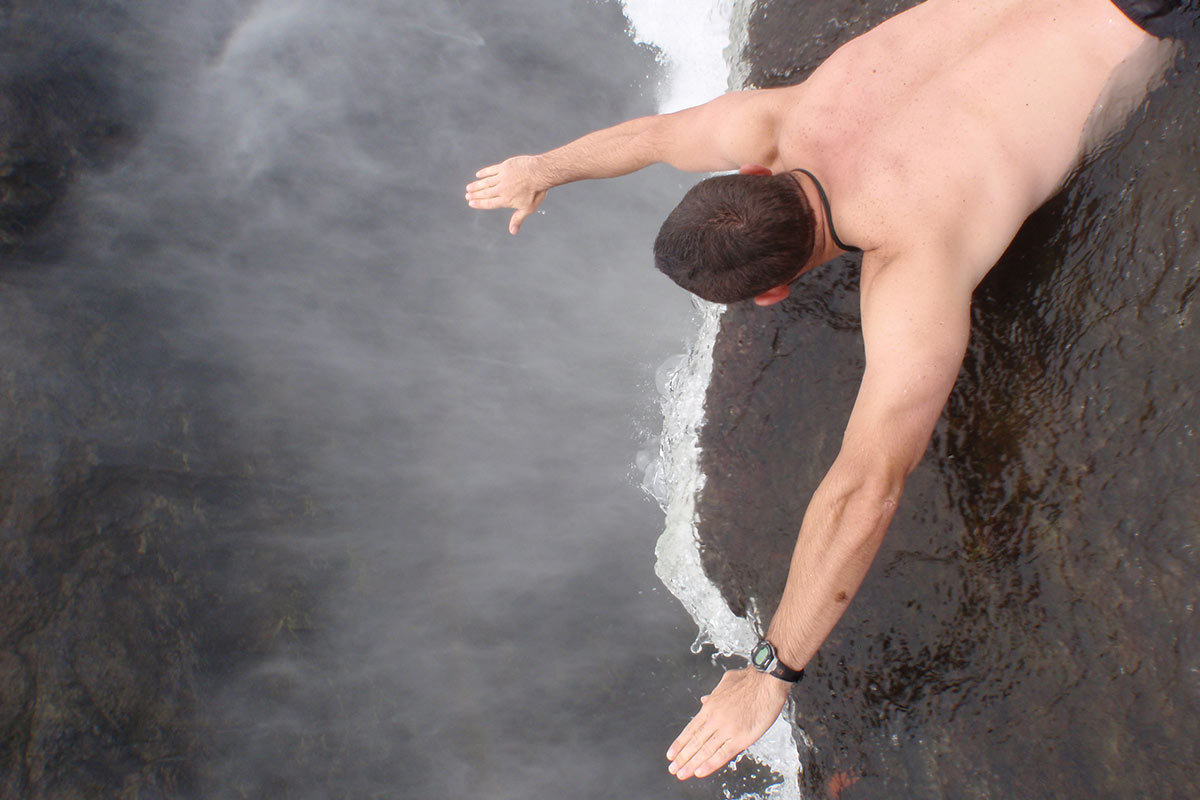 Victoria Falls, and my new appreciation of heights from inside the Devil’s Swimming Pool.
Originally, I was supposed to return the bike in a few days, taking a straight shot south from here, but I had built an extra week into my schedule in case of any mechanical problems, or other possible emergencies, so I could still make my departure flight home.
But, I was so close to the Skeleton Coast, heard about sunrises of Sossusvlei and the sand dunes turning into a deep red before lightening colors as the unforgiving sun beats down on the lunar landscape. How could I possibly miss that?
The dust was thick, there was no vegetation to hold it down and now I was grateful I hauled my goggles for the last month in the panniers, attempting to overtake slower vehicles while being cautious of washboards and wash-outs in limited visibility.
I enjoyed my few days in the German-inspired town of Swakopmund; its cool ocean breezes, proper west coast sunsets, and their magnificent dunes. The Skeleton Coast is a paraglider’s dream, steady offshore winds allowed me to soar the coast, and the wing served as a tow back to the top. I snuck in an entire day on a rental harness and parachute… another item off the bucket list.
Yesterday I hitchhiked into Sossusvlei, thumbing a ride in a “Scooby Doo” Volkswagen bus painted with African bushman-like art. Bikes were not allowed to the center of the park, sedans were stopped after sixty km, and four-wheel drives or feet were recommended if you wanted to reach the “vlei.” I was skeptical about this, but after I lowered the VW’s tire pressure, the longhaired and bearded owner floored it, and to the amazement of plenty of overlander 4x4s stuck in the soft sand en route to the dead lakes, we cruised the final six km without a problem.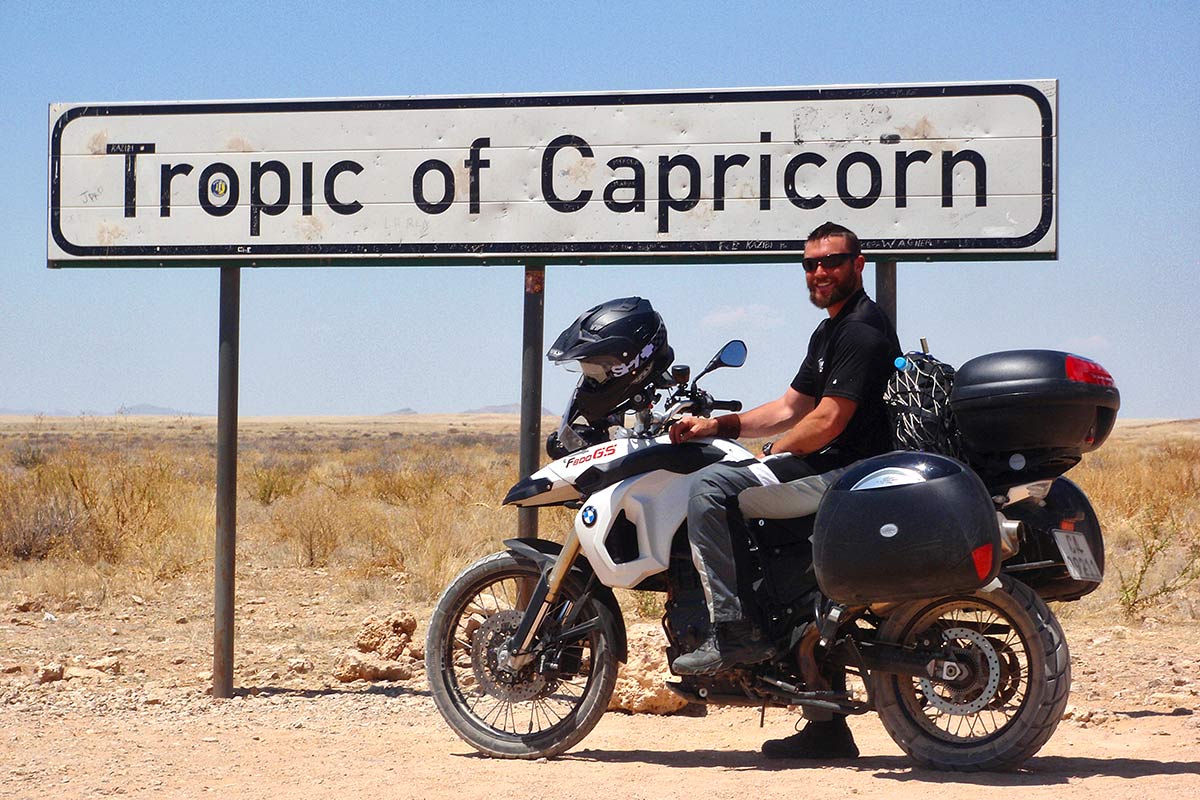 One of the greatest parts of the trip, something recognizable in the middle of nowhere.
The VW owner, who happened to be a historian, was not only kind enough to give me a ride, but also cooked breakfast after I came back from a sunrise hike to the dune he considered a jewel of the park. You couldn’t have paid for a better expedition.
Bidding my ride farewell at the dunes, I began walking the sandy trail hoping to thumb a lift back to the entrance. I still had a full day’s ride ahead of me to Fish River Canyon, Africa’s version of the Grand Canyon, and then on to Ai-Ais hot spring for a rest day.
As I pulled into a posh town in the heart of South Africa’s wine country, with gorgeous women shopping the boutique-lined streets, I felt depressed. There was a longing for the solitude of the deserts and gravel roads that had become such a big part of my ride over the last few weeks.
After leaving Namibia, I spent a few days in the Cederberg mountain range, viewing bushman art, hiking windswept rock formations, and talking with other motorcyclists at an oasis that is a gift to adventure riders. There I was adopted by the “Wild Dogs,” South African’s version of ADVRider. They led me out of the mountains showing me the jewels of their backyard that linked the majestic passes together before we parted near Cape Town.
I have decided to spend the few last days decompressing in Stellanbosch, playing tourist while enjoying the culinary capitol and the expanse of vineyards it offers. Knowing the journey was about to end, I planned to tour the Cape Peninsular and Table Mountain before returning my beloved F800GS and settling the debt.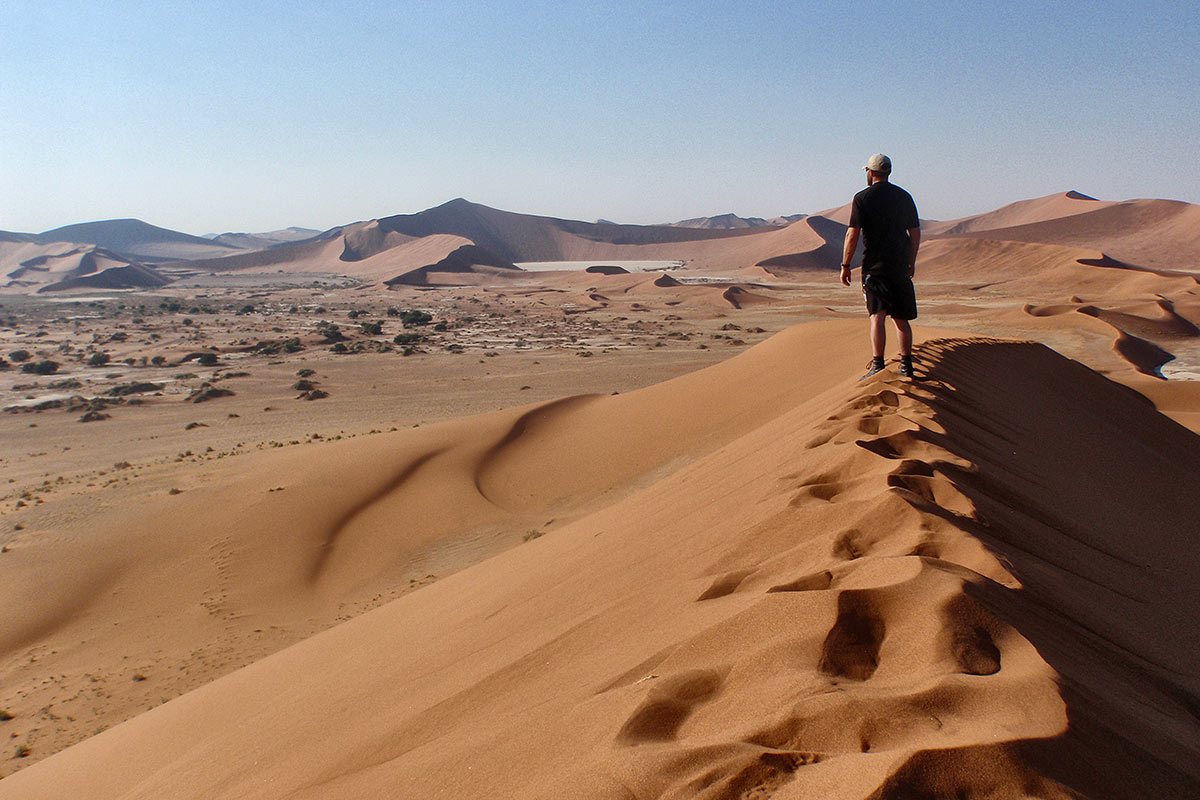 Admiring the Deadvlei Pan in Sossusvlei as the sand dunes continue to cut off the river’s path to the ocean.
* * *
Adventure is always possible. Expeditions do not have to be done on a grand scale, with a personal bike, a seemingly limitless budget and planned down to the tiniest detail. My life was changed in several short weeks—11,000 kilometers, 7 countries, with no direction, a rental bike, and a middle-class budget.
This is a prime example that exploring the world can be done on your own terms. With lots of options, making the decision to just get out there and go becomes easier. A tour is an excellent option, a ride with friends would be a dream… but it’s better to do it without a riding partner than not at all.
Tyler Hare can now be found obsessing over ride reports and maps while building an adventure bike for a return trip to overland Africa. He is now a booking agent and guide for a popular South African motorcycle tour company and can be contacted through his website at: www.AfricaMotorcycleTours.com.