 Sticky logo
 Search


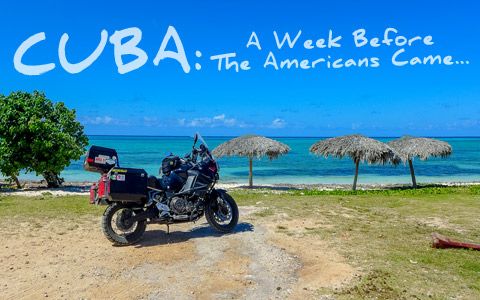
Back in 2013 I had plans of riding Cuba, but to my regret they fell through. Then I read of President Obama’s intention to visit the island nation—now I simply had to get there before him, before things would change forever….
By early March 2016 I’d boarded the schooner Stahlratte in Isla Mujeres, Mexico, and was en route. A few days sailing later I awoke to Captain Ludwig calling out, “I need the bike riders on deck!” In the darkness of the early morning we freed my bike of its seagoing restraints and unloaded it onto the dock. Then, with the experienced and necessary help of the good captain, it took the next eight hours to process a mountain of paperwork that, when finally complete, imported my bike into Cuba. By the end of that long, hot day I had the mandatory import sticker on the windshield, a Cuban license plate, and a Cuban driver’s license safely in my wallet.
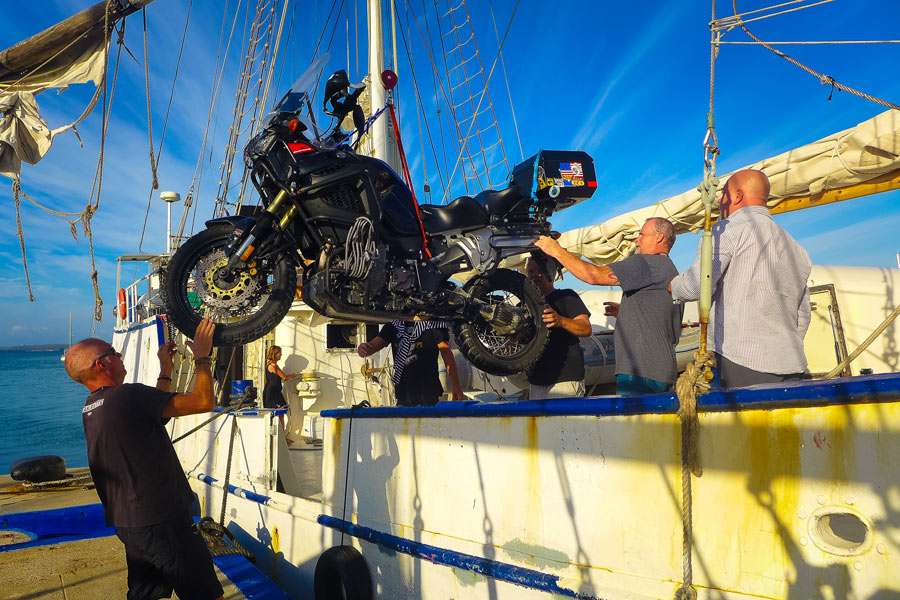
Weeks before, I’d studied the map to determine a route. Cuba has 16 provinces, one of which is an island that takes a couple of days or more to get to, so I scratched it off the list. For my 19 days, I decided on three in Havana, two in Santiago and Trinidad, and one day everywhere else.
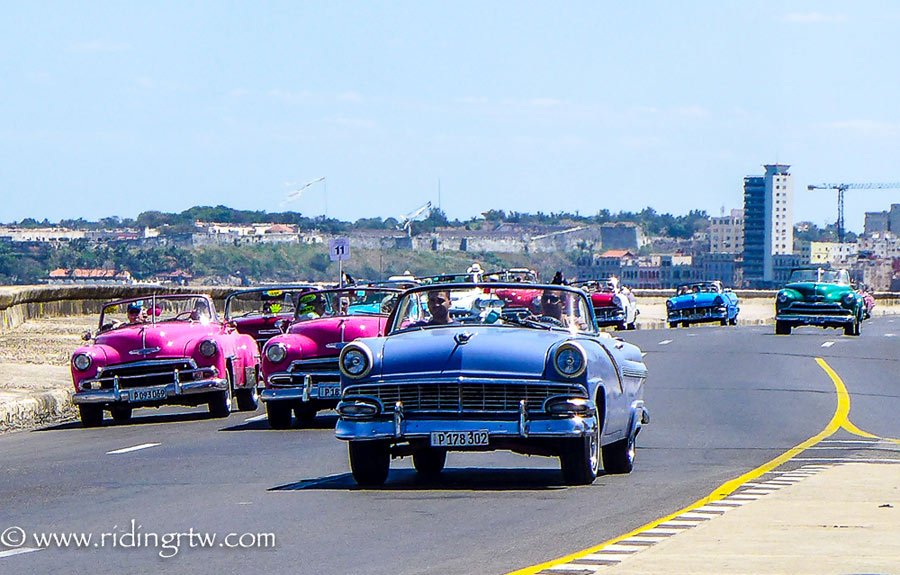
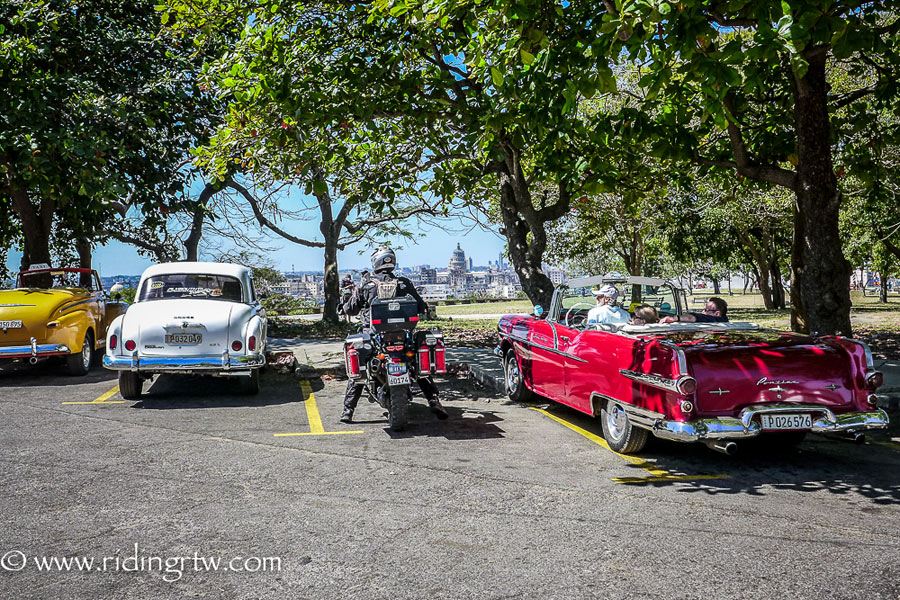
I had disembarked in Cienfuegos; from there to Havana is a short distance from one side of the island to the other. There’s the national freeway for most of the distance, which not surprisingly is almost free of traffic. The first time one of Cuba’s famed 1950s Chevrolets passes you it all changes, it’s tantamount to riding in a living museum. They’re all ancient and you find yourself looking at every car—the last of which were imported from the U.S. in the 1950s.
Collecting a key for a place I’d found on Airbnb was a simple process and my Spanish is reasonably good, so within minutes I was heading into the city and a suggested parking lot known to be secure. Upon arrival, the attendant moved his chair from his little cabin and sat himself right next to my Yamaha Super Ténéré, whereupon he immediately told everyone that he, and only he, could come near the bike. Throughout my visit, I discovered that Cubans in general have a great deal of respect for you and your possessions. Each and every time I would stop to fill up, a crowd instantly appeared and cell phone picture-taking would commence—but not one photo would be taken until they asked if it was okay. A simple nod and it was like having the paparazzi surround you. But I wasn’t the subject, the motorcycle was! Large motorcycles, other than the pre-revolution “Harlistas” and Soviet-era Urals, are not available to Cubans. Even the police rode little 250s.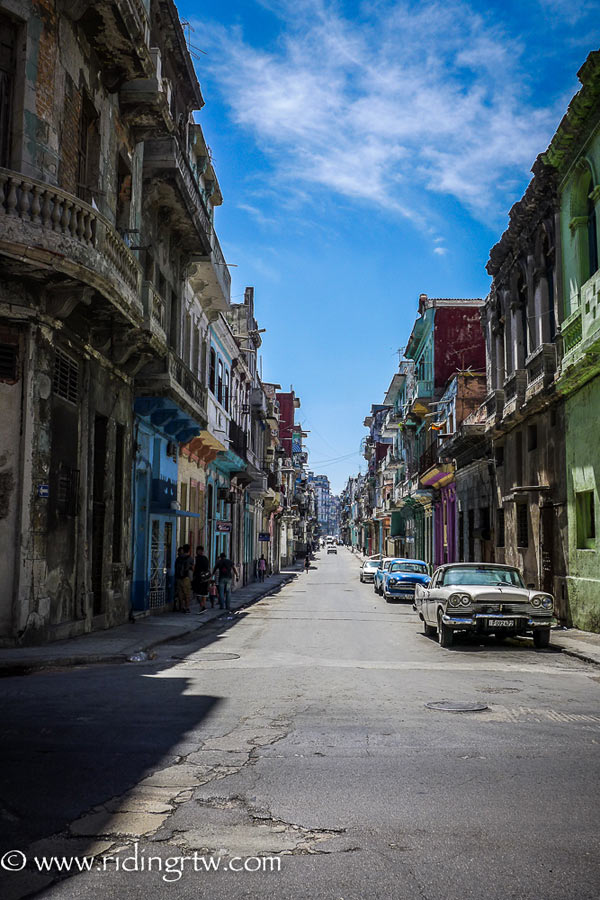 Havana is a large, densely populated, sprawling city that’s literally falling apart. Yes, there are new refurbished areas, but they do not have the same gritty feel of the older areas and are not as photogenic.
When I returned to where I was staying, the friendly owner, Felix, asked where I would be riding over the coming days. He took notes and, smiling, asked, “Would it be okay if I called my friends and asked if they have rooms for you? I’ll tell them you need secure parking for a motorcycle the size of a small car!” The following morning he produced a list of every town I’d mentioned and places to stay with parking.
Casa Particulars are rooms in the homes of Cuban people. They are government-approved, with rent from $15–$35 per day; many also include breakfast. A room for a single night is the equivalent of a month’s pay from their socialist government and for many it’s their sole source of income, by choice.
Over the remainder of my time there I rode through Havana, Vinales, Varadero, Santa Clara, Moron, Coco Cayo, Camaguey, Holguin, Guardalavaca, Baracoa, Guantanamo, Santiago de Cuba, Manzanillo, Bayamo, Sancti Spiritus, Trinidad and Cienfuegos. I could go into great depth about each place but space is limited here. What I will tell you is the roads are good for the most part, and the Cuban people are some of the friendliest and most welcoming you’ll ever meet. You’ll be made to feel like a rock star for your entire time there. And, good quality fuel is available everywhere in plentiful supply, and once you leave the main areas of Havana, Varadero, Santiago and Trinidad you’ll rarely see another tourist.
Cuba Travel Tips
Here’s a list of tips for navigating Cuba:
• As soon as possible upon arrival get some “nationals/CUP” from a cadeca (currency exchange).
$1 = 1 CUC (Cuban convertible peso)
$1 = 25 CUP (Cuban peso)
• Bring Euros or Mexican pesos for the best exchange rate, not dollars, as you’ll get hit with an additional 10% fee on top of the exchange rate.
• Learn the differences in the Cuban currency, some bills look very similar, especially the 3 CUC and 3 CUP bill. Both are red and both have Ché on them—with a $3 difference if you get confused
• At the cadeca read your receipt. I had a government employee try and stiff me for around $3 (if she can get away with it once a day she’s tripled her monthly salary). The trick is they give you a selection of bills, count them out leaving about 3–5 CUC off. This they hold out in coins as a tip, you grab the bills and walk away, and they pocket the difference. BTW, you need your passport for every transaction.
• ATM cards most likely won’t work here unless you get special clearance.
• Visa/MasterCard/Amex don’t work.
• 15–35 CUC ($15–35) is the standard rate for a casa particular. Location and quality don’t seem to have any bearing on the price; try negotiating, sometimes it works.
• Get the breakfast, it's huge, and at every place I had enough to make sandwiches for lunch—an easy way to save cash.
• If you want snacks look for small handwritten/painted “pizza” signs, most have a selection of food and small pizzas starting at 5 CUP (20¢ U.S.). Some do sandwiches—they’re like empanada joints in the rest of Latin America—good, cheap snack food.
• Check out the guys on bikes selling donuts, I got three donuts for around 8¢ U.S.
• Food on the road is NOT always easy to find; in smaller areas most Cubans don’t have spare money so stores and restaurants just don’t exist.
• The government regulates gas prices because they own the gas stations, prices are the same everywhere.
• The gas station sign is a green oval shape, “CUPET” for “Cuba Petroleum.”
• Learn how to say full (“lleno” or “complete”) at gas stations, otherwise you’ll have to play the guessing game of how much or how many liters.
• If you are asked, “efectivo” they are asking if you are paying in cash… si (yes) is the obvious answer. They will then tell you a pump number (hopefully the one your bike is next to).
• Gas is available in liters: 83 octane (0.80 CUC), 90 octane (1.00 CUC) and 94 octane (1.20). I used mainly 94 which is called “especial”—look for a blue sticker on the pump.
• Sometimes small towns only have 83 octane.
• Download open source maps for Cuba (free). They were 100% accurate and bringing a GPS is okay.
• Ride every road—even the freeway—like you are on dirt; potholes and bad conditions are everywhere.
• Potholes are fixed with an oil and chip mixture; you can usually smell them before you see them. A pile is put in a hole and NOT flattened, they let the cars do the flattening—very dangerous when it’s first laid and they’re everywhere.
• Train tracks—you must stop (as every Cuban will 100% of the time). Remember you’ll rarely see brake lights, so look for a sign with an old steam train.
• Speed limits in towns are 40 or 50 kph; don’t speed, too many people just walk out without looking, so beware!
• If it rains go slowly in the bends; some of the roads are so worn their surfaces are like glass.
• I rode with LED running lights; Cubans will make a hand gesture like squeezing a sponge, telling you your lights are on. Lights on in Cuba in the daytime means you have an injured person and are taking them to hospital, so everyone gets out of your way and will literally pull off the road to let you pass from either direction.
• Camping—it's forbidden for tourists, but if I was on a smaller bike I would have wild camped.
• Expect a large crowd every time you stop anywhere, and the most-asked question, “What’s the top speed?”
• A lot of seminars given by motorcycle touring companies don’t necessarily tell the truth. Much of what I was originally told was wrong, out of date or just totally inaccurate. Basically, they’re trying to deter you from taking your own bike so that you’ll go on their tours, which are very, very expensive!
• Cuba has to be one of the easiest of 80+ countries I have traveled in. Accommodation is everywhere, casa particulars are everywhere in bigger towns and cities—if you don’t find one just ask, as everyone knows where they are. If it’s not what you need, tell the owners, they help each other and will do everything they can to find exactly what you need.
• Three weeks is not enough time, but make the most of it, it will provide the opportunity to see all the major towns and cities, all the best spots. Never do a day over 400km/250 miles, also never arrive later than 4 p.m. anywhere.
• If I had been on a more dirt-oriented bike I would have headed for the areas around Trinidad and Santiago to Bayamo along the coast, lots of mountains and dirt tracks were everywhere and all shown on the GPS maps.
• If you want Wi-Fi then you need a card 2 CUC ($2) for 1 hour, but you have to find a hotspot—just look for crowds of people at a big building in the center of cities and towns, sometimes in main squares—you’ll understand when you see it.
• Ask the people at the hotspot where to get the card, most likely someone right there will be selling them; they’re sealed in plastic and you scratch off a cover to reveal the access code and number—kind of like a lottery scratch-and-win ticket. Wi-Fi is of really, really poor quality.
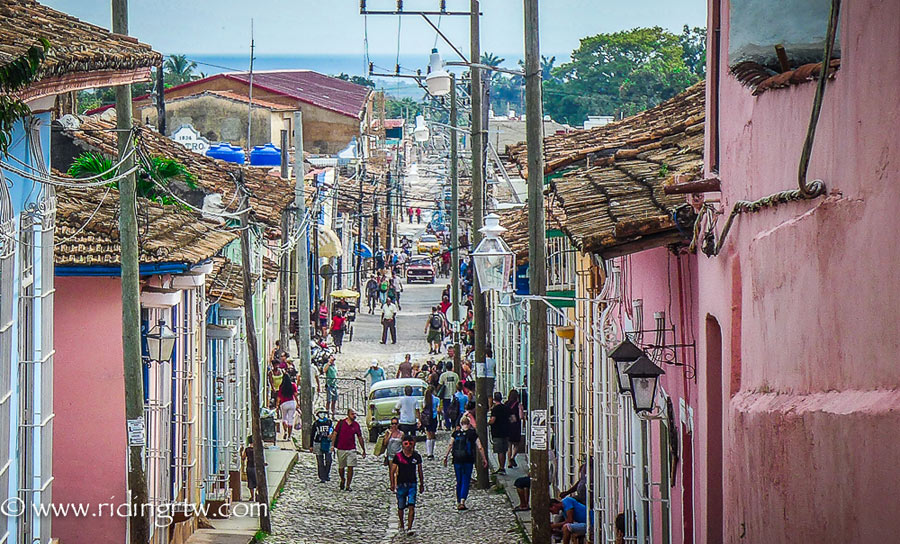
• Most photogenic place (towns): Trinidad and Havana.
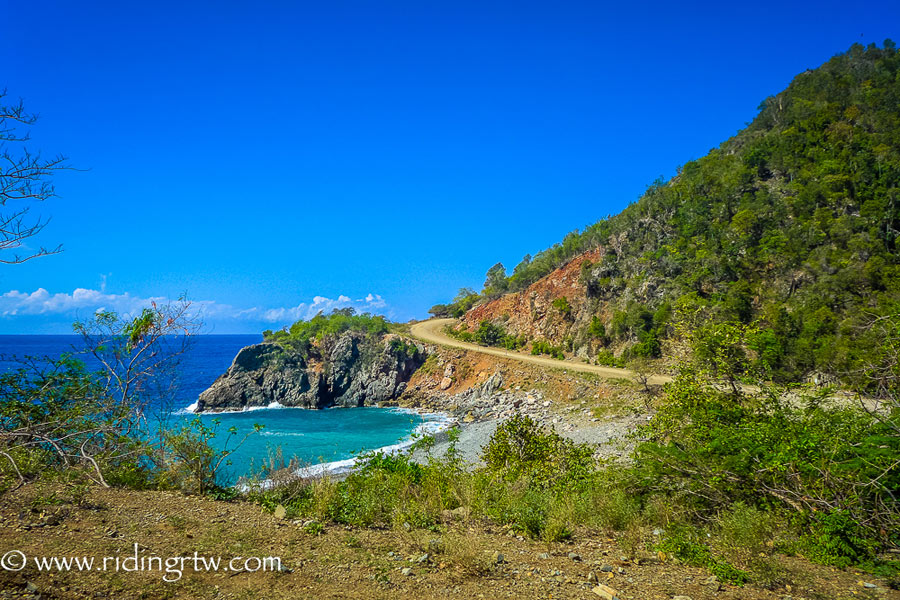
• Most photogenic place (scenery): Vinales and Santiago to Bayamo along the coast.
• Worst road (potholes): Moa to Baracoa.
• Best road for scenery (beaches): Baracoa to Santiago and Santiago to Bayamo.
• Best road for scenery (mountains): Around Vinales, Santiago and Trinidad.
• Friendliest place (people on the streets/locals): Everywhere but Santiago.
• Most dangerous place: Santiago.
• Most expensive place: Havana.
• Most modern feel: Camaguey.
• Nicest beaches I saw: Varadero, Cayo Coco and the Guardalavaca area.
• Cleanest places: Varadero and Sancti Spiritus.
• Best place to see good quality old cars: By the capitol building in Havana, parked or on the Malecon driving around Havana.
President Obama said, “I have come here to bury the last remnant of the Cold War in the Americas,” and, “The future of Cuba must be in the hands of the Cuban people.” Only time will tell if what he said will come true.
{gallery}ARTICLES/Rides/Cuba_PaulStewart/Gallery{/gallery}
 “As long as there’s a horizon and I can see it, then I want to know what's there, mentally, physically and visually.” Paul Stewart has been riding for over 40 years. Long adventure trips in recent years have become the main part of his life—and he’s ridden all 50 states and 78 countries and counting. RidingRTW.com