 Sticky logo
 Search


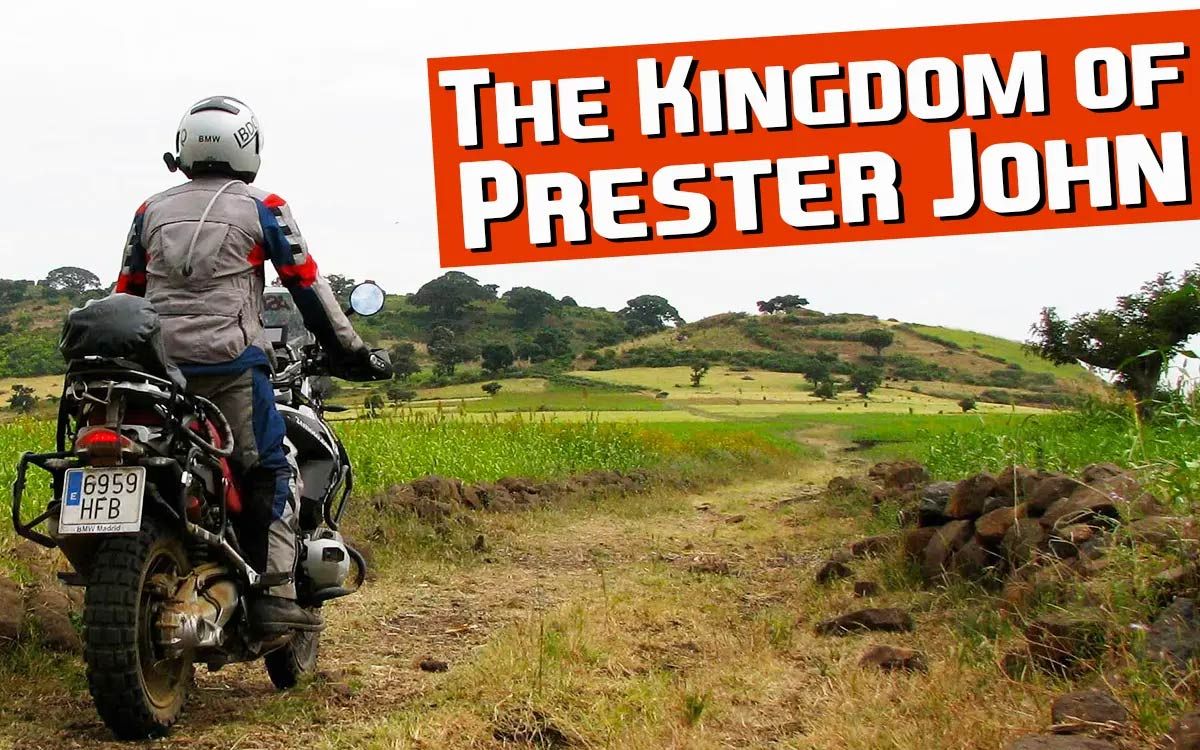
One of the Medieval myths that has been thriving in Africa is the story of the kingdom of Prester John. For centuries, they searched beyond the Sahara for a legendary and rich land, as mysterious as El Dorado, that would be governed by this Christian prince.
“They” were the European explorers, from the eleventh to the sixteenth centuries, pursued a dream that slowly became a reality with the development of geographical tools. A dream that lasted until Bartolomeu Dias rounded the Cape of Storms in 1488, opening the African route to the East Indies.
The same route that, ten years later, Basque de Gama would travel. When the Portuguese explored the east coast of Africa they discovered the empire of the Negus, who ruled a Christian nation surrounded by Muslims: Ethiopia.
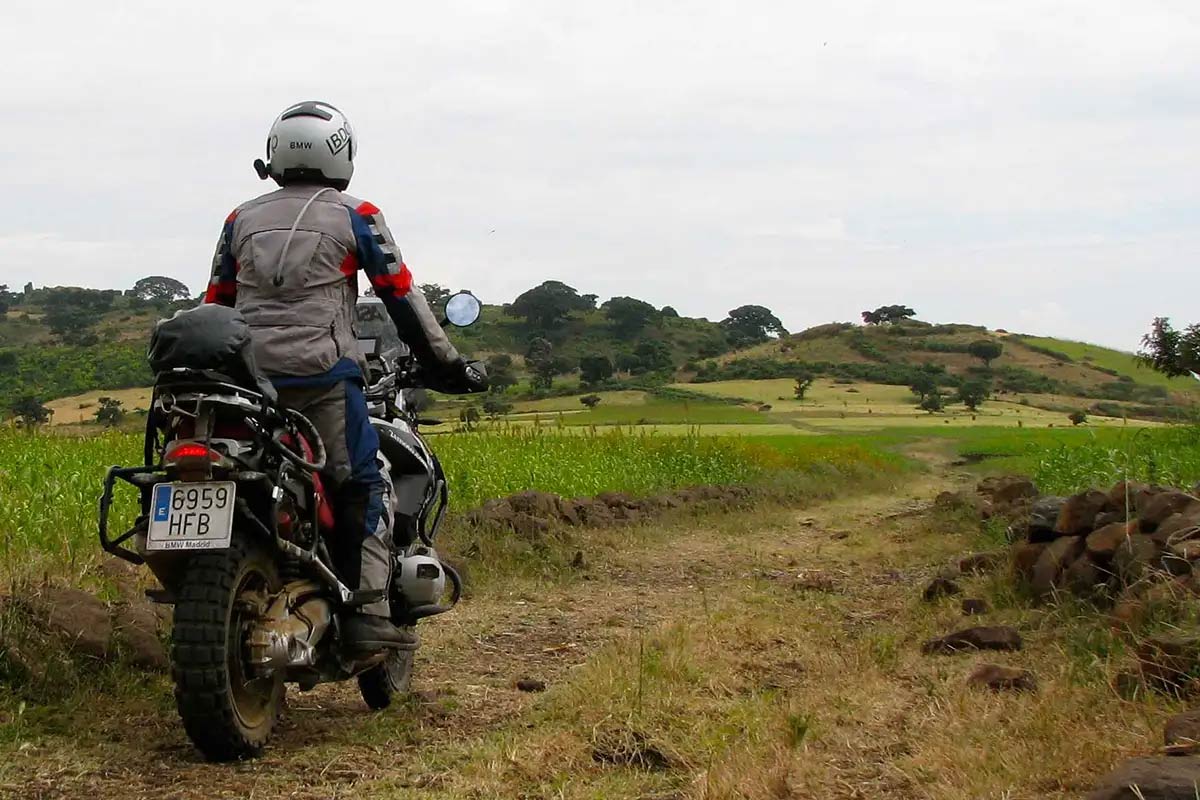 Miquel rides the trail to Paez tomb.
Question of Priorities
The only open border from Sudan into Ethiopia is Metema/Galabat. At the immigration office they check my visa, take my photo and record my fingerprints with a scanner. Finally, the questions of profession and an address in Ethiopia... as if I never know where I’ll stay.
I use the tactic that I explained in my first travel book through Africa, A Million Stones. In any hole, no matter how filthy, there’s always a Grand Hotel. So I say: Grand Hotel in Addis Ababa.
The exchange office is filled with planks. The clerk has a large cross hanging around his neck. Many women have the cross tattooed on their foreheads. Religion is omnipresent. Christianity came in the fourth century by Syrian missionaries, occurring during the kingdom of Aksum.
It was an era of great splendor that would extend from 400 BC to the seventh century, when the Arabs began their military expansion. With the rise of this new hegemonic power in the region, Ethiopia was isolated from Christianity.
The exchange trader opens the lock of the drawer and takes out the wad of bills more worn-out and dirty than I’ve ever seen. I need to make an urgent purchase. A refrigerator door is opened and at the bottom the treasure glitters. Bottles of beer! Fifteen days of abstinence in Islamic Sudan will come to end. Dashen, the cheapest, costs 10 birr. A half liter of water costs 10 birr also. The choice is clear. I buy two bottles of beer and leave the water for another time.
Cat Children
The bright green mountains are divided into grids of labor. Corn over here, barley over there and beyond onions and bell peppers. These highlands are fertile. However, not everything that glitters is gold. Ethiopia has suffered a crippling deforestation to feed its growing population of over 75 million people. Eucalyptus trees abound. They grow fast, give a lot of wood but impoverish the soil.
Everyone is forced to share the road with donkeys, cows and goats. The twisty road passes through dozens of villages. The houses are built with thatched roofs and wooden frames over which mud is crushed to form walls.
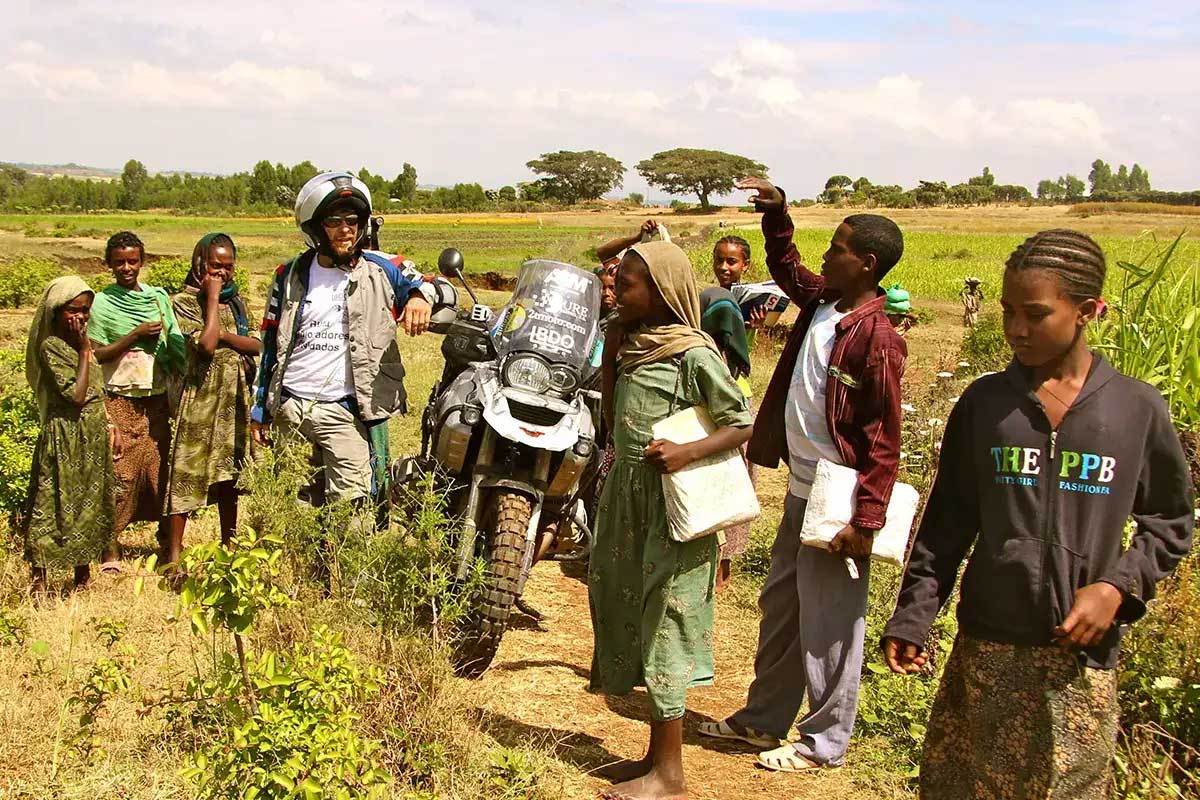
There are people everywhere. Children run behind the biker purring “yuiyuiyui” (“yui” means “foreigner”). Everyone in here spreads out their hands asking for money. Some of them are also skillful rock slingers.
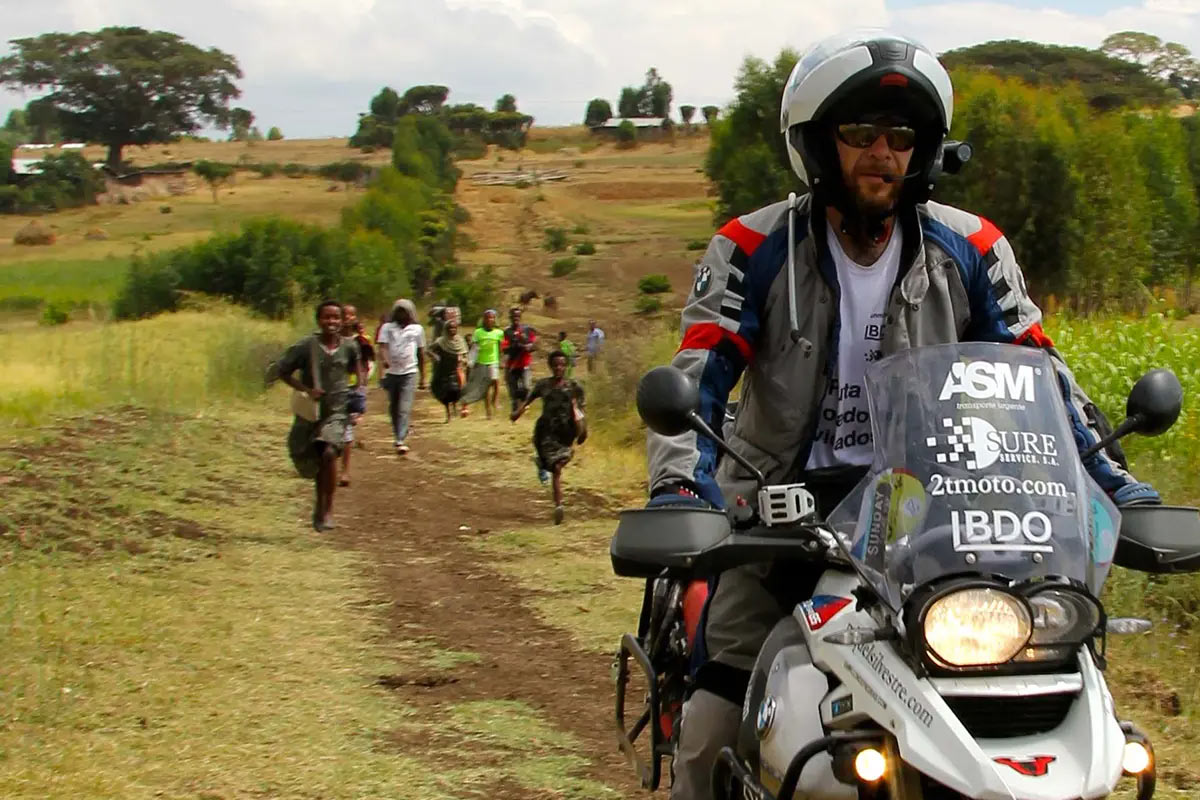 The Pied Piper leads the delighted children in a chase.
Gondar
Gondar is known as the African Camelot. Downtown one is assaulted by the typical opportunist guides that offer to visit the busy Fasilides’ Castle, who made this city the capital in the 17th century. Fasilides was the son of Susinios, the emperor friend of the Jesuit Pedro Páez from Madrid (Olmeda de las Cebollas, 1564), my forgotten explorer of East Africa.
Páez was sent from Goa along with another priest; his journey was not easy. Disguised as Armenian merchants, their ship was boarded by Yemenis pirates. He was taken prisoner and forced to walk, tied to a horse’s ponytail, the immense desert of Yemen, where Páez spent six years enslaved before being rescued.
After returning to Goa, he was finally able to step into Ethiopia in 1604.
I ran into a group of Spaniards. They have visited Niagara Tisisat. Has anyone over there explained to them who was the first European who saw that place? They shrug their shoulders. No, nobody has told them anything. When I tell them that it was a Spanish man, they seemed perplexed.
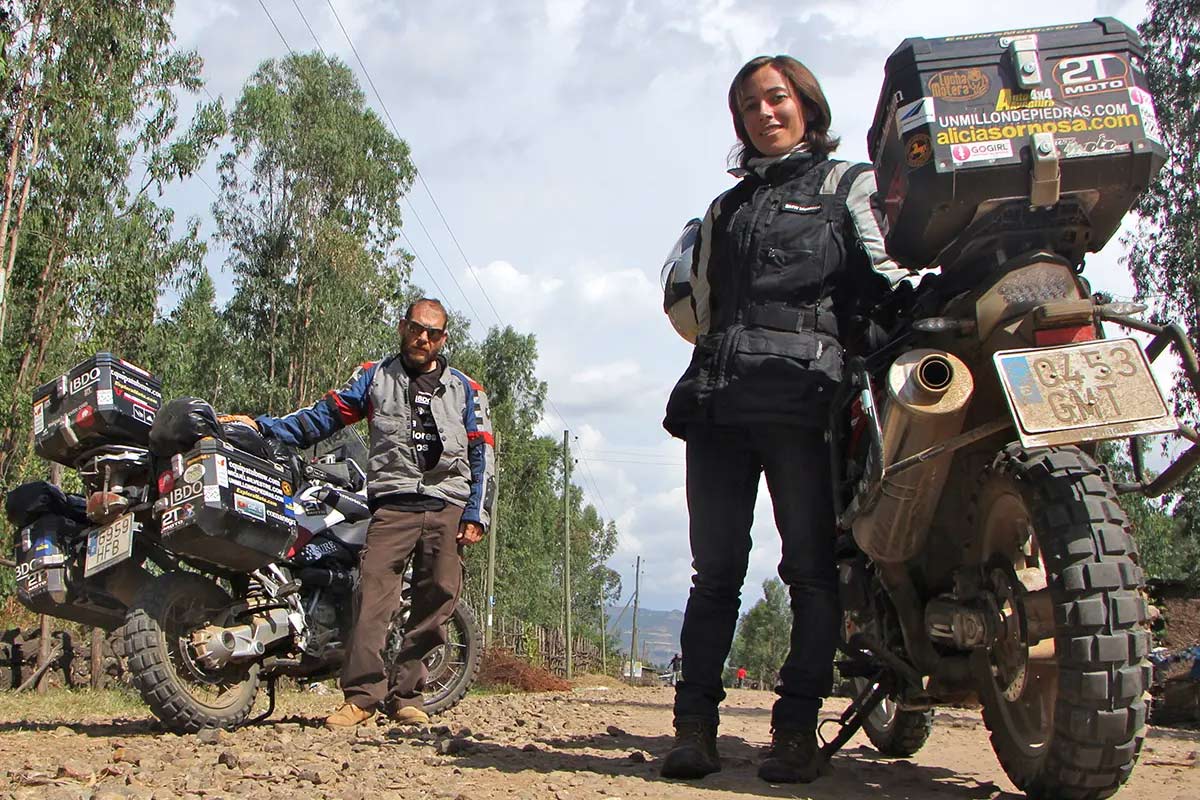
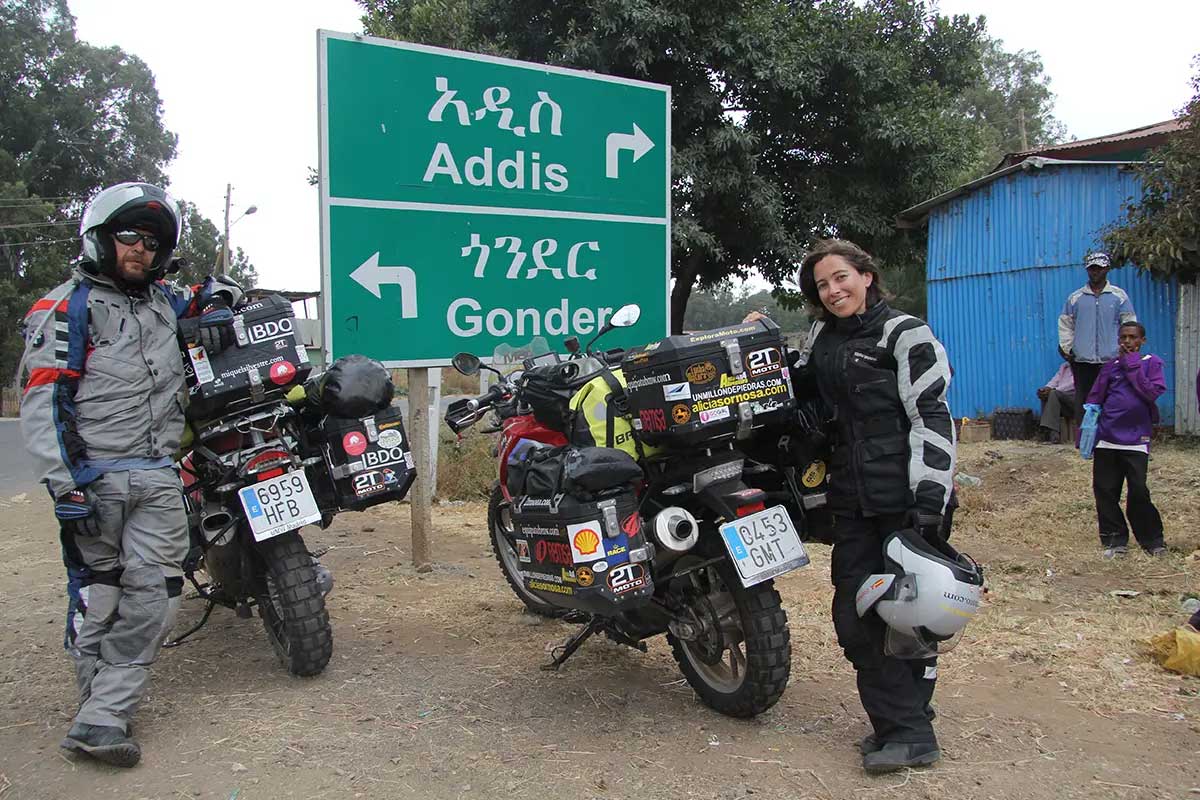 Miquel Silvestre and Alicia Sornosa at a crossroads.
The Falls
Susinios provided Páez the opportunity to visit the sources of the Blue Nile south of Lake Tana, in the Sahala mountains, close by the waterfalls of “the water that smokes,” located 30 kilometers down a dirt road from the pleasant lakeside city of Bahir Dar. An event that took place on April 21st, 1618.
“And I confess I was glad to see what the former King Cyrus and his son Cambyses, the famous Alexander the Great, and Julius Caesar wanted to see.” He wrote in his book History of Ethiopia.
Although the flood has subsided due to a power plant and is not as spectacular as before, I confess that I am also glad to see what Páez saw, one of the Spanish men with whom history has been unfair.
Gorgora
The road becomes gravel for fifty miles. A large cloud sits on the horizon. Soon it starts to turn a shade of grayish lead, pregnant with rain. Then it starts pouring. The ground becomes a slippery skating rink. However, impossible to relent. No more shelter for me than the huts of peasants.
I take the muddy path, go through another village full of animals, children and curious eyes, I climb a hill and then I see it. In the background, brown and rough, Lake Tana. A long straight line leads to Gorgora, a village of just a hundred mud houses.
Shortly afterwards another signal, “Tim and Kim camping.” After a left turn, paradise arises. Before me appear a few small conical lodges with thatched roofs. A young European man with long curly hair greets me with a smile. It’s Kim, the wandering Dutchman, that governs this simple overlanders’ complex.
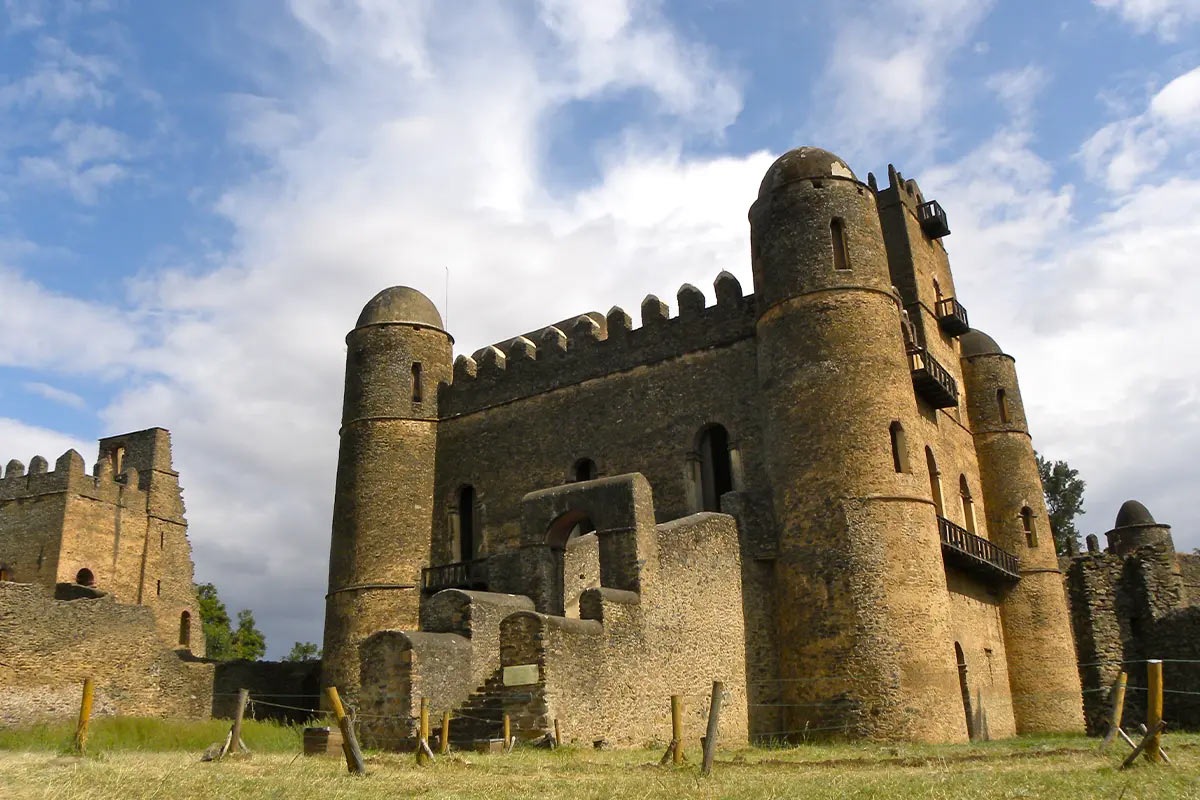 Castillo Gondar: A Susinios Emperor castle in the Medieval capital of Ethiopia, Gondar.
Susinios’ Conversion
During dinner we drink beer. I tell him that I am looking for the Spanish “discoverer” of the Blue Nile source.
“Ah, Pedro Páez,” says Tim.
I look at my host with surprise. “Do you know about him?”
“Yes,” he nods. “I love the history of Ethiopia.”
As the darkness surrounds us, mosquitoes buzz obsessively and unforgivingly.
“Did you know that Páez converted the Emperor Susinios to Catholicism?” Tim nods.
This conversion had much to do with politics. Susinios had a tremendous enemy: Islam. The Portuguese were a great ally, but they assisted him in exchange for admitting the Jesuits into the territory.
After the official conversion of the emperor to the foreign faith, a civil war began which resulted in the deaths of tens of thousands of peasants. Fasilides returned to orthodoxy and expelled the Portuguese settlers. It was the end of Catholicism in Ethiopia.
“But at least there was the palace that Páez designed for Susinios,” I say with a worried tone in my voice. For me it is vital to visit it. Páez came several times to Gorgora to supervise the construction of the complex. Each trip should have been a big effort for a man who was almost sixty years. On his last visit he got sick. On May 25th, 1622, Páez died and was buried there.
“It’s a ruin covered by bushes. You must go by boat. The road is impassable. I have never managed to get over there in my 4x4.” says Tim.
The Tomb of Páez
The next day I go out in search of the Palace of Susinios. The first hurdle announced in the sketch drawn by Tim is the fallen bridge. I ford a stream whose channel is filled with large stones. The rocks are sharp and loose and will be a constant anguish. The rocks come from the old road. It’s like a giant plow had scraped its metal down the middle of the road, leaving the stones in the worst possible position. Sometimes there is only a very narrow path by which a person can barely pass a cow, donkey or a pair of goats.
I accelerate; putting the wheels into the furrows, flying over the edges. In these compromising moments I really appreciate having provided myself with a set of custom-made Dutch TFX shock absorbers. They have reservoirs of oil for the front and rear, and do not reach their limit, not even once.
The recovery is amazing for such a heavy saddle. As for the grip, I ride on Continental TKC 80s. The best on the market. With both upgrades I never fear a fall. The bike is reinforced with all types of defenses by the German manufacturer SW Motech.
After reaching a plateau, I admire the stunning views. The lake is about 10 kilometers away in a succession of rolling hills, lush in fields, forests and farms. At the end stands a mountain on a small peninsula. Farmers and cows roam this idyllic horizon. Over my head fly predatory birds, the true lords of the skies in Ethiopia.
As I begin the final ascent I cannot recall riding a path this tiny through the bushes. I nail my boots to the footrests, stand on the bike, look up, grit my teeth and accelerate. The jungle swallows us. The characters that appear in front of us greet us but do not beg. Not many whites make it this far. So isolated, the people here are guardians of a treasure whose value they do not know.
I find the skeleton of the palace and the remains of a tower. All around lie scattered stones that formed the walls of the church. The peasants have used them to build their homes. There is not even a single latticed Portuguese arch left.
Nothing remains of the Jesuits. Ironically the Englishman known as Speke has a plaque on Lake Victoria in Uganda as the discoverer of the sources of the White Nile. Whereas Páez owns a black hole in a remote location. How different are the nations in the treatment of their children.
However, sniffing the pregnant and peppermint forest aroma, and contemplating this amazing landscape, brings to my memory the outrageous circus of tourists around the castle of Gondar. Perhaps this perfect solitude is the best tribute to a great man named Pedro Páez.
ENTRY REQUIREMENTS
- Visa obtained at the embassy—$ 20
- Carne du Passage issued by the RACE
CURRENCY
- 1 Euro = 23 Birr
TYPICAL FOOD
- Injera and tibs: acid-flat bread and spicy meat to pour over the bread
WHERE TO SLEEP
- Gondar: Hotel Ghoa. Good views over the city, clean Internet. 50 Euros.
- Bahir Dar. Ghion Hotel. 15 Euros. A little decrepit but centrally and conveniently located on the shores of Lake Tana.
- Gorgora: Camping Tim & Kim. Lodges without running water. 15 Euros. Idyllic situation. Environment travelers.
Miquel Silvestre (miquelsilvestre.com) is a Spanish writer and motorcycle world traveller. So far, he has ridden across more than 80 countries and is currently planning a multi-year adventure following the route of former Spanish explorers for a project called Ruta de los Exploradores Olvidados— The Forgotten Explorers Route ( www.unmillondepiedras.com). Along with BMW Motorrad Spain, Miquel Silvestre is looking to resurrect the memories of many lesser-known explorers— retracing the humble human stories of these great men.