 Sticky logo
 Search


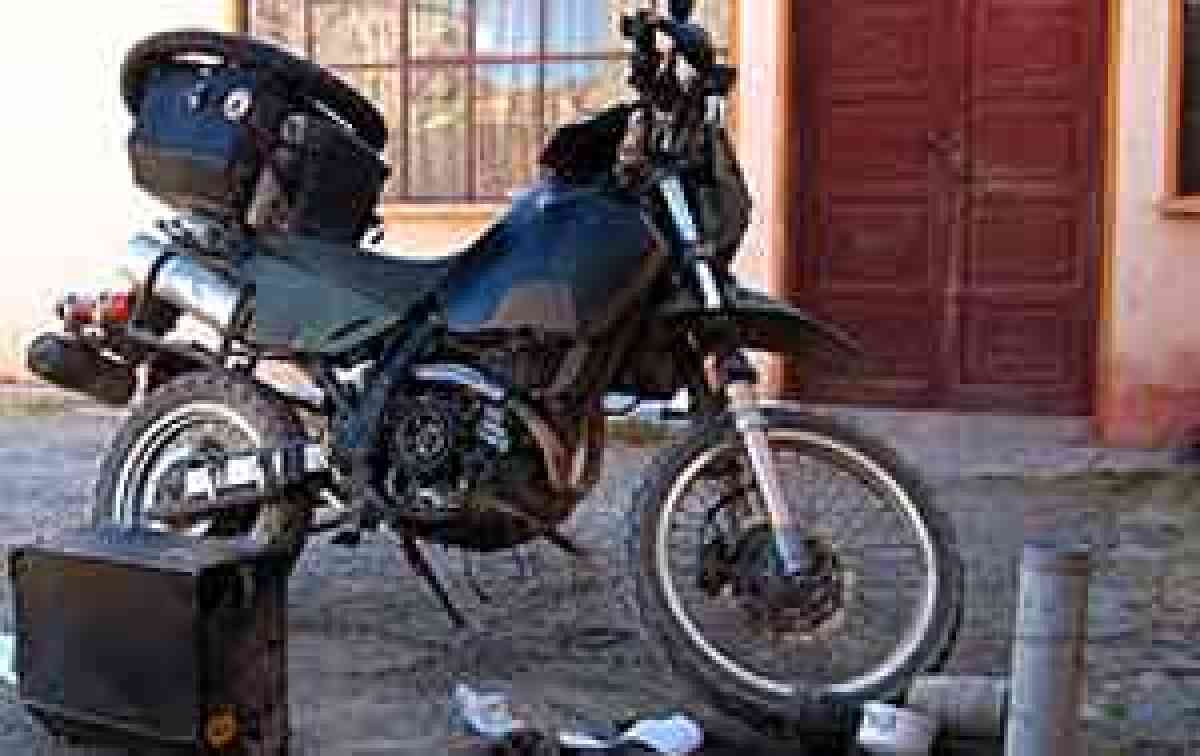
It was late afternoon and time to think about shelter. Passing locals told me that this road was rife with banditry at night as cartels smuggled in old Toyotas from the porous border with Chile. I removed the panniers and started pushing my sturdy lady up the hill to the village of Quillacas. I could only move a few feet at this altitude before becoming completely out of breath. The sun was setting and I felt the chill settling in, but it was actually rewarding for my sweat. I started to drain the fuel tank in hopes of lightening the load, but the trickle was no match for my remaining nine gallons. As other riders often do, I talked openly to my bike telling her that I would get her up this hill even if it took all night.
As chance would have it, a local Quechua family was returning to the village after a day of herding llamas on the Altiplano, and they offered to help me. Their adult daughter was a strong woman who helped push sanDRina up the hill. The father took my panniers on his bicycle and we made it to the village in half an hour! Then they took me even further up the hill to the mission of Santuario de Quillacas, refusing any kind of payment for their assistance. I’ve seen this happen throughout my travels and it reinforces my faith in the compassion of Homo sapiens, whatever our cultural and geographic differences may be.
I was delighted to find a safe place for sanDRina and they had a bed with warm blankets for me for 20 Bolivianos ($2.90)—feeding me for another ten. During dinner I noticed their phone and asked if I could make a call to the United States. Who would I call in a situation like this? None other than my mechanic mentor, Gus Gans, in the southern suburbs of Chicago. He rebuilt my engine and suspension before I left and taught me through the whole process. Gus told me that I had to cut some metal discs and put them in the clutch stack to increase the compression. That $5 phone call was all I needed.
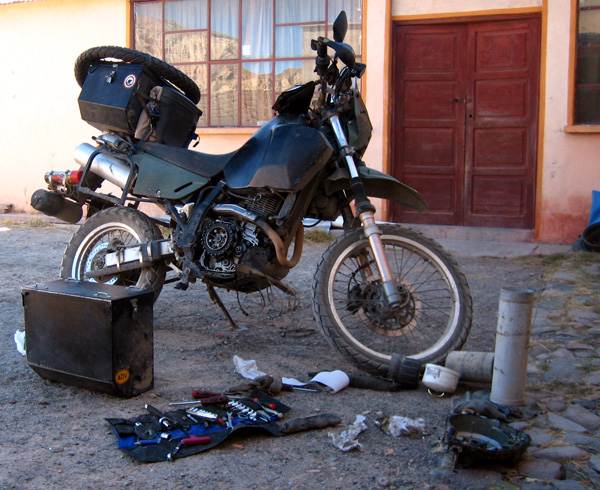
Gus said to use old coffee cans for the metal, but there wasn’t anything appropriate at the mission or in the village. The next morning, I put the ruined disc back in and decided to make the push back to Oruro. With the washers in place, I could now go 25 mph, so grateful for the relatively easy riding on the flatlands of the Altiplano. It took me the whole day to cover the 100 miles to Oruro, arriving just as shops were shutting down. Despite that, it was fantastic to be back in civilization, and come early morning I was at the mechanic’s to help restore sanDRina. Fernando, the shop owner, found some sheet metal and tin snips to sue. I traced the fiber disc and meticulously cut two steel discs and was ecstatic when sanDRina’s clutch gripped and went faster than 25 mph—all the way through the gears to 60!
Once again, I was ready and willing to pay Fernando whatever he asked but he refused payment and said he was happy to help a traveler. I am truly humbled on this journey for all the help that I’ve received.
With spirits rolling in the right direction, I headed out on the highway and rode the last 140 miles back to La Paz and the comfort of Alfonso’s home. There we managed to find a few replacement clutch discs from a Kawasaki KLX650 that had similar dimensions, and I was now set to continue north to cross the TransAmazonica of Brazil.
I didn’t get to ride on the Salar de Uyuni that time around, but was lucky enough to have the opportunity to return to Bolivia in a few months’ time, and I did indeed complete that journey on the Salar. I stood on the pegs, cruised at 70 mph and shut my eyes, sensing the flatness of the white earth under me and the expanse of the blue sky above. sanDRina and me… we lived the dream.