 Sticky logo
 Search



One of the Medieval myths that has been thriving in Africa is the story of the kingdom of Prester John. For centuries, they searched beyond the Sahara for a legendary and rich land, as mysterious as El Dorado, that would be governed by this Christian prince.
“They” were the European explorers, from the eleventh to the sixteenth centuries, pursued a dream that slowly became a reality with the development of geographical tools. A dream that lasted until Bartolomeu Dias rounded the Cape of Storms in 1488, opening the African route to the East Indies. The same route that, ten years later, Basque de Gama would travel. When the Portuguese explored the east coast of Africa they discovered the empire of the Negus, who ruled a Christian nation surrounded by Muslims: Ethiopia.
Question of Priorities
The only open border from Sudan into Ethiopia is Metema/Galabat. At the immigration office they check my visa, take my photo and record my fingerprints with a scanner. Finally, the questions of profession and an address in Ethiopia... as if I never know where I’ll stay. I use the tactic that I explained in my first travel book through Africa, A Million Stones. In any hole, no matter how filthy, there’s always a Grand Hotel. So I say: Grand Hotel in Addis Ababa.
The exchange office is filled with planks. The clerk has a large cross hanging around his neck. Many women have the cross tattooed on their foreheads. Religion is omnipresent. Christianity came in the fourth century by Syrian missionaries, occurring during the kingdom of Aksum. It was an era of great splendor that would extend from 400 BC to the seventh century, when the Arabs began their military expansion. With the rise of this new hegemonic power in the region, Ethiopia was isolated from Christianity.
The exchange trader opens the lock of the drawer and takes out the wad of bills more worn-out and dirty than I’ve ever seen. I need to make an urgent purchase. A refrigerator door is opened and at the bottom the treasure glitters. Bottles of beer! Fifteen days of abstinence in Islamic Sudan will come to end. Dashen, the cheapest, costs 10 birr. A half liter of water costs 10 birr also. The choice is clear. I buy two bottles of beer and leave the water for another time.
Cat Children
The bright green mountains are divided into grids of labor. Corn over here, barley over there and beyond onions and bell peppers. These highlands are fertile. However, not everything that glitters is gold. Ethiopia has suffered a crippling deforestation to feed its growing population of over 75 million people. Eucalyptus trees abound. They grow fast, give a lot of wood but impoverish the soil.
Everyone is forced to share the road with donkeys, cows and goats. The twisty road passes through dozens of villages. The houses are built with thatched roofs and wooden frames over which mud is crushed to form walls. There are people everywhere. Children run behind the biker purring “yuiyuiyui” (“yui” means “foreigner”). Everyone in here spreads out their hands asking for money. Some of them are also skillful rock slingers.
Gondar
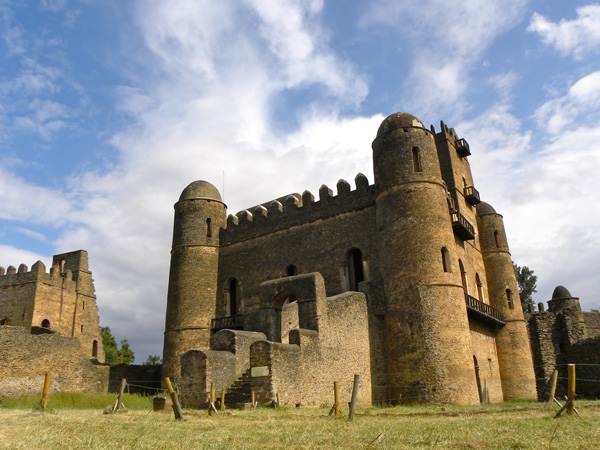
Gondar is known as the African Camelot. Downtown one is assaulted by the typical opportunist guides that offer to visit the busy Fasilides’ Castle, who made this city the capital in the 17th century. Fasilides was the son of Susinios, the emperor friend of the Jesuit Pedro Páez from Madrid (Olmeda de las Cebollas, 1564), my forgotten explorer of East Africa.
Páez was sent from Goa along with another priest; his journey was not easy. Disguised as Armenian merchants, their ship was boarded by Yemenis pirates. He was taken prisoner and forced to walk, tied to a horse’s ponytail, the immense desert of Yemen, where Páez spent six years enslaved before being rescued. After returning to Goa, he was finally able to step into Ethiopia in 1604.