 Sticky logo
 Search


Ship of Horror
Sudan is the great unknown. Until recently it was the largest country in Africa, with two million square kilometers and more than 40 million people. The recent secession of Southern Sudan has reduced these figures, but it has not diminished the overwhelming sensation of crossing a border once the traveler steps off of the ferry that weekly connects the Egyptian city of Asuan with Wadi Halfa.
But first we must embark. Passengers immediately scurry to find places on the deck or in the lounge. There are hundreds who try to enter all at once with all their impediments… the old, young, suitcases, boxes, bags, carpets, bicycles… screaming, sweating, pushing, cursing and just two latrines for 700 people for 20 hours of sailing ahead of us. As a surreal picture it may seem terrible, but this is Africa and not a postcard.
That night we went to the ship’s bridge. The navigation was calm and above us the clearest view of the Milky Way I’d ever seen—amazing in its purity. Just watching the African sky gives me reason to do what I do. In the face of such immensity everything else fades—even the water that floods from the ship’s filthy toilets into the Nile seems only a little out of place.
Wadi Halfa, Black Hole
The motorcycles traveled on a boat whose engine failed. We had to wait indefinitely in Wadi Halfa, a dead place where there is nothing to do but drink tea. This village did not revive until dusk, when a lively crowd came from who knows where to sit on plastic chairs and watch TV. We ate whatever there was: chicken or lamb… but not one damn beer. In Sudan, the alcohol prohibition prevails.
The Nile, Fertile Wound in the Absolute Emptiness
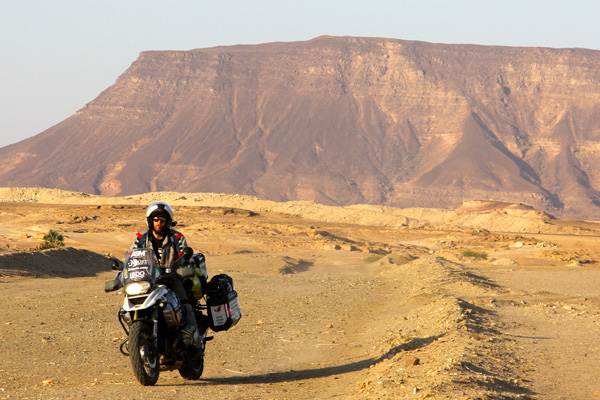
The bikes arrived after five days of anxiety. Finally on the road, the desert receives us with horizons infinite and burning. The temperature was over forty degrees Celsius. The asphalt reverberates. Pedestrians are scarce. The people of this arid land seem consumed in its darkness. Thin and fibrous, they dissolve within the white cloth of their djellabas. It seems as if resisting the sun any longer would turn them into ashes and nothing else will remain than their long and billowing garments.
The route runs parallel to the Nile. Over here, the Nile River is a miracle come true, a green gap in the vast wasteland. Palm trees sprout cheerfully throughout and the Sudanese are crowded into this little fertile land of simple adobe houses. The view is very beautiful, primitive, poor and terrible… but real. As real as thousands of years ago when this territory was the site of the legendary kingdom of Nubia mentioned in the Bible as Kush.
The Kingdom of Nubia and the Gold of the Desert
Located between the first and sixth of the Nile’s waterfalls, its relationship with Egypt has always been close and so often conflicting. The Pharaohs conquered Nubia at various points in history, although the Nubians retaliated conquering Egypt during their 25th dynasty. There were several Nubian pharaohs and Nubian elite troops at the service of the Egyptians. By the middle of the New Kingdom it was difficult to distinguish one culture from another, inextricably mixed.
Nubia was the principal source of gold in Egypt. Even today the search goes on for treasure in open pit mines. We spotted them on both sides of the road. A huge plastic camp welcomes a crowd of miners who splash around in puddles. They watch us in amazement. They don’t know who we are or what we do. This is not a path for tourists, rather one for the shabby pick-up trucks that carry them from one place to another in this forgotten slum.
Old Dongola
Nubia disappeared in 350 AD with the invasion of an Ethiopian king. Three small kingdoms emerged. To the north, Nobatia between the first and second waterfall; south of the sixth, Alodia; and in the middle, Makuria, with its capital at Dongola, that from the seventh century was the dominant power in the region with sufficient force to resist the invader Arabs who conquered Egypt. Following the signing of a treaty, Nobatia and Makuria maintained its independence and Christian religion until the fourteenth century. However, Islamization was unstoppable, first by the merchants and then the warriors. The Mamluks of Egypt invaded the region and the mysterious realm of Makuria disappeared swallowed by history and sand, leaving only a trace of the gutted ruins of an adobe church.
Sand swallows everything as soon as one exits the road. I want to visit old Dongola but it’s like diving into an ocean of ground quartz. I managed quite well, despite carrying so much, thanks to the TKC 80 tires and TFX suspension custom made to my specs in the Netherlands, but Alicia suffers a lot. She rows, sweats, and advances at turtle speed but she does not quit. Her self-pride forces her on despite the suffocating heat. The police showed up as we reach the village and take us to the police station to explain our plans and who we are. The officer in charge shows us his bare fingers under the table. That gesture is enough for us to understand if wish to visit the ruins we must pay fifty pounds.
The trail towards the fortress is steep, a mountain of crumbly material that will trap the heavy BMW, although I still accelerate. The dust may stop me, not my lack of will. When the bike’s wheels run aground, I get off and continue on foot until reaching the top where an old medieval fortress stands. In the distance, the endless desert, ocher, terrible and eternal. At the other side, the river bed full of life. Under my feet, Makuria’s history… I made it! Another goal accomplished… dominating another bunch of nothing that, in the end, will only matter to me.
The Pyramids of Meroe
The Nubian pharaohs were moving their capital to the south as invading forces came from the north. In 800 BC, pressed by the Assyrians, the kingdom of Kush moved to Meroe just 230 kms from the Khartoum of today. There they fortified themselves. Strabo mentioned in his writings the victory of the Nubians’ archers in the battle of Meroe over the Roman legionaries. Although they kept many customs inherited from Egypt, they had their own achievements such as a written alphabet, which eventually resulted in the abandonment of the primitive hieroglyphics. Today one can visit their sharp pyramids which cannot compete in magnificence with their Egyptian counterpart, but wins in being undoubtedly more desolate. There’s nobody here but us… and the ubiquitous dust.
The Confluence of the Niles
Khartoum is a city of five million people founded on the confluence of the White Nile born in Uganda and the Blue Nile that rises from Ethiopia, whose fountains were discovered in the seventeenth century by the forgotten explorer Pedro Páez. We are greeted by the popular neighborhood of Ondurman. Here is where the poor live and where Ahmed Mohammed is buried—the one who self-proclaimed Mahdi. His followers defeated the troops of the British governor Gordon in one of the most ignominious battles ever suffered by His Majesty’s army. The Mahdist’s revolutionary ruled in Sudan until 1898, when Lord Kitchener finally defeated them and Sudan became a British colony.
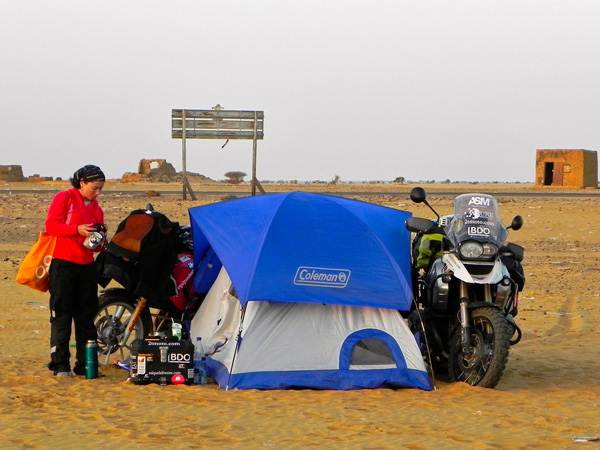
Khartoum does not offer much. It’s just a crossroads, a place to cross on our way through, but where we must provide ourselves with Ethiopian visas in order to get to Lake Tana. We spent a couple of days in the National Camp Resort camping. The price is cheap: just 5£ per person. The only problem is finding a decent place to camp that will give us shade, a valuable commodity here in Sudan, for as long as possible.
When we finally set up our tents in the greenest part of the garden, in came one of the guys that was just hanging around doing nothing when we arrived. He tells us that we cannot camp here because we’re in front of the mosque; that white travelers stay away, at the very end, where the sun does furious justice with all their Western sins. I suspect that some fundamentalist has gone to complain to the administration about our improvised accommodations. I refuse to move. I decide to use the same tactic they use among them to resolve any problem or objection.
“Ok,” I say, smiling. “Tomorrow.”
“Tomorrow in the morning?” Asks the censor.
I agree slapping him on the shoulder. “Tomorrow morning we will move, I promise. And if tomorrow we have not moved, do not worry, because I will then tell you that we will leave again the next day.” In Africa there is always tomorrow to turn to.
PRACTICAL INFORMATION
Entering
Mandatory visa requirement. In the Sudanese Embassy of Cairo it can be obtained by paying $100USD. You must register with the police within three days. It costs 115 Sudanese pounds but be prepared for quite a long time waiting.
For the bike
You’ll need a Carne du Passage issued by RACE.
Currency
Credit cards don’t work. The Queen’s currency is the dollar. The Sudanese pound has an official exchange rate of 1 to 2.7. In the black market they pay between 3, 6 and 3.9. You get a better rate by exchanging higher bills. Bills with any damage are not accepted.
Sleeping and eating
Except in Khartoum, where hotels that are worthy are expensive. For something more reasonable you’ll want to use a guesthouse (“Lokanda”). Most have shared bathrooms consisting of a Turkish plate, on which there is a shower head that discharges water sometimes. It is common that before handing you the keys they will require police permission for housing.
The best advice for overlanders is free mode camping. However some recommendations are:
• Wadi Halfa: Hotel Kilopatra. 40£ double room
• Dongola: Lord Hotel. 35£ the only room with bathroom
• Khartoum: National Camp Resort camping
Eating
In the coastal communities, fish of the Nile. Inland communities: lamb and falafel.