 Sticky logo
 Search


Ship of Horror
Sudan is the great unknown. Until recently it was the largest country in Africa, with two million square kilometers and more than 40 million people. The recent secession of Southern Sudan has reduced these figures, but it has not diminished the overwhelming sensation of crossing a border once the traveler steps off of the ferry that weekly connects the Egyptian city of Asuan with Wadi Halfa.
But first we must embark. Passengers immediately scurry to find places on the deck or in the lounge. There are hundreds who try to enter all at once with all their impediments… the old, young, suitcases, boxes, bags, carpets, bicycles… screaming, sweating, pushing, cursing and just two latrines for 700 people for 20 hours of sailing ahead of us. As a surreal picture it may seem terrible, but this is Africa and not a postcard.
That night we went to the ship’s bridge. The navigation was calm and above us the clearest view of the Milky Way I’d ever seen—amazing in its purity. Just watching the African sky gives me reason to do what I do. In the face of such immensity everything else fades—even the water that floods from the ship’s filthy toilets into the Nile seems only a little out of place.
Wadi Halfa, Black Hole
The motorcycles traveled on a boat whose engine failed. We had to wait indefinitely in Wadi Halfa, a dead place where there is nothing to do but drink tea. This village did not revive until dusk, when a lively crowd came from who knows where to sit on plastic chairs and watch TV. We ate whatever there was: chicken or lamb… but not one damn beer. In Sudan, the alcohol prohibition prevails.
The Nile, Fertile Wound in the Absolute Emptiness
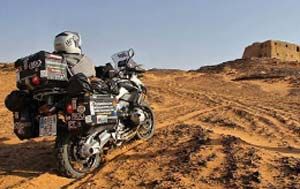
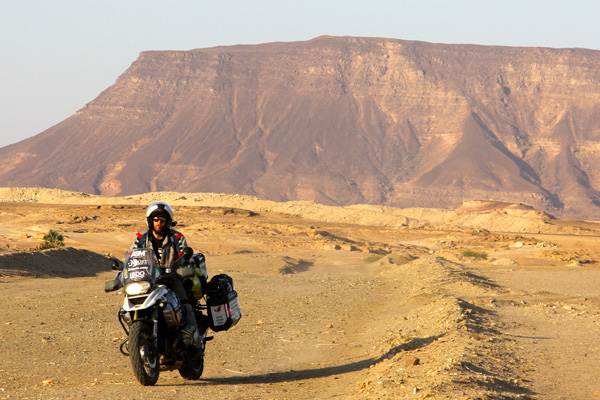
The bikes arrived after five days of anxiety. Finally on the road, the desert receives us with horizons infinite and burning. The temperature was over forty degrees Celsius. The asphalt reverberates. Pedestrians are scarce. The people of this arid land seem consumed in its darkness. Thin and fibrous, they dissolve within the white cloth of their djellabas. It seems as if resisting the sun any longer would turn them into ashes and nothing else will remain than their long and billowing garments.
The route runs parallel to the Nile. Over here, the Nile River is a miracle come true, a green gap in the vast wasteland. Palm trees sprout cheerfully throughout and the Sudanese are crowded into this little fertile land of simple adobe houses. The view is very beautiful, primitive, poor and terrible… but real. As real as thousands of years ago when this territory was the site of the legendary kingdom of Nubia mentioned in the Bible as Kush.
The Kingdom of Nubia and the Gold of the Desert
Located between the first and sixth of the Nile’s waterfalls, its relationship with Egypt has always been close and so often conflicting. The Pharaohs conquered Nubia at various points in history, although the Nubians retaliated conquering Egypt during their 25th dynasty. There were several Nubian pharaohs and Nubian elite troops at the service of the Egyptians. By the middle of the New Kingdom it was difficult to distinguish one culture from another, inextricably mixed.
Nubia was the principal source of gold in Egypt. Even today the search goes on for treasure in open pit mines. We spotted them on both sides of the road. A huge plastic camp welcomes a crowd of miners who splash around in puddles. They watch us in amazement. They don’t know who we are or what we do. This is not a path for tourists, rather one for the shabby pick-up trucks that carry them from one place to another in this forgotten slum.