 Sticky logo
 Search


Old Dongola
Nubia disappeared in 350 AD with the invasion of an Ethiopian king. Three small kingdoms emerged. To the north, Nobatia between the first and second waterfall; south of the sixth, Alodia; and in the middle, Makuria, with its capital at Dongola, that from the seventh century was the dominant power in the region with sufficient force to resist the invader Arabs who conquered Egypt. Following the signing of a treaty, Nobatia and Makuria maintained its independence and Christian religion until the fourteenth century. However, Islamization was unstoppable, first by the merchants and then the warriors. The Mamluks of Egypt invaded the region and the mysterious realm of Makuria disappeared swallowed by history and sand, leaving only a trace of the gutted ruins of an adobe church.
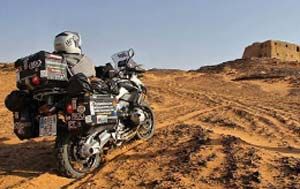
Sand swallows everything as soon as one exits the road. I want to visit old Dongola but it’s like diving into an ocean of ground quartz. I managed quite well, despite carrying so much, thanks to the TKC 80 tires and TFX suspension custom made to my specs in the Netherlands, but Alicia suffers a lot. She rows, sweats, and advances at turtle speed but she does not quit. Her self-pride forces her on despite the suffocating heat. The police showed up as we reach the village and take us to the police station to explain our plans and who we are. The officer in charge shows us his bare fingers under the table. That gesture is enough for us to understand if wish to visit the ruins we must pay fifty pounds.
The trail towards the fortress is steep, a mountain of crumbly material that will trap the heavy BMW, although I still accelerate. The dust may stop me, not my lack of will. When the bike’s wheels run aground, I get off and continue on foot until reaching the top where an old medieval fortress stands. In the distance, the endless desert, ocher, terrible and eternal. At the other side, the river bed full of life. Under my feet, Makuria’s history… I made it! Another goal accomplished… dominating another bunch of nothing that, in the end, will only matter to me.
The Pyramids of Meroe
The Nubian pharaohs were moving their capital to the south as invading forces came from the north. In 800 BC, pressed by the Assyrians, the kingdom of Kush moved to Meroe just 230 kms from the Khartoum of today. There they fortified themselves. Strabo mentioned in his writings the victory of the Nubians’ archers in the battle of Meroe over the Roman legionaries. Although they kept many customs inherited from Egypt, they had their own achievements such as a written alphabet, which eventually resulted in the abandonment of the primitive hieroglyphics. Today one can visit their sharp pyramids which cannot compete in magnificence with their Egyptian counterpart, but wins in being undoubtedly more desolate. There’s nobody here but us… and the ubiquitous dust.
The Confluence of the Niles
Khartoum is a city of five million people founded on the confluence of the White Nile born in Uganda and the Blue Nile that rises from Ethiopia, whose fountains were discovered in the seventeenth century by the forgotten explorer Pedro Páez. We are greeted by the popular neighborhood of Ondurman. Here is where the poor live and where Ahmed Mohammed is buried—the one who self-proclaimed Mahdi. His followers defeated the troops of the British governor Gordon in one of the most ignominious battles ever suffered by His Majesty’s army. The Mahdist’s revolutionary ruled in Sudan until 1898, when Lord Kitchener finally defeated them and Sudan became a British colony.
Khartoum does not offer much. It’s just a crossroads, a place to cross on our way through, but where we must provide ourselves with Ethiopian visas in order to get to Lake Tana. We spent a couple of days in the National Camp Resort camping. The price is cheap: just 5£ per person. The only problem is finding a decent place to camp that will give us shade, a valuable commodity here in Sudan, for as long as possible.