 Sticky logo
 Search


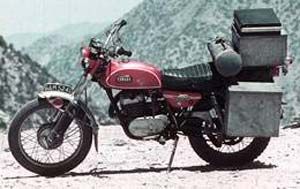
Each issue of ADVMoto starts me reminiscing about a 1971 motorcycle trip from Singapore-to-Holland. Seeing all the ads for modern bikes and gear got me thinking about the differences in gear, and trip planning from “way back then” to the present day.
1969 found me selling a Yamaha “Big Bear Scrambler” in the U.S., and heading off for a job in New Zealand. There I bought a surplus police bike, a Triumph Trophy (650 twin with single carburetor). One day a friend came back from a ride on his Triumph Daytona and muttered something along the lines of “that was great, I could do that all day.” I’d been fantasizing about riding overland to Europe, so in a fit of bravado said, “Well, how about a trip through Asia to Europe?” His reply was, “You’re on!” So began one of the most fun parts of motorcycling—trip planning.
The first issue was money. New Zealand was a wonderful place but wages were low and it was difficult to take money out of the country. So, off to Australia we went to find jobs in the outback where the money was better and there was no place to spend it. Working in the outback also provided plenty of time to think about travel plans and gear—nothing like a couple of Swan Lager’s after a hot day in the Great Sandy Desert to stimulate traveling fantasies.
A big difference between “now and then” is access to information. “Then” the sources of information were occasional articles in motorcycle magazines and travel guidebooks, and there weren’t any guidebooks specific to traveling by motorcycle at all. “Now” there’s the internet, a large selection of books and videos, and ADVMoto, that all provide enough information to boggle the mind. The other huge change is in all of the specialized gear and bikes available. Travel opportunities have changed, too. Some countries that were accessible then are not particularly good for traveling these days—others that weren’t open then are open now. Some don’t even have the same names or borders.
The “overland” route back then, from Australia to Europe, was through Indonesia, Singapore, Malaysia, India, W. Pakistan, Afghanistan, Iran, Turkey, Greece and the former Yugoslavia. And we added in Thailand and Nepal while we were at it. “Way back then” a westerner couldn’t ride through Burma (still can’t), China, the Soviet Union (as it was called then), or the communist countries of Eastern Europe (save Yugoslavia on a short transit visa). But you could comfortably ride through Pakistan (“West Pakistan” at the time), Afghanistan, and Iran. It certainly would be a real adventure for a Yank to travel through those countries now!
From Australia visas were fairly easy to arrange for most of the countries on our route. This was before easily accessible and universally useable credit cards, so traveler’s checks and cash were the only way to carry money. Most of our meager funds were left in an Australian bank to be sent via American Express offices along the route as needed. Also, “Carnet de passage” documents were obtained that allowed us to temporarily import the bikes to each country without having to leave a cash deposit at each border. The carnet is an international guarantee for payment of customs duties if for some reason the bike didn’t make it out of a country—if you sold it, wrecked it, etc.
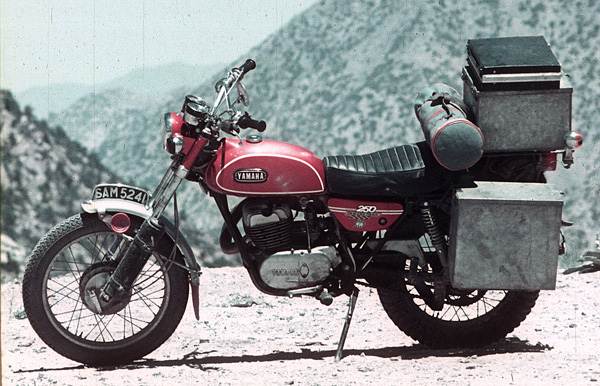
The Motorcycle
“Way back then” there weren’t bikes on the market especially designed for adventure motorcycling like there are now. If you were planning a trip in Europe, and heading east, the most common choice was typically a BMW R60. At least that’s what I saw most folks riding west-to-east on. But, there was the occasional Triumph, Bultaco, and even a Honda CB750. The Honda 4 turned out to not be the best choice—a guy riding one in India told us that his bike wouldn’t run on the local petrol and that forced him to find higher octane aviation gas. Since we were heading east-to-west, the idea of purchasing a bike in Singapore favored the Japanese machines at the time. This was reinforced by talking to Aussies who had made the trip on 125cc and 250cc Yamahas. After much discussion the decision was made to go with the Yamaha DT1, a 250cc two-stroke single. The DT1 was the first of the “Enduro” dual-sport type motorcycles, an improvement on the late ’60s street scramblers which were basically similar, but with high pipes and a skid plate. We reckoned the single-cylinder, two-stroke engine would be easily maintained, need a minimum of spare parts to carry along, and would run well on the low octane fuel we expected to run across from time-to-time. And, they were relatively cheap—about $535 U.S. at the time. But why not choose a street bike? Not knowing what kind of roads we’d encounter it seemed a good choice, but the total reasoning behind the decision is lost in the cobwebs of my deteriorating gray cells. Somehow we got the address of a Yamaha dealer in Singapore (Motorcycle Industries), and arranged to have the DT1s waiting for us.