 Sticky logo
 Search


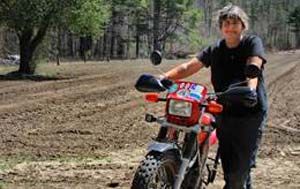
A beautiful and haunting memory of Newfoundland had Molly Nelson dreaming of her return for decades. Hitchhiking there in 1982 left her with the burning desire to explore this breathtaking landscape again, and to match its discovery with an equally immersive mode of transportation. But, what would give her a speed that’s slower than a car to take in the surrounding details, yet faster than on foot to finish the trip within her allotted time frame? Upon hearing that the Trans-Labrador loop was now open, Molly eagerly began planning her enthusiastic return on her transport of choice… a Yamaha TW200.
Molly, now 47, placed her highlighter on the north-eastern portion of a map of Canada to outline the route of a thirty-year-old dream. From her farm in Cornish, Maine, she began drawing a loop to the right through New Brunswick, down through Nova Scotia, across a bridge to Prince Edward Island (PEI), over the Gulf of St. Lawrence by ferry, across Newfoundland to the last ferry to Labrador where she could run the Trans-Labrador Highway, and then back home through Quebec.
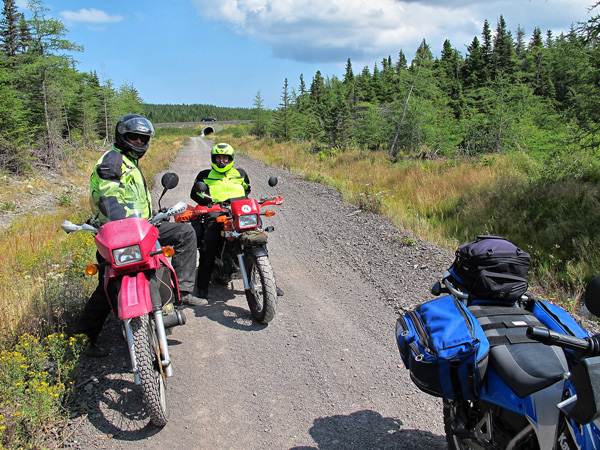
“I could leave from my yard, do a big circle, and come home,” she stated simply. But, drawing a circle on a map is a heck of a lot easier than tackling all this terrain without incident… especially when taking it on solo. The trip started quite smoothly—as Nelson puts it, she was “in the Zen zone.” After a couple days with friends in New Brunswick, she crossed the northern part of the province mostly by gravel roads, plowing through massive puddles across the trail along the way.
“What could be better than having no agenda, just tooling along on the bike at 25 miles an hour for six weeks?” Molly continued, “It was beautiful to just be out there. To take my time setting up camp. To wake up after the moose got off the road. I would start around 9:30 or 10:00 in the morning, and then stop at 4:00 in the afternoon every day to set up a new camp. I did it like that to avoid running into animals that would be more likely to frequent the roads from twilight to just after sun up.”
While in the cities, Molly ditched the tent and stayed with Couchsurfing.org connections. She followed her map across the Confederation Bridge to Prince Edward Island, and traveled by the Wood Islands ferry to reach Nova Scotia where she caught the Argentia ferry to Newfoundland. After reaching the island, she ran the backroads and trails to St. Johns, the island province’s capital city. This proved to be the point on the map where she would meet her fate.
From the beginning, all bets should have been against Nelson’s itinerary. For starters, her August departure date came at the worst possible time of the year for a farmer. She and husband, John, run a 30-acre farm, and late summer is one of their busiest seasons. To make sure Molly could leave at her scheduled time, she worked part-time jobs the two winters before, so that a friend could be hired to step in for her on the farm.
It’s not as if Molly’s bike would be most people’s first choice for a trip like this, either. Yamaha TW200s are small, underpowered, and not known for long-range fuel capacity. But, this bike suited her purpose just fine—and its pokey speed let her take in the sights along the way. “I like to look at everything. That’s why I took a bike instead of a car,” she says.
About the only part of the trip she’d really researched much was the distances between gas stations. She knew from the get-go that she’d need the extra fuel capacity. So, to extend the TW200’s range, a welder friend modified her gas tank, allowing it to carry another gallon. This gave her a range of about 280 miles between refueling stops.
In addition to the tank, a few other farkles were added to her machine to build it out for the longer ride: fog lights, handguards and a custom-welded rack a friend put together for her, allowing for strap-on panniers.