 Sticky logo
 Search


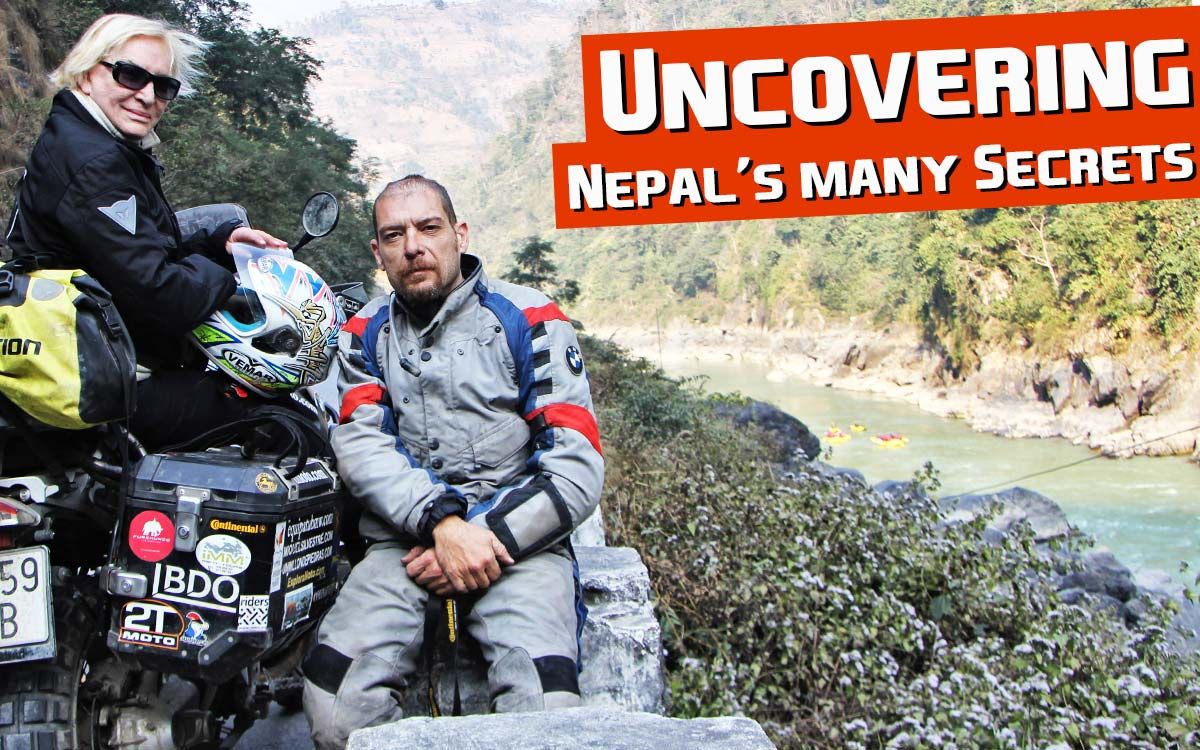
Waking up in a hostel room I go check email on my laptop to find a message from my seventy-four year old mother. Like everything about her, the email was direct and somehow managed to seal my fate, “Son, I see on your world tour blog that you’ve arrived in Nepal. You need good pictures of the Himalayas, so I will take them. I’ll be arriving tomorrow.”
As usual, her decision was final. The email left me somewhat baffled and a prisoner of conflicting emotions. On one hand I was excited to see her, since I’d been gone from Spain for eight months, living with only the little comfort that fits on my motorcycle. But, the idea of touring the challenging Asian high mountain roads with my mother as pillion worried me greatly.
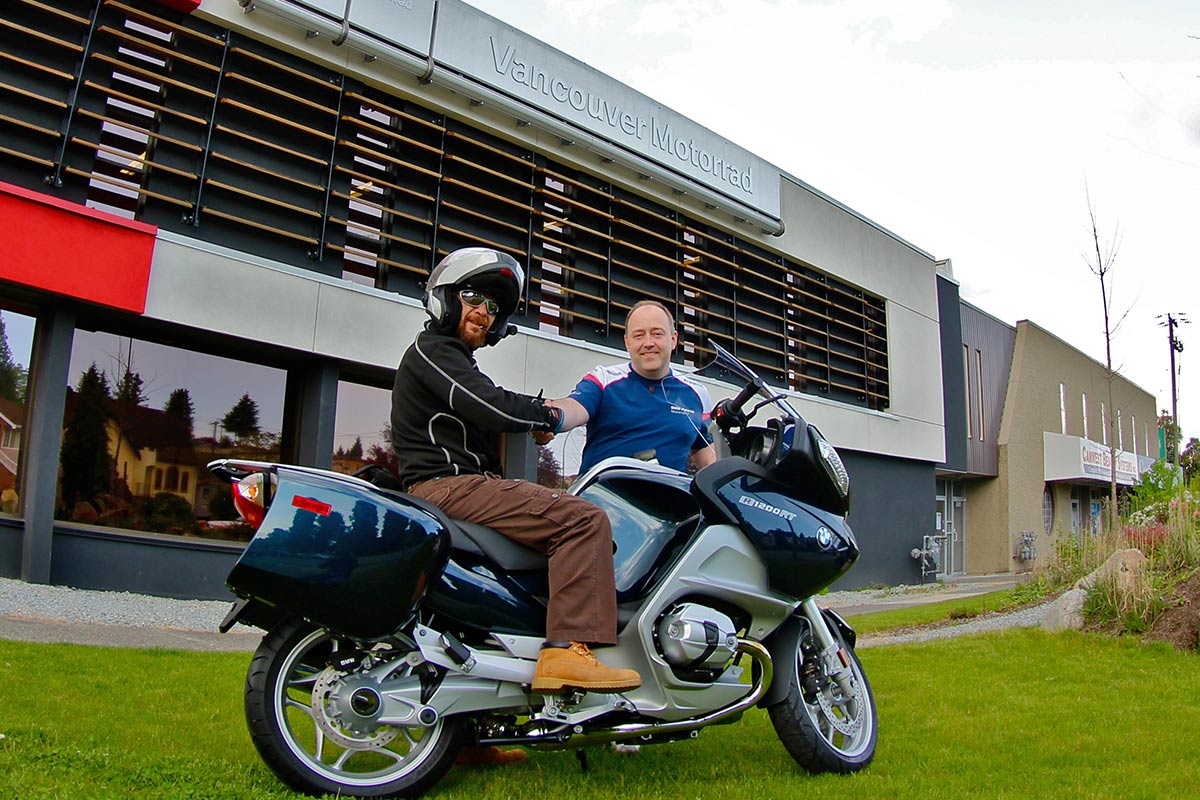 Miquel Silvestre has arrived to Vancouver from the Philippines on his World Tour Trip. As his bike has not arrived, BMW Motorrad Canada is provided him a press bike to keep him on the go. Meanwhile his BMW R1200GS is sailing to America. Thanks to Vancouver Motorrad and BMW Motorrad Canada for their help to our contributor.
The following morning, arriving at the airport to pick her up, I ran into a massive protest march in favor of an independent Sherpa state. Here in Nepal, if there isn’t a strike… or a power failure… or a riot… one can always find a something to interrupt the daily routine.
To make matters worse, after the civil war Nepal became a republic divided between two powers: the elected government and the Maoists.
The funny thing is that the Maoists, today, are also members of the government. And that situation, for some reason, doesn’t seem to hinder the continuation of protests against power outages, or the rising price of gasoline that the government decrees. Nor does it stop the illegal Maoist tolls that one finds on major roadways throughout Nepal.
At the airport, one cannot wait for the passengers to orderly make their way for the exit door. Instead we join the massive pile-up as hundreds jam the way and police do their best to maintain some semblance of order in the beating sun. I watch Westerners being expelled from the aircraft bellies.
A pale Scottish Llama with red robes and an inexpressive face, a group of trekkers, two impeccably dressed executives, a couple of American hippies who came to fetch their parents, and a groom and his mother-in-law who greet each other with a bird’s hug (a hug without warmth, contact or affection).
And then I see my mother. We hold each other in a deep embrace. She has endured over twenty hours of waiting in lines and a cramped aircraft seat, but she still emanates an extraordinary energy.
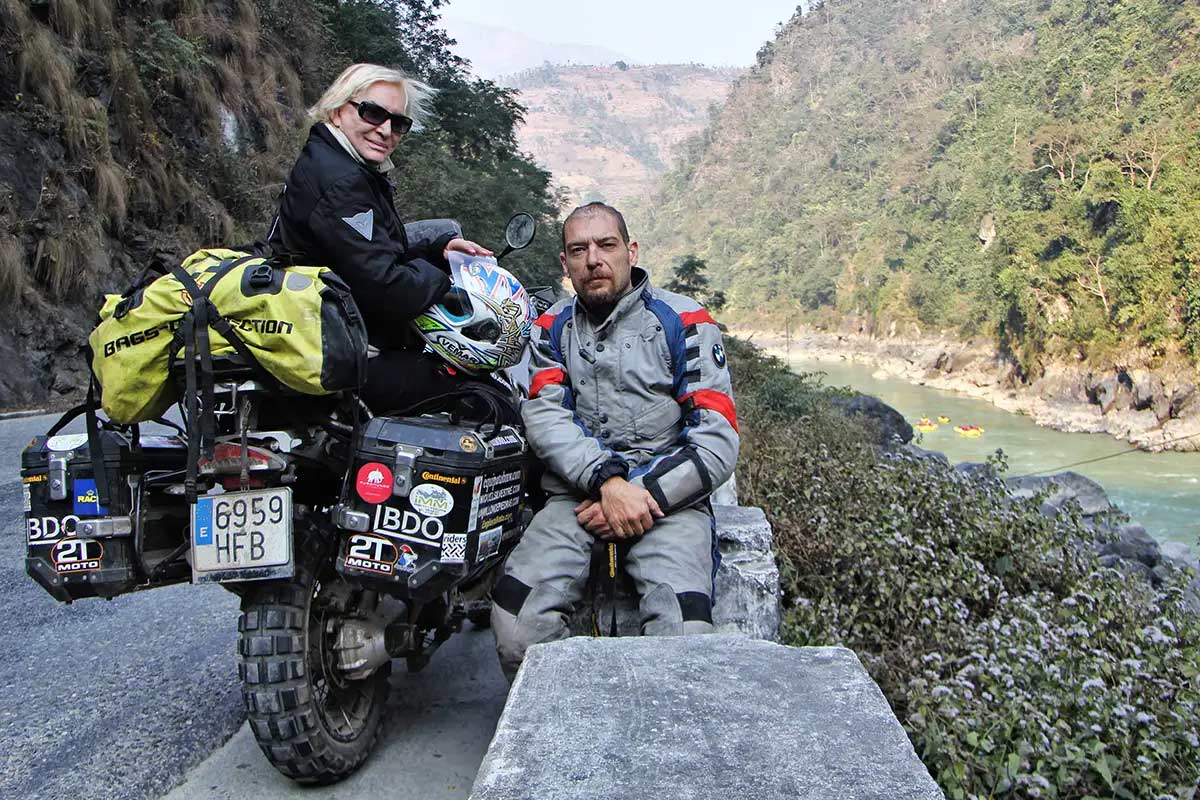
“Where are we going to stay?” She asks as she climbs onto the backseat of Sassy, my BMW 1200GS.
“I’m at a hostel in the city center.” I reply.
“Oh no!” She protests. “You are not going to take me to one of your hole in the walls. I want to go to Dwarika’s. I love that place. And they have the best collection of Nepal’s ancient craft.”
Gosh! The Dwarika’s is the best hotel in the city. It’s like a museum. A place worth visiting just to enjoy the loving care the owners undertook for the restoration of its great national treasures. The problem is the price….
“Aren’t you a travel writer?” She says as if I were being silly. “Tell them you’re going to do a story about them and ask for a discount.”
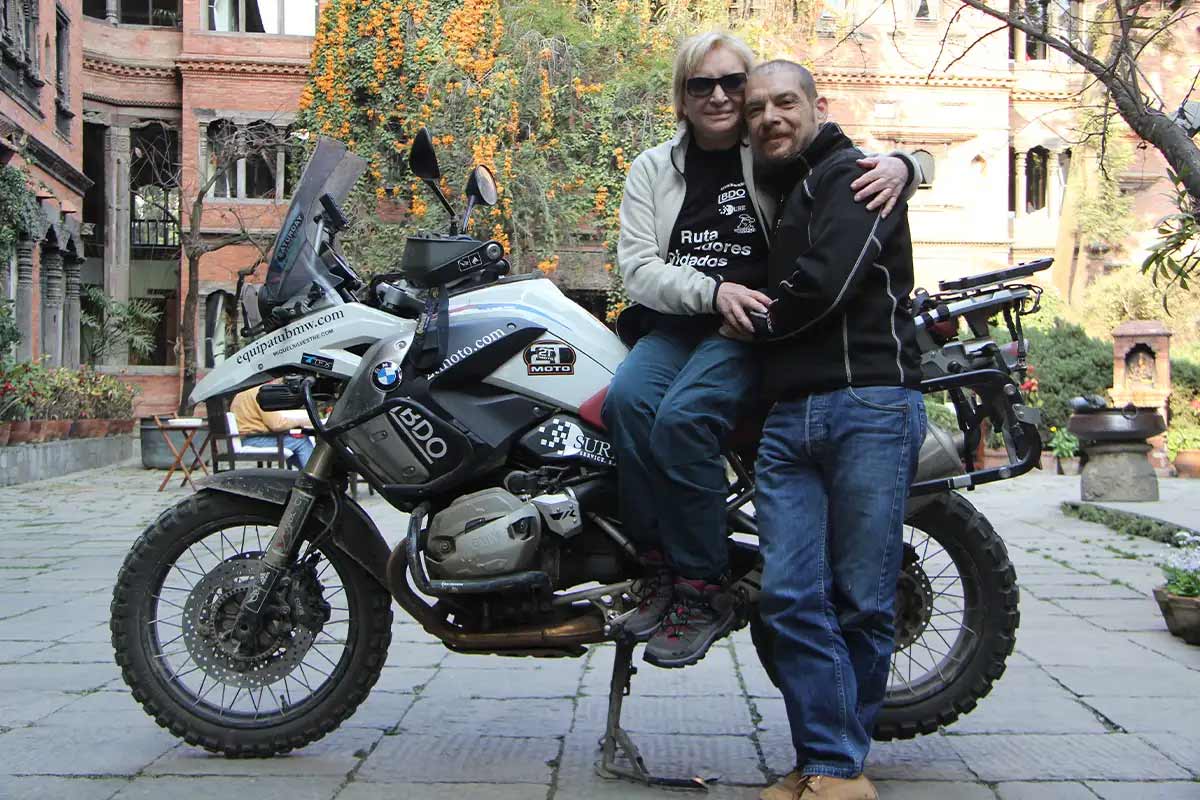
It is impossible to refuse her. So, I tried her trick, showed them my BMW and explained that I was going around the world on a motorcycle writing for magazines and newspapers. Miraculously I managed to get a substantial price reduction, as well as the courtesy to allow me to enter with my bike through the courtyard garden for a photo shoot with all the hotel staff!
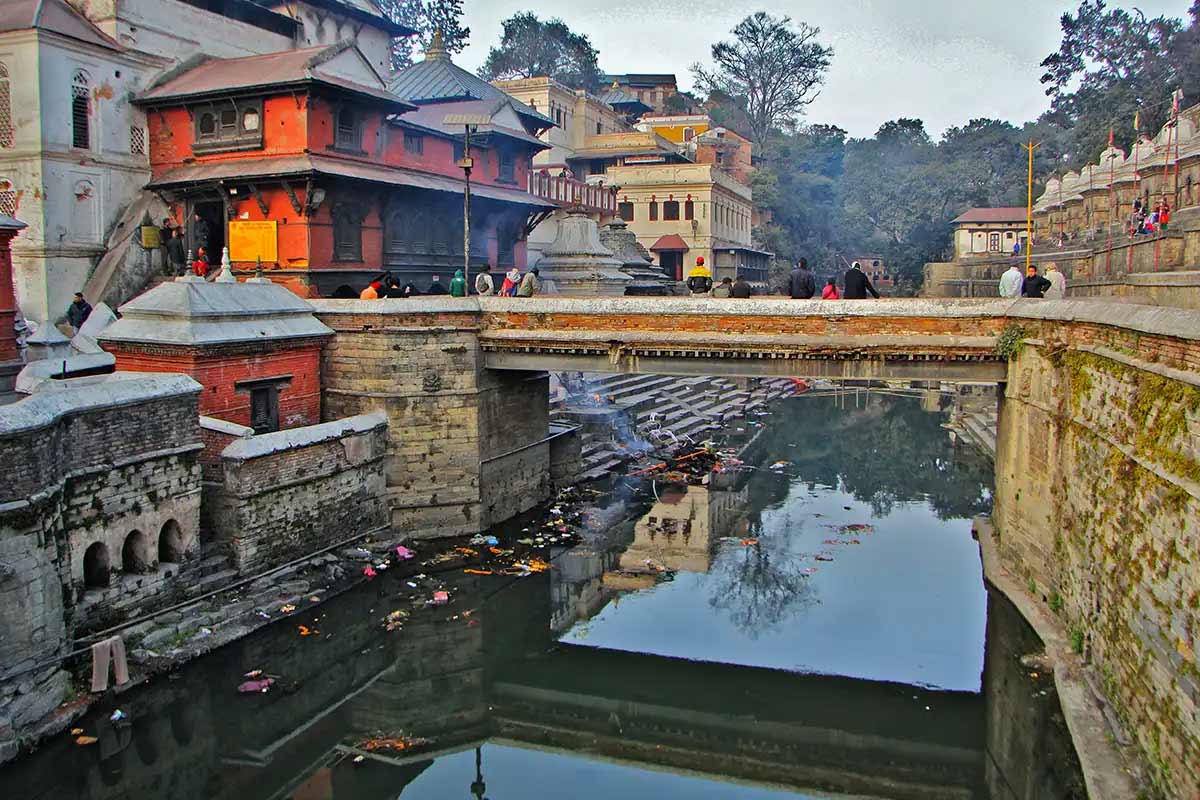
Nearby, and along the Bagmati River, is the magnificent Hindu temple of Pashupatinath, the oldest in Kathmandu. Declared a World Heritage Site, it is a center of Hindu pilgrimage. Along the roads of Nepal one can see the tattered pilgrims who come on foot from India.
On the steps leading to the river is where the bodies are cremated. The pungent smell of burning flesh fills the air as we climb the endless stairs that lead to the top of the mound, passing hundreds of monkeys that benefit from the food offerings to the gods.
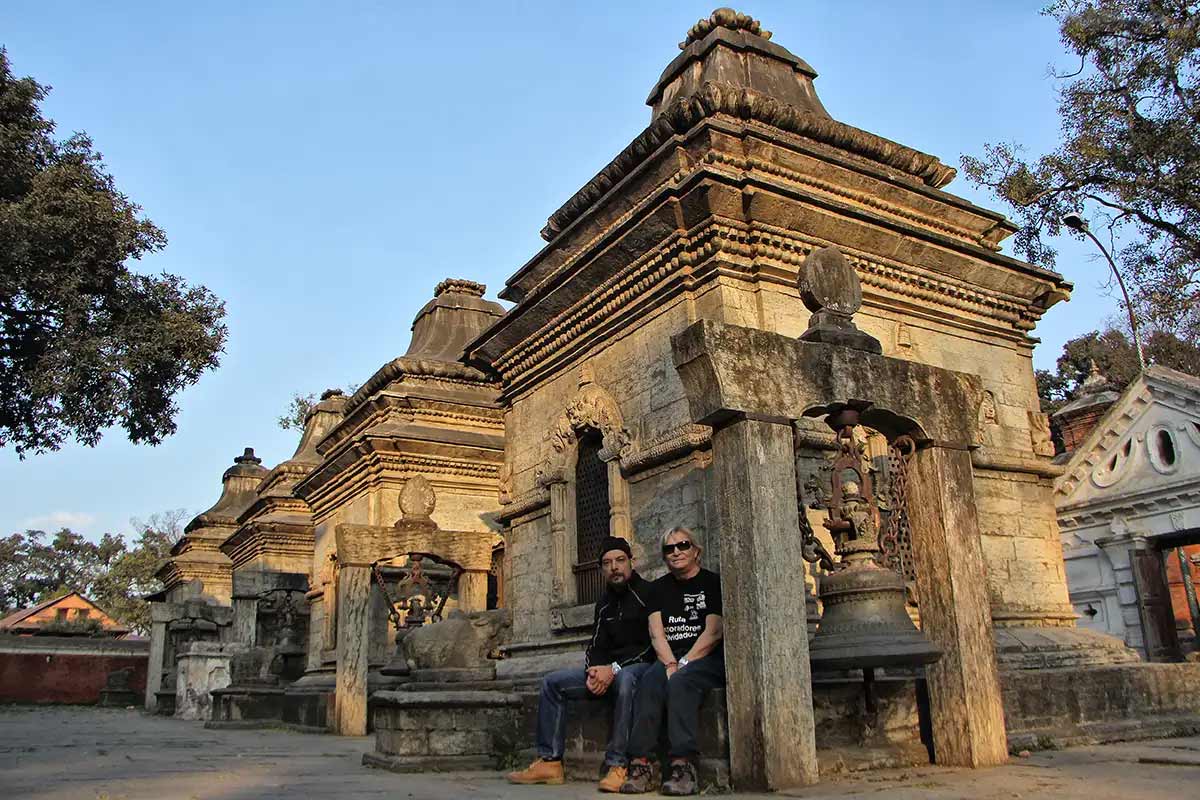
A guard intercepts us… apparently only Hindus are allowed this way. “But what are you saying?” My mother shouts at him. “My son is a writer and needs to take pictures of this place, so let us work!”
She is impossible to resist! The guard allows us free passage along with a military salute.
When we finish with the “work” my mother says, “In Kathmandu there are many things to do, but I think the more interesting places for you will be only those where you can get your motorcycle into. Remember that the journey you are on is exceptional. Because you are not traveling by plane, like everyone else, you should always mention your BMW. Forget the stupas—let’s go to Durbar Square.”
“But, Mother!” I dare to object. “The center is only for pedestrians, plus there is also a strike against the government going on. Nobody else is circulating in the city today.”
“Do not be silly!” She responds. “You are a foreigner. Nepali politics do not affect you.”
The Durbar Square is in the very heart of the city where sits a curious wooden temple. It’s a reconstruction of the original that thousands of years ago gave the city its name. And it’s also the residence of that unfortunate girl goddess they call the Kumari.
“An evil tradition.” Says my mother while we are surrounded by curious onlookers at the site. “That poor child won’t be allowed to touch the ground, nor relate to other children, and will not carry on a normal life. She may be a goddess, but only until her first menstruation, then she will be returned to her original home.
"What kind of a future can be expected for a girl who lived her early years in complete isolation from reality?”
Leaving Kathmandu is not easy. People, traffic, potholes… with lots of curves and switchbacks. Our plans soon fall apart. At a Maoist “checkpoint” they beckon me to stop. I never pay bandits, not even when they wear legitimate uniforms, of which these guys don’t.
So, I try to dodge them by passing on the left of the car ahead of me, but that leaves me with only a very narrow viable space and I hit his bumper with the right side case of my motorcycle.
The impact knocks us down. My first reaction is to ask my mother if she is okay. The second is to check the status of the bike. The motorcycle is in a weird position—lying on its side with the front wheel stuck in a ditch. It is impossible to remove the bike by myself; I need and somehow get help from those road pirates.
In Pokhara we ride to the Fewa Lake area. We end up at the Swiss Home hotel, though “Suisse” only by name. It’s actually just a big house with an overgrown garden and two floors of very Spartan rooms. After a short bargaining session we end up with a couple of rooms for $15 each. It would be nice if they at least had electrical light, hot water, heat… or something. Well, from Dwarika’s to the Swiss Home is over 200 km. Out here, that’s a world apart and one must be prepared for either extreme.
The next day I get up, go outside half sleep and then… I see it for the first time. From every street in Pokhara one can see the Annapurnas. My goodness, they’re so huge! During the dawn of the winter months the snowy walls glisten a pinkish color, like diamonds.
They dominate the village as jealous guardians, with a constant and challenging presence. “We are here!” They seem to tell me, “Here forever… long before you, you little half-evolved reptile.”
You gaze at them and know they are right, they are great, powerful, and eternal… and that you are nothing in comparison, a mere ant next to them. But they are blind, mute and deaf. They have no heart or will. There are some men who can beat them, men who struggle with all their heart and will. And although the mountains do not know it, their very existence is the seed of these climbers’ dreams.
If I have come here for a reason, it has been to pay humble tribute to those brave explorers of the recent years. The Spanish climbers who died on their conquests. The Majorcan Spaniard, Tolo Calafat, in 2010 on an expedition led by Juanito Oyarzabal. And Iñaki Ochoa de Olza, in 2008, when he suffered a stroke just a few meters before reaching the top—resulting in one of the most fantastic rescue operations in mountain mountaineering history. A failed attempt to save the life of this exceptional man.
We climb a steep dirt path. As pillion, my mother holds on with all her strength. I feel her fear. I am already accustomed to almost any climate and situation, but even I feel as if my blood could easily freeze as we explore this rugged trail with such a sharp steep cliff next to us.
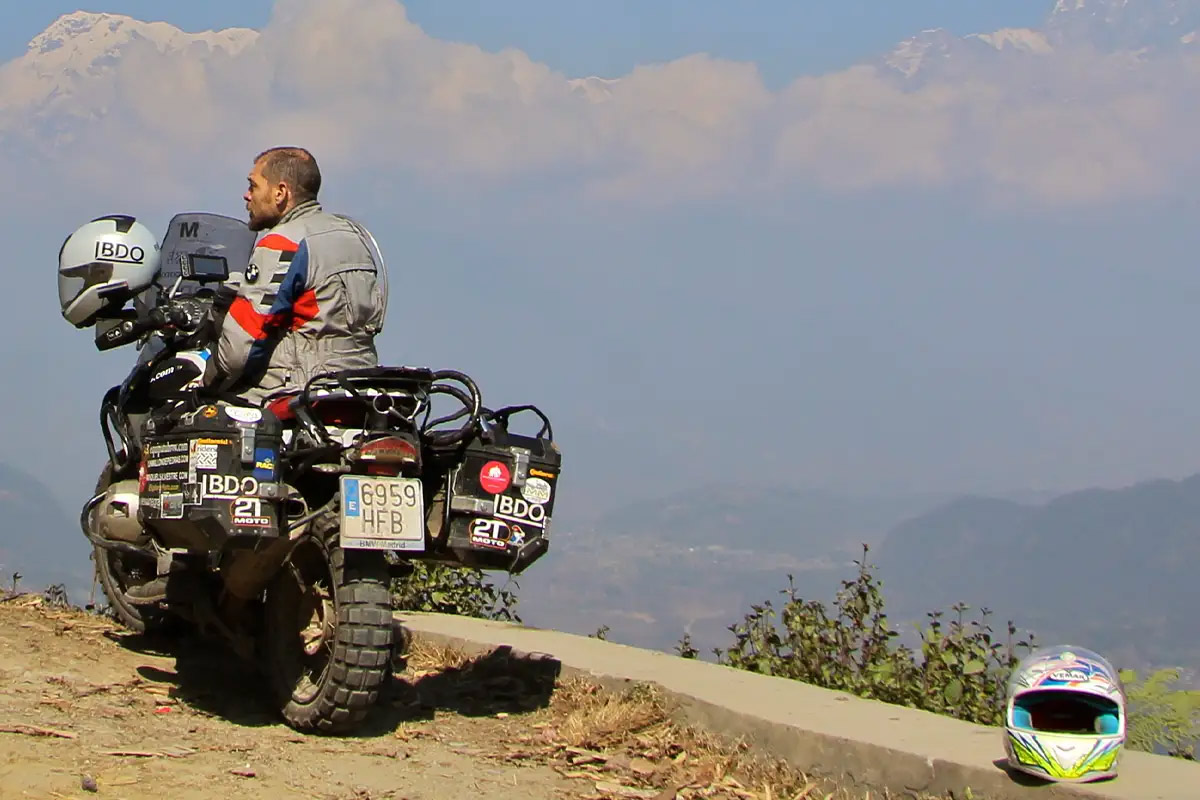
Later, when I review the photos we took that day, I realized the size of the void that skirted us. But the truth is that at that moment I did not fully comprehend it. I knew it was threateningly there, but my passion to capture the moment sometimes prevents me from properly assessing the risks.
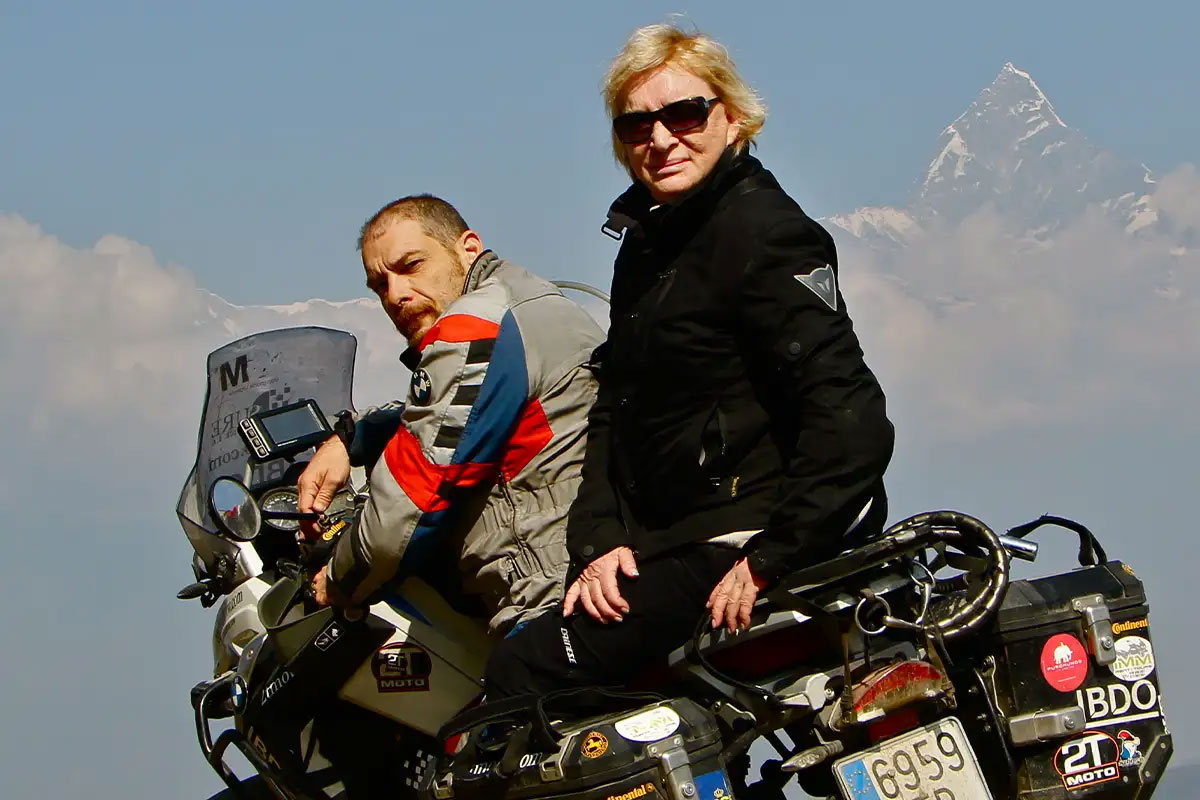
As we stop the bike in front of the massif my mother asks, “Do you know what I really came here for? That mountain in front of you speaks to us. I came to Nepal because I want to hear what she has to tell you… and to make sure that you will never forget.”
As I face the majestic stone, I realize that for the first time, I’m looking at the mountain as it really is. A mirror. A mirror of snow, sky and sun. The highest and purest mirror in the world. It tells me that we fought hard to get here, although may never fully understand why.
There are those who believe that mountaineers are crazy, risking their lives to conquer this majesty. But the mountain tells me there’s something up there. Reaching that summit must be akin to what I feel when traveling around the world by motorcycle, on this mission to write about the forgotten explorers.
There’s a special satisfaction in that—something deeper which takes us out of this world. I don’t know what is it exactly, but standing here with my mother before this tremendous mountain, I know it exists and is something really worthwhile.
For video coverage of this amazing journey, please visit:
{youtube}O_o9cfuKGTg{/youtube}