 Sticky logo
 Search


“He’s a bad friend, Cooper. Don’t be like him.”
This comment came from a guy I had just met at the campground I had checked into in Rasar, Washington, a few minutes before. He was pointing at me when he said it. Having seen me poring over my map at a picnic bench beside my heavily-laden V-Strom and tent, he closed in for a chat. I figured he wanted a few minutes of peace having checked out where he wandered over from: His site had about a dozen screaming kids, blasting techno music, and, for an inexplicable reason, dancing laser lights you might put outside your house at Christmas.
My new friend wanted to look at my bike and ask where I was going. Most of all, he wanted to know why I was alone on the Fourth of July. Before I could answer, his son, Cooper, had come over and asked if he could sit on my bike. I obliged. I obliged again when a couple more kids also wanted to be lifted into the cockpit.
Then I explained why I was alone.
***
When you live on an island, most adventures begin with a ferry ride. In the case of Rob, Daniel, and myself, we live on Vancouver Island and had set aside five days to tour Washington State, beginning with a ride on Black Ball Ferry Line’s single-hull Coho that runs between Victoria, B.C. and Port Angeles, Washington. Juan de Fuca Strait can get pretty rowdy with wind-over-tide, so we lashed our bikes to the sides of the ferry shortly after riding into its gaping belly. This action completed the extent of our trip planning; from here, everything was spontaneous, free, and fun.
The lineup to access famous Hurricane Ridge a few minutes outside of Port Angeles was not fun. Neither was the newly implemented $25-per-bike fee, especially when low-slung clouds moved over the surrounding peaks like the bottoms of battleships, reducing visibility and eliminating the single reason why anybody would go up Hurricane Ridge.
Instead, we headed for Highway 112 to Neah Bay, the westernmost point of Washington state on the Olympic Peninsula, despite being advised against it by locals we had met in the parking lot of Safeway.
“Been a few washouts on that road. I’d be careful,” said the president of a local riders group. “Been at least four fatalities there already this year.” We need not have worried. With it’s hurricane hairpins, sweeping apexes, and subtle berms —the engineer must have been a rider — Highway 112 was nothing short of a howl-fest that left us grinning ear-to-ear and exchanging high-fives once it spit us out at the Hwy. 113 junction. Even the washout areas were gravel- and dirt-free, and the resulting heaved asphalt was well-signed in most places. Leading the way, I dove my Suzuki into a beautifully cambered sweeping right, only to realize too late a washout-induced heave lay in waiting. With my suspension already preloaded, I absorbed the compression with my arms and legs, and, with nowhere else to go, a blast of air vacated my lungs. The bike took it like a pro and the tires remained stuck to the asphalt.
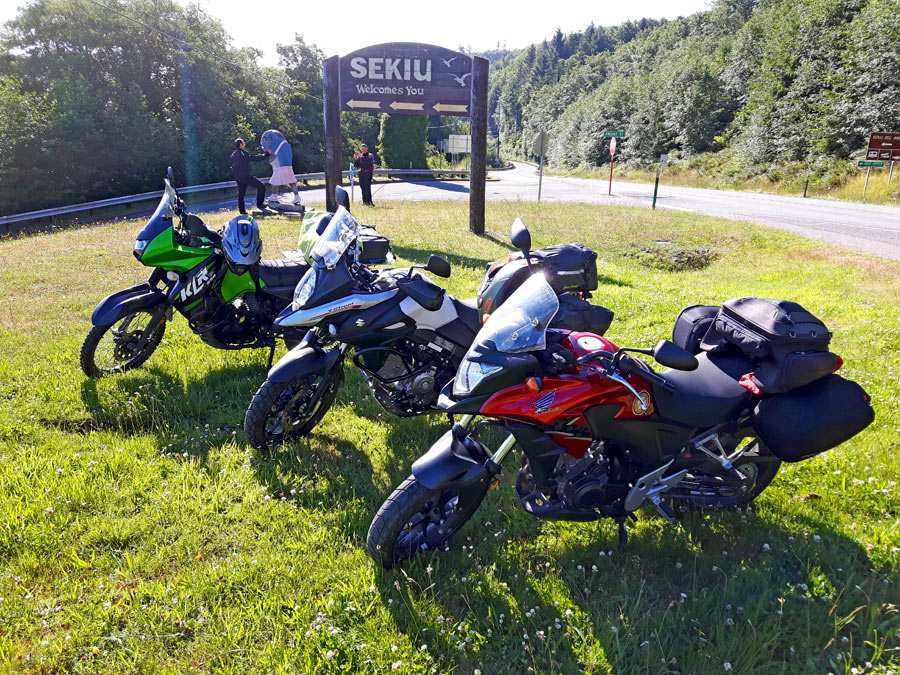
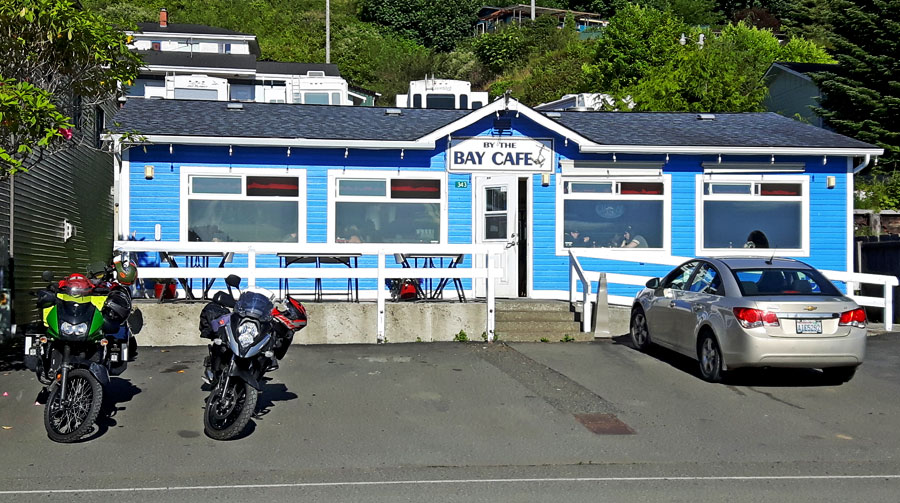 By the Bay Café in beautiful seaside Sekiu.
A couple of hours later we stood overlooking Cape Flattery, the northwesternmost point of the contiguous United States. Of course, this was a good time to compliment each other on riding styles, choice of gear, and virtually everything else as we hiked down to the dramatic cliffs. What else would you do at Cape Flattery on the first day of what was turning out to be a fun adventure? What we didn’t do was crack open an alcoholic beverage. Out of respect for the Makah Tribe, which has called this part of the Olympic Peninsula home for thousands of years, we refrained as alcohol is not welcome.
Backtracking along Cape Loop and Cape Flattery roads, we made our way back to Sekiu, where we wound the day down at the By the Bay Café with a burger and a beer and camped by the ocean.
The second day broke with perfect riding weather, and we backtracked down Hwy. 112 to 113 and eventually to the famed 101 that circumnavigates the Olympic Peninsula. We checked out the resort town of Westport before pointing our headlights east, finding the Lewis and Clark campground as the sun began to set. For me, the next day held the most excitement and I crawled into my tent with eager anticipation.
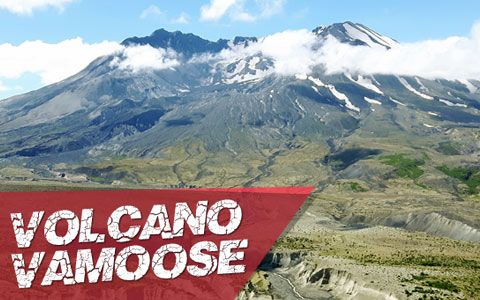
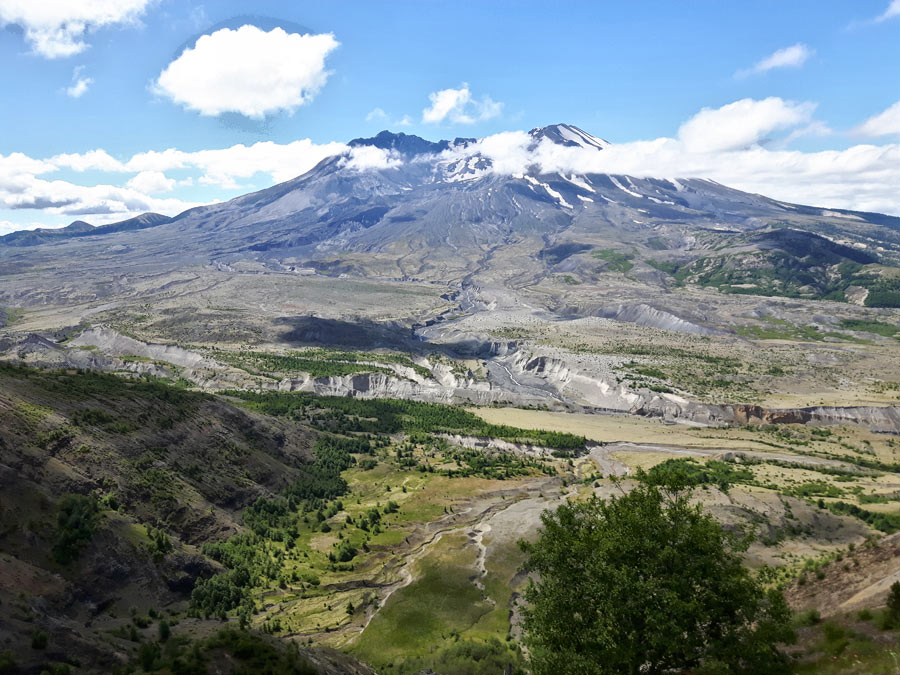 Thirty-eight years after Mt. St. Helens erupted, the devastated landscape remains.
Mount St. Helens blew its top on May 18, 1980. Sizeable earthquakes preceded the eruption in the days before, and geologists were monitoring the bulge in the mountain’s north side as magma from a deep reservoir within the Earth made its way to the peak. At 8:32 a.m. on a blue-sky morning much like the one that lay before us as we packed up our bikes, Mt. St. Helens erupted, killing 57 people, including volcanologist Dave Johnston who famously reported “Vancouver! Vancouver! This is it!” moments before succumbing to the toxic gases and the blast wave. It could have been worse. There had been extensive logging in the area at the time, and workers had been allowed in the day before to collect their belongings from camp. Because it was a Sunday, few people were in the vicinity. I was nine years old, and I recall standing in the middle of my Calgary, Alberta suburban cul-de-sac staring at the sky wondering why ash was falling. As the news broke, the story and images of the eruption haunted me. How could something so massive and solid be destroyed so completely? Mount St. Helens was a key inspiration for me enrolling in geography, and later geology, in university, but it’s the stories of survival and death that have gripped me for almost four decades.
As we ripped up Highway 504 I couldn’t help but feel Mt. St. Helens had had a similar impact on millions of others. The amount of money spent to build the almost 52-miles of highway and bridge spans must have been massive, but it allows thousands of people to access the Johnston Ridge Observatory and learn more about the largest geological explosion in American history. Standing on the observation deck, the power of the explosion became clear. Massive mud and rock slides crashed down so violently they moved like a wave, sliding up and over what is now Johnston Ridge where the observatory now sits. Two hundred and thirty square miles was levelled by the lateral blast killing countless mammals, birds, amphibians, reptiles, and fish, and the resulting moonscape exists today, 38 years later. Rock, ash, and magma reached 80,000 feet into the deep blue sky. In the observatory, I soaked up all I could about the devastating explosion.
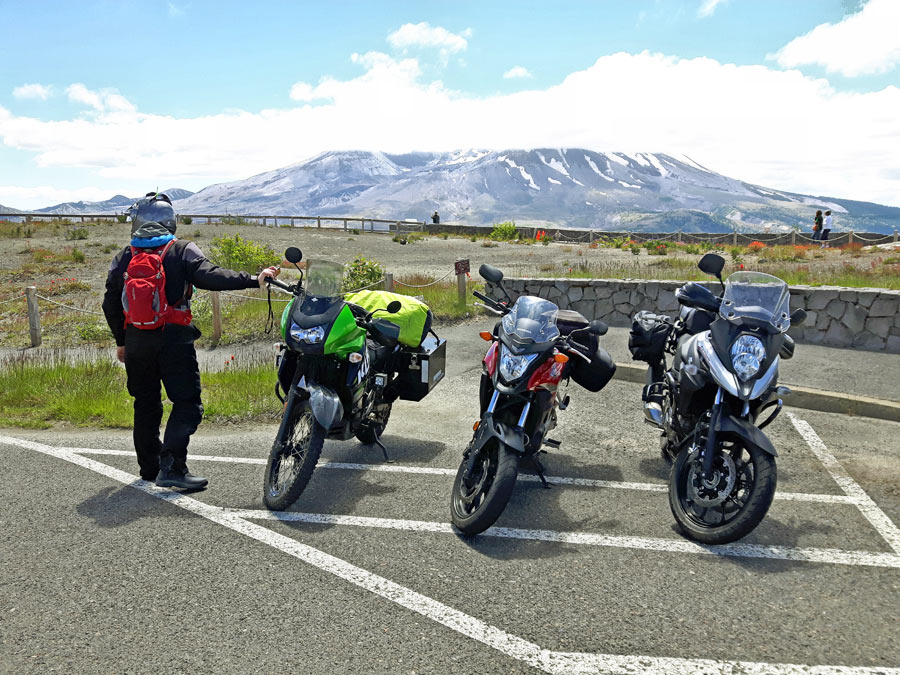 Preparing to ride away from the most powerful geological explosion in US history.
Riding back down the beautifully built 504, I felt unsettled. The ghosts of Mt. St. Helens had always haunted me, and now I had come face to face with them for the first time. I had expected some kind of closure, but instead, the power of the volcano had consumed me once again. Daniel and Rob descended the smooth, winding road ahead of me at a brisk pace, seemingly eager to escape, but my mind was stuck in May 18, 1980. I didn’t want to leave.
That night at a riverside campground in the Yakima Canyon, having followed up Mt. St. Helens by riding Hwy. 410 through Mount Rainier National Park, I turned in early. The lazy river swished by almost silently, interrupted by the occasional plop of a jumping fish, as the day’s heat and heat from the engines subsided into a cool calm. The unsettled feeling continued and as the minutes passed by — I felt more and more like I wanted to be alone.
We were up early the next morning as the heat in the canyon built. Daniel’s KLR, Rob’s CB500X, and my V-Strom throbbed with eagerness for the upcoming canyon road and the arid surroundings. They waved me to lead and I revved the V-Twin and turned left out of the parking lot, happy to be distracted by the attention the road demanded. Less than one minute up the road, they were gone from my mirrors. I waited on the roadside for 10 minutes. Some sheep had caught their attention. Time after time during our ride north toward Winthrop, they disappeared from my mirrors. Unplanned gas stop, wasp in a jacket, traffic was too fast, somebody had to pee. In the heat of the afternoon, I stood on my pegs and surveyed a river, thinking of a cool dip in the glacial-fed waters. I motioned to stop but was told to keep going, so I did. Two minutes later, Daniel and Rob were once again gone from my mirrors.
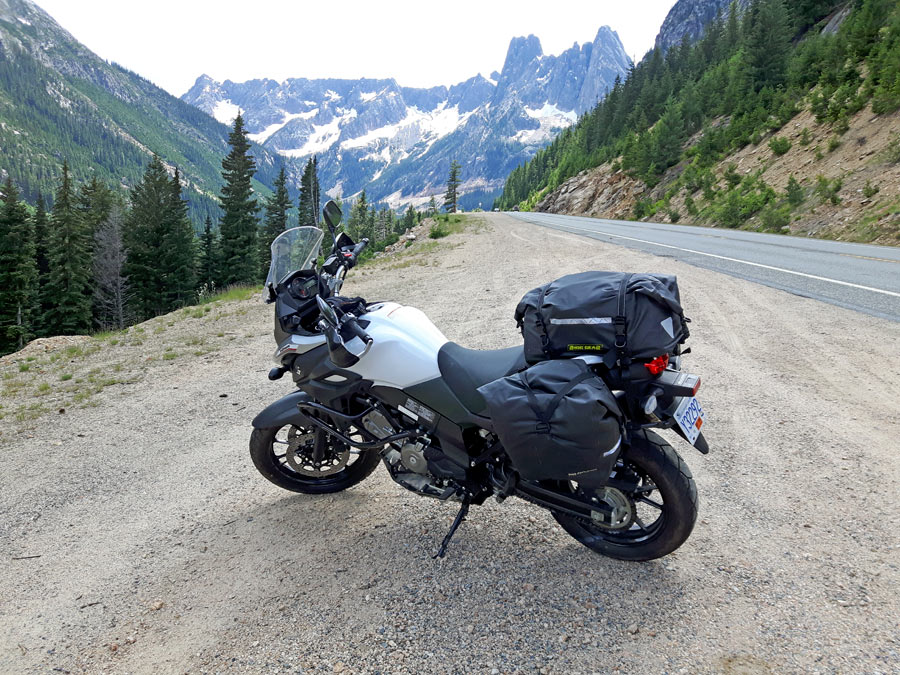 Beautiful Liberty Bell Mountain on the North Cascades Highway.
I twisted the throttle and kept going. The North Cascades Highway is as good as it gets for scenery and is rated among the top 10 rides in the country. I snaked past the Diablo Dam and stunningly beautiful Liberty Bell Mountain as late afternoon turned to evening. I fueled up in Marblemount and made my way to the tidy little town of Concrete. When I entered the Lone Star Saloon, every head in the house swiveled in my direction, taking in my orange and grey kit. I sidled up to the bar and struck up a conversation with the bartender while ordering dinner. I ditched my friends, I told her. Her expression revealed her disapproval. The guy at the end of the bar looked my way and shook his head. Point taken. Nevertheless, they steered me in the direction of the nearest campground and under a barrage of Fourth of July fireworks exploding in every direction, I checked in.
Turning down an invite to stop by my new friend’s campsite for a drink with his rowdy group, I said goodbye to him and Cooper and headed for the showers. Feeling rejuvenated, I climbed into my tent and considered my actions and the potential consequences. Were they worried? Were they pissed? I flipped off a short text to say I was safe. As the light faded the thundering booms slowed from their manic pace. One here, one there, one off in the distance. Finally, the campground was silent. I pulled my sleeping bag up and prepared for a deep sleep. As the day’s chaos slipped away — the traffic and crowds, my annoyance with my fellow riders, the rush of wind in my helmet, the percussive explosions — somewhere out there high on a ridge, a lone coyote sang to the moon. It was the most beautiful sound.
{gallery}ARTICLES/Rides/VolcanoVamoose/Gallery{/gallery}