 Sticky logo
 Search


AM: To have that moment of connection between not only a racer, and brother, but from another human being at a time in need, probably changed everything for you. Did the entirety of taking on this race affect your life’s perspective in other ways?
KM: You know I was in the hospital in Lima for nine days. If I told you at that time I was glib and happy I’d be lying. I went on an emotional roller coaster that hit every emotional high and low you could imagine, six times a day. What stood out in my mind was the talk I had with the liaison before the race:
“Kevin, what’s your extraction plan if you don’t finish?”
“I don’t have one. I’m finishing.”
“Have you filled out your last will and testament?”
“No, I’m coming home.”
“We hate to tell you this, but not everybody comes home.”
So, you have this reality push ’n’ pull going on in your mind, where you’re forced to think of the what ifs. Then, I thought about the second-timers who admitted that they “made it to Day Three,” or “Thirteen,” as we all shared stores in the bivouac during tech inspections before the race. And, without having any prior experience of the crazy intensity of this race, I naively judged them. So, my perspective today is completely different in every way than it was before the race. How dare I not respect these guys for not finishing. These are all good, hard, and humble men and women who are great riders. How dare I question their motives, inspirations, and the pain they’ve gone through.
AM: Did your Honda CRF450X perform to your expectations?
KM: I should have put my race engine in on the first day. I planned on running the stock engine in the dunes and then, halfway through, switch to the full-built race engine. I had to second guess how far I could nurse the race engine along during 14 days of sheer abuse. Also, the few mods that I did to the bike had to be strong ones to reinforce the extra weight of the bike from the navigation tower and nine gallons of fuel. That’s why I had Woody Wheels here in Denver build my wheels for me. You certainly don’t want to get stuck out there popping off spokes or sprockets, or breaking rims from the weight and forces. All-in-all, I’m glad I chose Honda over KTM.
AM: I understand that you used your Redverz Series II tent in the bivouac. How did it hold up?
KM: It was surreal to have my tent there. Inside the bivouac there was no space to even move, and all these guys around me had these tiny little pop-up tents. Well, here I am with the Taj Mahal, where I can sit in shade in the vestibule, or set up a queen-sized bed inside the tent. Then, all of a sudden, I have about six Dakar racers around me sitting in their underpants in 100°F+ talking excitedly about the day’s ride. When I was designing the tent, making it a central gathering point for other campers wasn’t my initial intent, but it’s something that happens to us now wherever we go. The concept came to me when I was sitting in places like the Zaire rainforest, with a little poncho and mosquito net, saying, “Why am I doing this?!” No one wants to be in the elements all of the time, or always having to lie on your back to pull your pants on. I made it cool to stand up in your tent again.
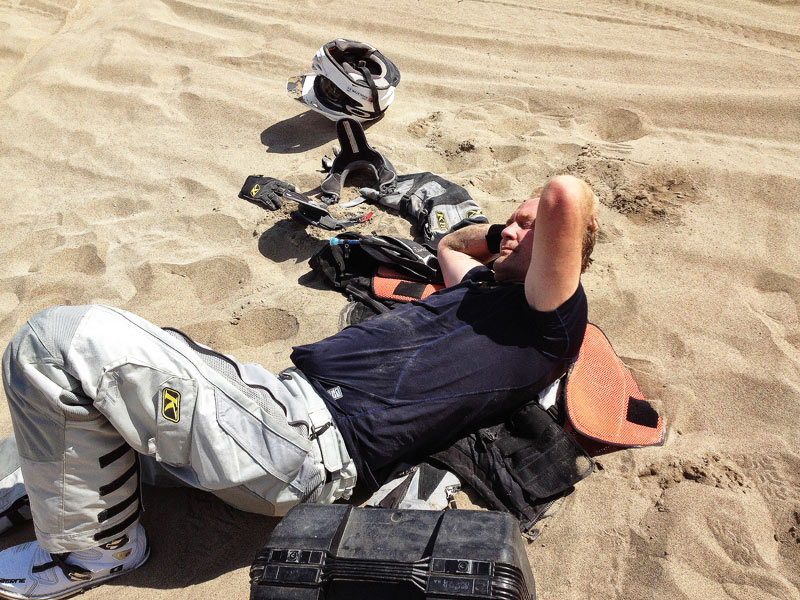 AM: Have you been kind to yourself during racereplay from the hospital bed?
KM: There are a couple of ways of looking at it. One, is the way your family will explain it to you, “Just getting there is fantastic.” But, that’s not how you think. So, you dig into how you’d approach it again. Yeah, I’ve relived that crash about 1,500 times. There were about 100 riders in front of me leaving tracks that left my bike slapping back and forth. You’re always trying to get a line where you can ride as smoothly as possible. So, if I rewind and replay it again, nine times out of 10 I’d ride the same line at the same speed. I can’t change that. That was my choice at the time, and I’d do it again.
In my mind, I have to do this again. This is the peak, and you can’t maintain that peak for very long. So, the game right now is 2014. I’ve done everything, so the learning curve is behind me now. I know what needs to be on the bike, what gear I need, and what training I have to do. There will definitely be more dune training this year to gain more experience learning how to read them. I’ll get into my race quicker, and won’t care about my positioning. I’m going to ride at a pace that I think is comfortable. And, hopefully with that thought process I’ll make it through to the end. Now, I realize that you just can’t take anything for granted.
If you’d like to support Kevin in the 2014 Dakar, please visit Redverz.com