 Sticky logo
 Search


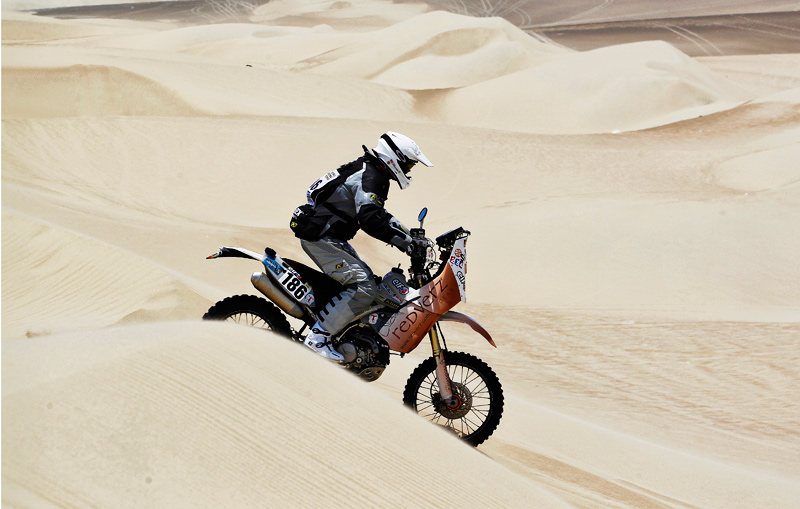 Dreams. They’re the heart that keeps the passion pumping through our veins. Without them we die. And if there’s one thing we can say about Dakar racers, it’s that they share one of the biggest dreams many riders have had since childhood. Kevin Muggleton, one of this year’s first-time Dakar racers, was one of those wide-eyed 11-year-old boys who used that fire from his Dakar dream to set the tone of his adventurous life. From kayaking down the Amazon and Zambezi Rivers, to 4x4ing the length of Africa in search of the matriarch of the elusive Lovedu tribe for a National Geographic documentary, to round-the-world adventures by every form of transport imaginable, to founding Redverz Gear with the design of the first motorcycle-specific tent, Kevin has no shortage of passion pulsing through his veins.
Dealt a hand of cards that plucked him from the most brutal race in the world, on the second day of the whiplashing and treacherous dunes of Peru, he broke his back. Now, Kevin sheds light on his process of rising up to take back his dream…
AM: You have inspired many by qualifying for the most grueling race on two wheels. Who has inspired you most at this point in your life?
KM: I’ve done lots of very interesting things in my life, but the Dakar is different than anything else. It breeds a group of people who have inspired me. As soon as I got off the plane in Lima, Peru, and was swarmed by other racers, I knew I was home. There’s one thing that you notice by being amongst them. It’s not even that you need inspiration from them, because you’re swept up in a feeling of pure strength, humility, togetherness, and a knowing that each and every one of them has your back. Here you’re with a group of people who know you can do this, after many from the outside have questioned you, and they’re right on the edge there with you. They have dreamed of something big, and have gone out and done it. These are the people who have the moral courage to say, “It’s time to stop talking, and time to start doing.”
AM: Any special techniques used in your training?
KM: One day I received a package from elite endurance coach, Tom Wigginton, that said, “What you’re doing is so cool we’re going to sponsor you.” So, there I was with a sponsor who is a mental coach training top athletes for some of the most demanding endurance races. After dialing in my riding technique, he then pushed me with high-intensity impact training sessions, with strength training first, and conditioning training afterwards. Working on recovery was the most important aspect of training, with lots of sprints, and no time to breathe in between.
The Dakar is endurance and recovery… period. You can be riding for two to three hours at high intensity, where you’re just dripping with sweat, and as soon as you relax someone else will ride up on you. Then, you use the time you’re standing on the pegs, as the bike’s twisting underneath you, to recover and prepare for the next sprint.
AM: Would you give us a physical and psychological account of the moments before, during, and after your accident?
 KM: There’s this procedure during a crash. The Dakar organization’s control of where you are on the bike at any given point in the race is incredibly high-tech. Coming off a 90-foot dune at 100 mph—then stopping dead at the bottom— has the guys at the Comm Center a continent away sending a helicopter to you before you even have your helmet off. They know that a crash at that speed is critical, so they’re talking to you immediately. When the Paris Comm Center noticed that a Dutch rider rode up right next to me, they started triaging and communicating with him on his bike via satellite right away.
“Is he bleeding? Is he conscious? Is he breathing?”
“Yes, he’s breathing.”
“Okay, what does it look like?”
“It looks like he’s broken his back.”
“Okay, stay with him.”
And, then another rider joins the Dutch rider, and the Comm Center says, “Send the other rider to the top of the dune as quickly as you can.” What they’re trying to do is protect the scene.
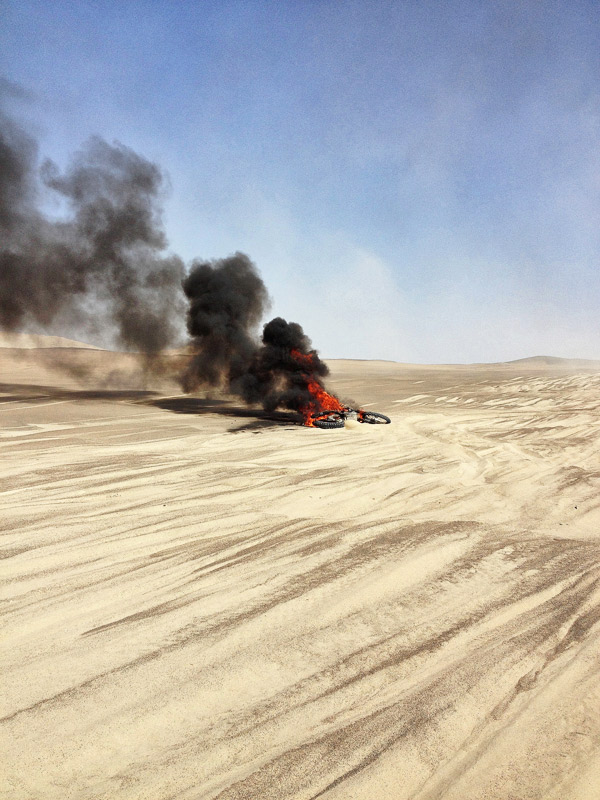
There are about 120 riders still to come, and you start seeing them crash left, right, and center off the same dune. They now have a helicopter hovering at the top to mark the spot. And, what’s crazy is that moments before I had just ridden past an Argentinian rider, and saw his head in his hands as he was crying—his bike next to him engulfed in flames. Here I am watching this horribly despondent rider, and I’m thinking, “Poor guy!” Yet, at the same time I’m thinking, I’ve just moved up one more position. That may sound really mercurial, but it’s really strange what goes through your mind out there.
What happened after that was monumental. Here was another racer, Luis Belaustegui, on a 150cc, trying to be the first ever Dakar racer to race a 150 and finish, and he pulled up right next to me. Then, while losing race time, he knelt down next to me and took my hand. I said, “Luis….” He interrupted immediately, “No, don’t worry about me. You’re going to be okay. Everybody in the world will understand this. This is what we do. We are Dakar racers, okay? People will understand this. You will be fine, you will repair, and I will see you back here next year.”