 Sticky logo
 Search


When I descend the other side the sun shines and it is warm again, so I make up time. I have a clear run along Chile, no interruptions in the Atacama, a desert I know well, and decide to ride non-stop to Peru.
My route through Peru would be extraordinary if the sun was up. The Panamericana Sur clings onto cliff edges past Pedregal, Pescadores, Chiguay and Chala. But I don’t take in the scenery; instead, I hold on through the night, deeply tired. I eat at late night street stalls, and sleep for a while on my bike, wondering to myself about the meaning of life, wondering why the dark makes me reflect. I nearly had a sleep on a bench in the small plaza des armas, but unsavory characters were around, so I carried on. I have a last chance to stay on the 21-day schedule if I make Nazca by 6 a.m., Lima by noon and Chiclayo by midnight today. I can get three hours sleep there, then make for the Ecuadorian border at Tumbes, ready for when it opens at 8 a.m. on Thursday.
Passing through Nazca I spend a few moments in a hotel I know, collecting my emails whilst sipping a small coffee. Then I bolt through this country as if my life depended on it, riding through Lima at midnight, piling on the pressure by filming and writing when I can until the morning.
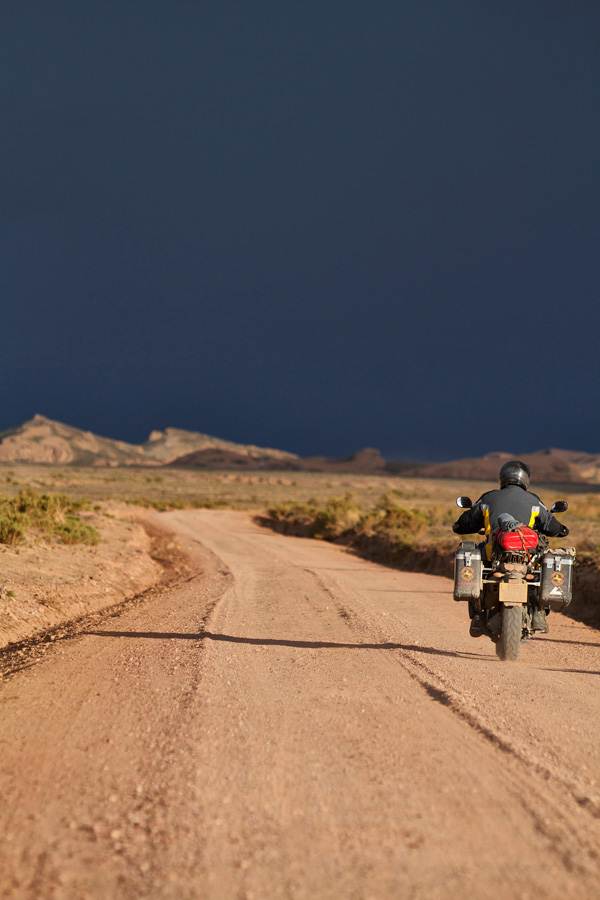 Suddenly, as I ride a long sweeping left-hand bend, a bus comes towards me with a pickup overtaking—on a collision course with me. Looking around quickly, I see the desert is level with the road - the run-off is survivable. He sees me… I have already started to brake and give him a moment to react. In these split seconds, I wonder if he’ll force me off the road, or allow me to pass. He slows… we have a mere two seconds before impact. I see his face as he keeps traction and nudges back behind the bus. The moment passes—and it was close.
Then I notice the sea is on my right, and unless this is an inlet, I have turned back on myself—I have gone the wrong way. Road signs confirm I am returning to Lima. So, I turn around and go back the way I’d ridden that morning. As I make it to the pass where I should have been riding, I spot a group of people surrounding a white emergency services van. A young motorcyclist has been killed at precisely the time I should have been here. And I can’t help but wonder if perhaps there is a way to become invisible, a way to delay the inevitable, when you have to be called in by the Great Accounter. Perhaps absent-mindedness acts as a screen and is a time when your God, or whoever it is who looks after you, looks into your eyes and has no way of knowing what you are thinking.
I see a sign that reads “Trujillo 268 kilometers” and head in that direction. By 3 p.m. the cloud dissipates and the sun shines. The chilblains on my hands and feet have begun to feel better, and my spirits have lifted. I am ambling through a 960-kilometer day without trying too hard, but it took 64,000 training kilometers to get to a riding fitness state where 1,000 kilometers is easy.
As I ride, I plan the rest of my record-breaking effort. At this point, I’ve got to slow the project down to accommodate the winter schedules of Girag Cargo, the company flying my bike over the Darien Gap from Colombia to Panama. This means the return ride will drop to a 23-day schedule, although I might be able to reduce that time in North America.
After I fly from Bogota to Panama, my return journey across Central America takes two days and nights. Then, I nervously cross Mexico, riding non-stop again again, and enter the U.S.A., still riding hard. Three days later I am in Canada for more rain. The storm I hit around Edmonton is stupendously heavy. At this point, I have not slept for two days and nights, except for brief naps on the bike, lasting only minutes at best. About 113 kilometers south of Calgary I sleep for a half hour again on the bike, forgetting to switch off my heated jacket. When I wake, I am groggy and stagger around the quiet road until I recover what few senses I have left. The bike won’t start and I need to bump the engine by running it against the traffic down the southerly-facing freeway entrance, but considering the service this bike has already given me, this is not a chore.
Four days later I am in Prudhoe Bay once again. The journey has been 46,880 kilometers in 46 days on a Super Tenere that never broke down once. It is a flawless performance by the bike, the Campanero suit superb, the Conti Trail Attack tyres never punctured. The journey is over. I can go home.