 Sticky logo
 Search


Andrea had planned and saved her money for this adventure for years. She had ridden from Punta Arenas, Chile, enduring the cold and the malevolent winds that almost blew her off her bike. But the desolate beauty of this region was worth it, and now she was almost to her destination, the port city of Ushuaia.
Ironically, her accident didn’t even involve a motorcycle. She had stopped with her group at a dreary little petrol station north of Ushuaia, and when she was walking on the fringe of roadway surrounding the pumps, concentrating on getting a photograph, she stumbled in a pothole and something snapped in her lower right leg. It was that simple.
All that Andrea saw of Ushuaia was the emergency room at the small city hospital. The doctor showed her the X-ray. “You have a spiral break of both the tibia and fibula bones. We cannot perform the needed surgery here. I will stabilize your leg in a cast and you will have to be evacuated.”
Luckily, Andrea had travel medical insurance. She called her insurance carrier’s 24-hour emergency assistance line and described the situation. The insurance company conferred with the hospital, and she was flown out from Ushuaia to Buenos Aires on an air-ambulance flight, accompanied by a flight-nurse. From Buenos Aires, she flew to New York, and ultimately had surgery at a hospital in New York City, close to her home. She recovered fully, and all her medical expenses and travel costs to get her to her stateside hospital were covered by the insurance policy.
Adventure motorcycling will take you where you might not have state-of-the-art emergency medical care, and if you have first-world expectations of hospital treatment, you may be grievously disappointed. If you have an accident on or off your motorcycle while overseas, you may need to be evacuated to your home country for treatment. That can easily cost upwards of $50,000. And, it doesn’t have to be a motorcycle mishap… you can simply have a bad fall, as Andrea did, or suffer an illness that would require you to be evacuated.
So what exactly is travel medical insurance? It’s simply an insurance policy that will provide medical evacuation or repatriation if you suffer an accident or illness while traveling. The difference between “medical evacuation” and “medical repatriation” is that evacuation will pay for your transportation and care in the country or region in which you’re traveling, and repatriation will transport you back to your home country if necessary, usually to a hospital close to where you live, for treatment. You’ll definitely want a policy that covers repatriation.
If something happens, you, or someone traveling with you, calls a 24-hour emergency number (the assumption is that you have a cell phone, good coverage, etc., which isn’t always the case). A medically trained insurance company employee determines the severity of the situation (if you sprain your thumb, you are not going to be flown home), and, working with local medical personnel, ensures that you’re given proper initial treatment and stabilized. If necessary, a medical-evacuation flight will be initiated to pick you up and get you back home, wherever it may be, for specialized treatment and recovery.
Many riders think that their existing medical insurance will cover any eventuality when they’re overseas. Sorry, but if you carefully read your current insurance policy, you may find that while you have coverage in your home country, any expenses for emergency medical evacuation to get you from, say, somewhere on the Silk Road in Mongolia to Denver for medical treatment, are your financial responsibility. And even your domestic medical insurance policies may not pay for transportation to the hospital of your choice if you’re in some distant part of the U.S.
Luckily, this insurance is reasonably priced, and can be part of your regular travel insurance. Internet research will show you a number of travel insurance companies and their products. You obviously want to save money, but make sure you have adequate coverage. Dan Skilken, CEO of Travelinsurance.com, suggests purchasing at least $200,000 of medical evacuation coverage for travel in remote locations.
If you’re going to be on a multi-month journey, MedJetAssist offers longer-term policies that are worth checking out. In addition to medical coverage, MedJetAssist offers a ($35) policy that will pay $3,500 toward the return of your motorcycle to your home from anywhere in the U.S., Canada, and Mexico.
A few pointers
Don’t think that having this insurance makes you bulletproof, or that all you’ll have to do when you crater your bike is to pull out your insurance card, and a magic helicopter will pick you up in minutes… ride safe, don’t drink 10 Bia Hoi beers and ride back to the hostel on your bike; try not to ride at night, etc.
Take the time to contact whatever insurance company you choose, and make it very clear that you will be on a motorcycle. Most companies don’t require special coverage if you’re going to be on a bike, but you may be directed to a policy for “sports enthusiasts.” Some policies cover motorcycle travel only if you’re on “paved” roads. The last thing you will want to hear after an accident is a cultivated voice on the phone, saying, “I’m very sorry, but you’ll note that our policy specifically excludes motorcycle usage on gravel roads in Kurdistan.”
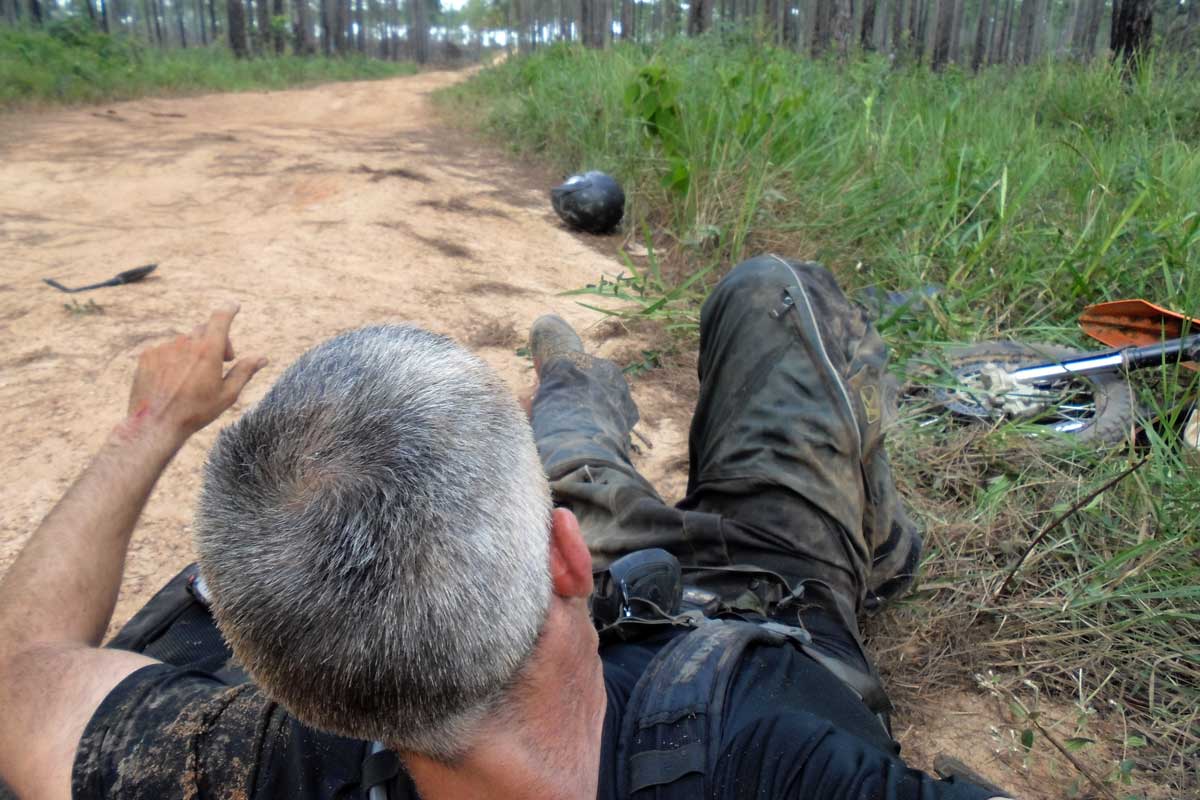 Peter Day from MoskoMoto made good use of his insurance in Honduras.