 Sticky logo
 Search



In the world of North American adventure motorcycling, there hasn’t been much to choose from, with the exception of BMW’s hugely successful GS bikes. Oh how the times are changing! Triumph has boldly stepped into the ring to try and capture a share of the only growing section of the North American motorcycle market. With modern technology, sharp looks and European styling, the introduction of the Tiger 800XC is just the beginning.
COMFORT AND ERGONOMICS
When I first threw a leg over the Tiger 800XC, we instantly felt at home on the machine. Coming from a mostly dirt background, the bike has a very off-road-bike-like riding position for its size. The Tiger’s wide handlebar stance made controlling the 470lb cat an easy exercise when the going gets rough, but slowed handling a bit on the pavement. Standing up, the narrow tank-to-seat union allowed ample room to move while standing. Seated, the narrow tank-to-seat area makes for a roomy cockpit.
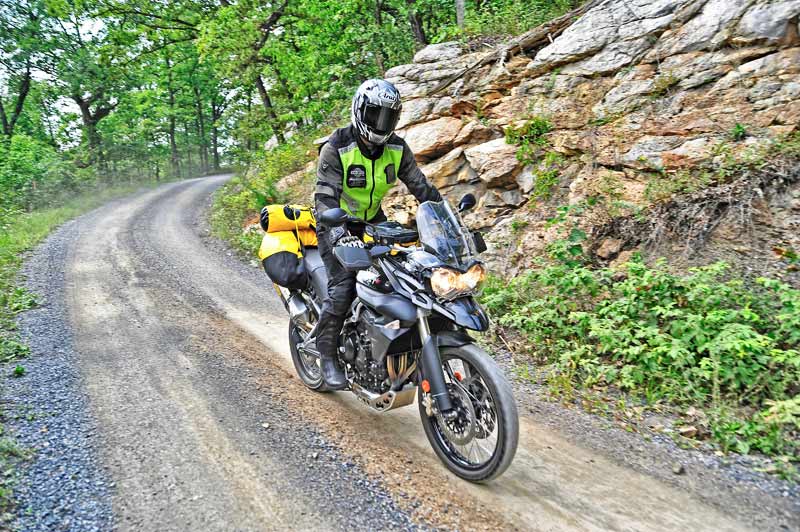
Triumph did a good job on the saddle overall, but some testers complained about the seat being uncomfortable after a few hours in the saddle. We think a quick fix for this would be to simply widen and contour the back half of the seat, but we hear Corbin will bring out an option before too long. A very useful feature the Tiger 800XC incorporates in to the saddle height from 33.2 to 34 inches and one inch less for the Tiger 800.
Narrow at the saddle and a little wider up front, the Tiger’s in-line triple spreads the bikes girth a bit and can make for some toasty knees. Some noted a lot of contact with their lower legs on the engine cases and a fair amount of heat coming from the engine. In the summer heat, this may be a little much for some, but it personally didn’t detract enough from the experience to matter, and the extra heat would probably be enjoyed on a cold, damp morning.
Everybody knows comfort in the wind is subjective, and dependent on a myriad of factors. Our test riders from 5’7” to 6’0” plus felt the Tiger’s screen did a decent job at keeping the wind at bay during off road or around town riding, but there’s only so much a small fairing can do at high speeds. Nevertheless, the Tiger’s minimalist fairing was large enough to protect the gauge cluster, some accessories and tank back. To do a little more for the rider, ADVMoto installed the Touratech adjustable wind screen mount, and found that at highway speeds, the cockpit had less turbulence making this, or any taller windscreen, a must have addition for those who favor high speed extended touring.
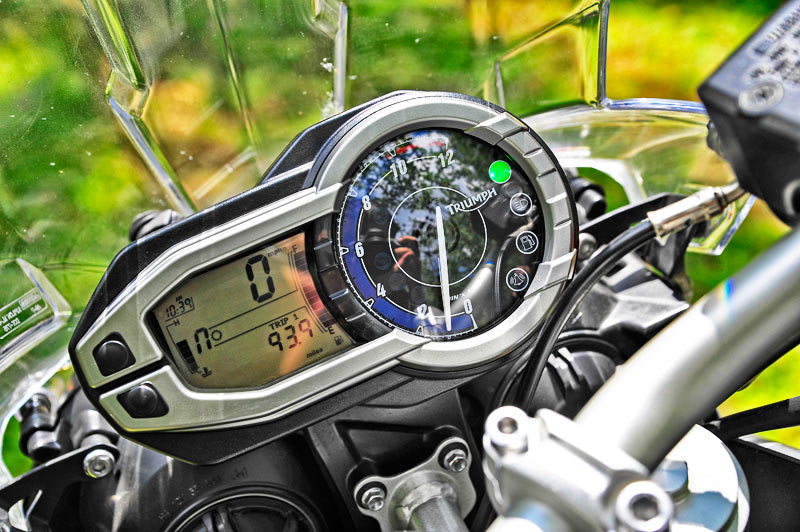 The digital speedometer and analog tachometer cluster is very user friendly, large and easy to read, night or day. Unlike some of BMW’s models, the Tiger doesn’t have any rider selectable fields which can be actuated at the grip, but the information is well laid out and easy enough to change on the cluster itself. At night, the twin Tiger eyes cast a usable wide light pattern in both low and high beam settings. A nice feature on the left side switch cluster is a passing trigger that the staff at ADVMoto found handy. We’re not sure why these have been absent on bikes in North America for so long, but we’re glad to see them coming around. Handlebar controls and switches are pretty standard layout and, with the exception of a rather flimsy turn signal button, all worked well.
One of the biggest faults of the Tiger 800 is actually its plastic and rubber trim. Our test bike, with only 3000 miles, was showing signs of problems with the gas tank trim, which was pulling away from the metal. The rear chin guard and hand deflectors could also be more robust, but these can be easily replaced if desired. Considering this is a first generation bike, some fit and finish problems like this can be expected, but we’ll be looking for improvements in these areas down the road.