 Sticky logo
 Search



ENGINE AND PERFORMANCE
Triumph’s goal was to make a strong multi-purpose engine, and what they came up with is exactly that. Although sharing the same basic platform found in the 675 Daytona and Street Triple, it’s mostly a new power plant. The Tiger triple mill generates power at the top end more like an inline four without sacrificing too much of the low end torque commonly found in twins, like its closest competitor, the BMW F800GS. With a longer crank throw (increased to reach 799cc’s), it makes for a slower revving easy-to-use power curve with 70% of the torque available below 4,000rpm. The 74mm bore size remains with slightly different crowning on the pistons to work better with the new combustion chambers sporting lower compression ratios (11.1:1 from 12.7:1). The resulting motor has plenty of pull across the power band so if you’re chugging along in fourth gear at 2,500 rpm, all it takes is a quick twist of the throttle to get up to speed.
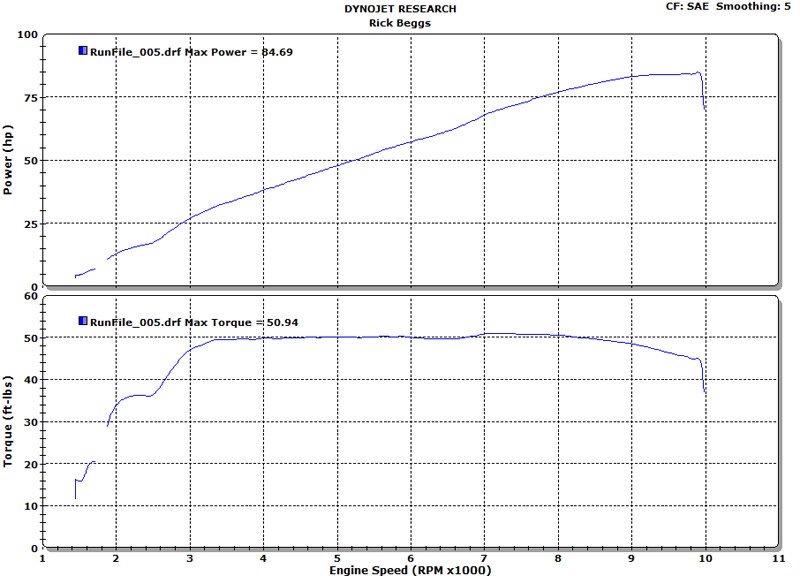
Triumph claims the Tiger motor produces 94bhp at 9,300 rpm with a peak torque of 58 ft-lb at 7850 rpm, but we did our own research by heading over to RnR Cycles for some dyno time. Our results varied slightly from Triumph’s which made us think the quoted output numbers are taken at the crank. At the wheels, we got peaks of 84.7bhp at 9,900rpm and a table-top flat torque curve you could eat off of cranking out 51 ft-lb at 7,100rpm. Our test bike from Triumph came with a nicely finished Arrow exhaust which may have helped the numbers. A couple horsepower aside, the biggest benefit would probably be weight savings and a nicer exhaust note.
Looking at the overall package, we’d have to guess Triumph put the greatest amount of emphasis on making this engine just right... and that’s only smart. The throttle response doesn’t have any of the disturbing “on and off” feeling that many fuel injected bikes exhibit, especially in their debut years. Smooth and strong, with a slick shifting transmission that doesn’t miss a beat, this young Tiger has a promising start.
BRAKING AND HANDLING
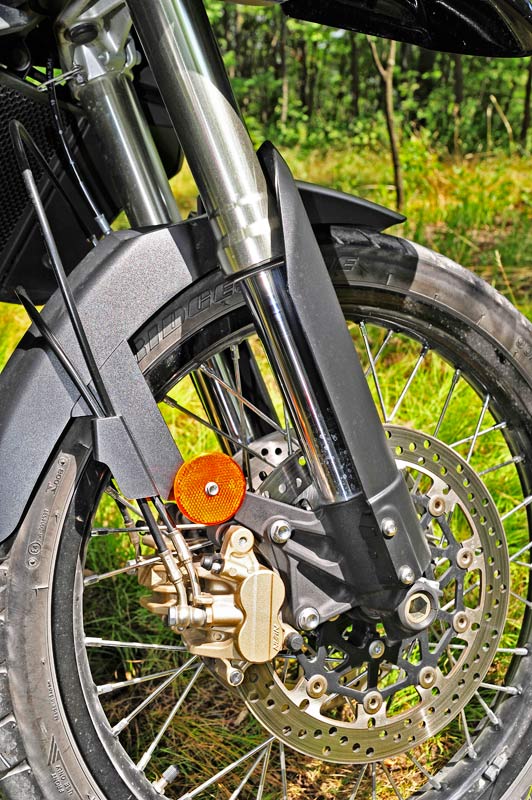 Between the Tiger 800XC and its XC-less sibling, the Tiger 800, their biggest difference is in the suspension and wheels. The Tiger 800XC gets a larger 21" front wheel with spokes and tubes all around. The Tiger 800 receives a cast alloy 19" front wheel, tubeless tires and a slightly shorter suspension which leads to a lower ride height, quicker turning and more pleasant street manners. You could really take the Tiger 800 on many of the same roads but if you spend more time on dirt, or have inseam to spare, the XC is definitely the way to go. Should, however, an enterprising rider want the best of both worlds, an XC front hub could be laced to a 19” rim for a fun and quick character change.
The stock Bridgestone Battle Wing tires on the XC were a little disappointing at first, but once off pavement we were pleasantly surprised by how well they worked. Given the XC’s extra off road brawn, we all agreed a 50/50 or 60/40 tire would have better fit the bike’s persona. The twin pot Nissin front calipers clamp down on dual 308mm rotors doing a great job of coming to a halt in a short distance. Front brake lever response is firm with stainless lines throughout that didn’t lock up too easily on tarmac or gravel, while the rear brake response was also firm and linear.
Our tester, Brian Jeffery, comes from a touring background and was a little nervous to throw a leg over the Triumph in the dirt (effectively on street tires) for the first time. Those nerves disappeared in about 10 seconds. He noted, the Tiger 800’s balance of suspension, geometry and linear power delivery is incredibly confidence inspiring off road, and that the front end exhibited less dive than the F800GS bikes he’s ridden thus far. The Tiger’s riding position is so well suited for off road riding, and it’s easy to read what the front end is doing. The Tiger 800XC will absolutely rip with a proper dual sport tire like a Kenda Big Block or Heidenau Scout K60s.
Handling was a little heavier than expected on asphalt, mostly due to its 21" front tire and wide low bars. The Tiger requires hefty steering inputs to get leaned over, but we found that with a little extra effort, the bike does what you want and feels planted. The front suspension, although not adjustable, was impressive for stock. Its oversized inverted Showa 45mm forks (2mm larger than the non-XC) traveled nicely and showed minimal flexing or twisting in corners. Stock settings stayed well balanced through side-to-side transitions and over large bumps. It would have been nice to see front forks have at least preload adjustment at this price point (the BMW F800GS has both preload and rebound), but we figure the next revision, or the aftermarket, will provide this feature.
LUGGAGE
Although our bike wasn’t available for long term testing, the Tiger’s long, flat rear seat and ample grab rails (which have thoughtfully molded hook stops) make strapping on luggage an easy chore. Our Giant Loop Coyote bag setup was in perfect proportion to the body and it could have easily taken more. The lack of plastics in the bike’s stern portion not only saves weight, and is one less thing to crack, but provides bungee mounting options galore. With the addition of a rack and side cases, now available through suppliers like Twisted Throttle and Touratech, there’s no lack of storage for whatever you may need to bring—which is almost always too much!
ADVMOTO DYNO RESULTS