 Sticky logo
 Search


What is green or red and rides all over? The newly updated 2009 KLX250S from Kawasaki! What is apparent with this ultra -versatile machine is that, barring any single profound change to the bike, cumulative updates add up to further enhance its overall performance. Let me clarify briefly, by “overall” I’m speaking about “overall terrain” performance rather than individual bike niche performance.
Alongside the pleasant sighting of several other new 250cc size dual-sports to appear this year, the KLX ranks high in the pack. Derived from the lineage of what once were termed “trail bikes”, this now termed “dual-sport” is taking the technology and capabilities of those former once “more preferred machines” to a new level.
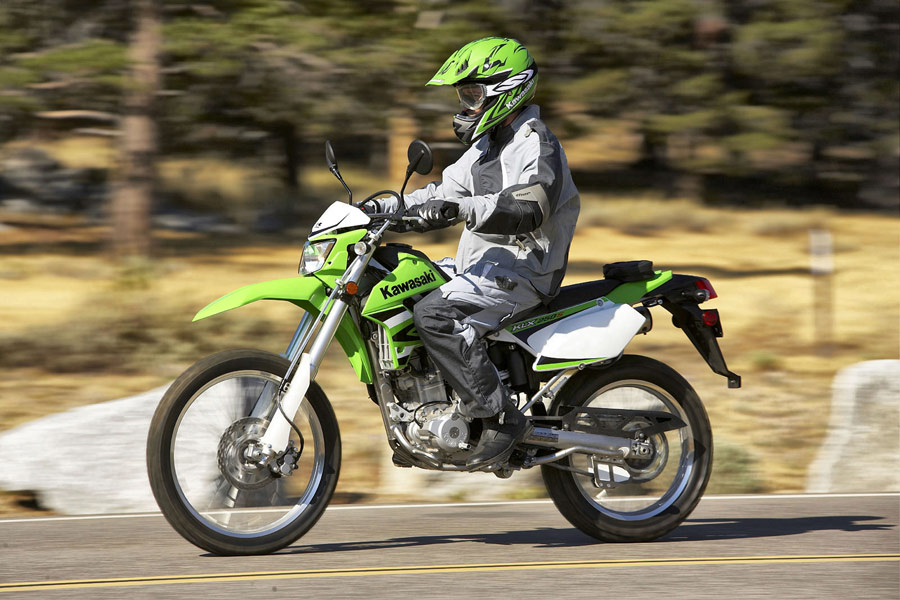 Photo Credit: TotalMotorcycle.com
Think of a bike that is light, say 275-280 pounds, then give it a nice leggy suspension, say nine to ten inches of travel. Place the rider in an upright seating position that allows for ultimate comfort, control, and minimal fatigue. Make sure the bike has healthy ground clearance, with a profile where the seat isn’t too high. Throw in a six-speed transmission that will perform from a walk-like crawl to above 70 mph with ample torque…and, what do you have? You have a super street bike, and a trailbike! Now you’re getting the picture of a KLX.
The KLX250 dual-sport has been around for about 3 years now. With the latest updates we find the bike has predominantly been sweetened. To begin, let’s look at some features, both frame and handling related.
ON THE BIKE SIDE
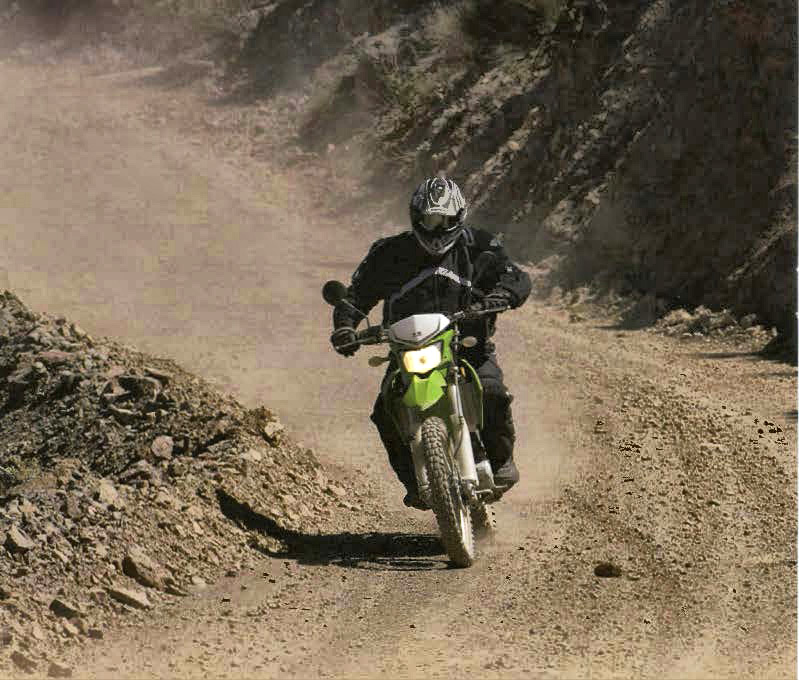 For one, the rake has been changed from 27.5 to 26.5 degrees. This accounts for the wheelbase being slightly shorter than the previous model. However, we should note, that among the other new similar sized bikes, the KLX wheelbase is three to four inches longer than its competitors. With the KLX wheelbase, wheel sizes (21 inch front, 18 inch rear), and rake combine to make an interesting situation.
For one, the bike has better stability due to a longer wheelbase when on open highway or outback. In contrast, this may make some tighter switchback trails a bit more difficult. Yet, as a balancing benefit, with a rake of 26.5 degrees, and typical offroad competition wheel sizes, the bike tends to turn responsively on both trails and tarmac.
New smaller block tread Dunlop D605F tires, and beefier 4.0mm spokes further enhance quick turning stability. These tires provide lighter smoother handling, with more grip on street, and greater longevity overall. On dirt, I found these tires to track effectively. They have a sense of durability; however with minimal sidewall height off-road, forgiveness is nominal.
Frame improvements further refine KLX250 handling. For one, the KLX utilizes a lightweight box tube style high tensile steel frame, with a new D shape cross section rear swing arm. This set up provides for rigidity and vibration damping within a rugged design. New racing type precision adjusters mount on the end of the swing arm for finer tuning chain adjustments.
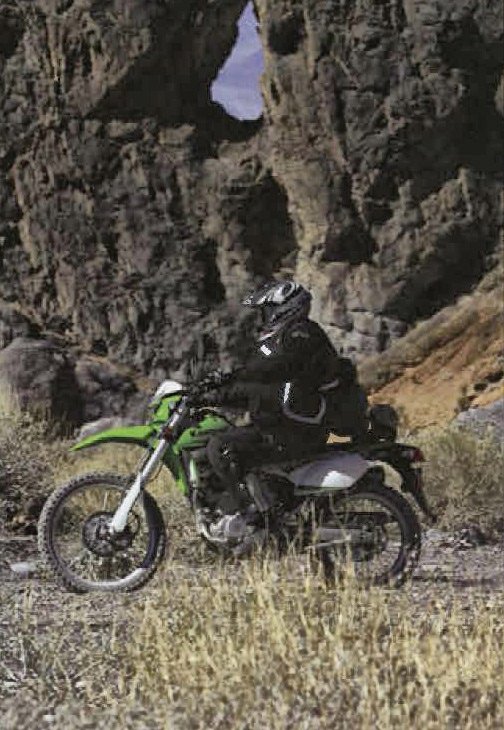 Suspension and braking have also improved. Starting up front, down turned 43mm diameter, 10 inch travel, 16 position adjustable forks have new internals. In the back; a revised Uni-Trak link, with a 16 position adjust compression/rebound damped shock has been retuned to 9.1 inches of travel. Overall suspension travel in this year’s model KLX has lessened by one inch. While this is likely an improvement in the overall sense, for open cross-country offroading we find it a slight pinch of compromise.
Brake refinements include; a 20mm larger rear disc, new petal discs front and rear, different brake pad material, and a revised lever ratio. Together with twin piston front and single KX ™ type rear calipers we find braking has improved power and feel.
Moving to the cockpit, one notices the KLX’s virtually all digital dashboard. The display window is a healthy 6 in. wide by 2 in. high and its well-designed readout makes for easy viewing in all but the worst bright sun-angle scenarios. A bar graph type tachometer spread across its entire width makes rpm viewing quick and excellent. Conveniently, both clock and trip meters are spread apart and at opposite sides of the view screen. In between them, a larger speedometer readout integrates nicely to make overall viewing uncomplicated, clean, and fast. At the bottom of the view screen’ high beam, neutral, oil, temperature, and turn signal indicator lights add further to the simple trim.
Handlebars on the KLX are about two inches narrower, slightly higher, and is highly personal, I found all but the narrower width to be an improvement. Ideally, I feel two inch wider bars would provide better leverage, control, and long ride comfort.
The bike’s new seat contour provides greater comfort and ease of ride position change due to the new shape. However, its firmer and thinner padding began to be noticed at the end of one long, good days ride. All hand and foot levers are tight and responsive. They have good ergonomic feel, they are positioned well, and they actuate cleanly and with little play.
*For a list of other great small displacement adventure bikes, check out our Best Used 250cc Adventure/Dual-Sport Bikes article.
(continued on page 2.)