 Sticky logo
 Search



Introduction
The essential features of an adventure motorcycle - strong engine, tough chassis with long travel suspension, upright riding position and wide handlebars - ensure its usability whatever the terrain. This practicality has been key to the popularity of these machines: they are easy to ride, comfortable and adaptable, at home on the road whether touring mountain passes and highways, or filtering through jammed city streets. And when the desire for a true adventure takes hold, they’re capable of traversing great swathes of distance after the tarmac runs out.
Throughout the development of the CRF1000L Africa Twin, the search for the optimal blend of off-road performance, touring comfort and agility was a constant theme. One motorcycle consistently impressed with its usability, poise and handling both on road and in the dirt: the original XRV750L Africa Twin. It proved a worthwhile benchmark when set against today’s myriad choice of adventure bikes. The machine that now bears its name may share no common part with the old model but - on road or off-road - it inherits to the full the essence and spirit of what made the XRV750L Africa Twin so popular.
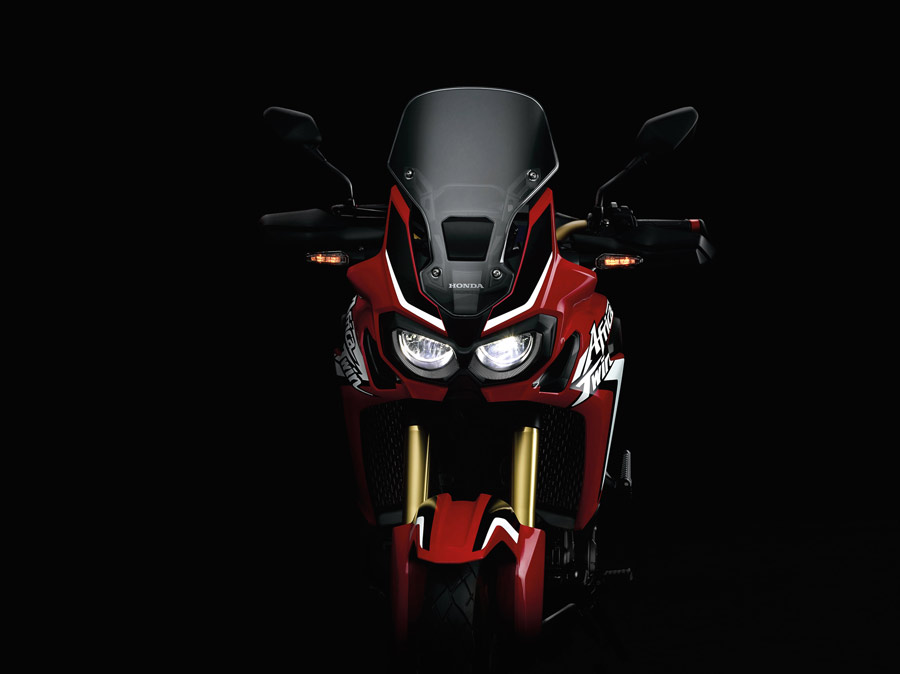
Mr Y. Hasegawa, Series Large Project Leader (S-LPL) CRF1000L Africa Twin: “From the outset of designing and engineering our new Africa Twin, we wanted to create a full-scale true adventure motorcycle that was equally enjoyable and capable in crossing vast continents as it was on the highway and in everyday use. The legacy and performance of the previous model was a significant reference point in our thinking and after many satisfying months of research work, testing, development and riding, our CRF1000L has off-road ability that makes dirt roads a joy to tackle, with the comfort of a tourer and agility of a commuter. In other words, a model truly worthy of inheriting the Africa Twin name.”
Model Overview
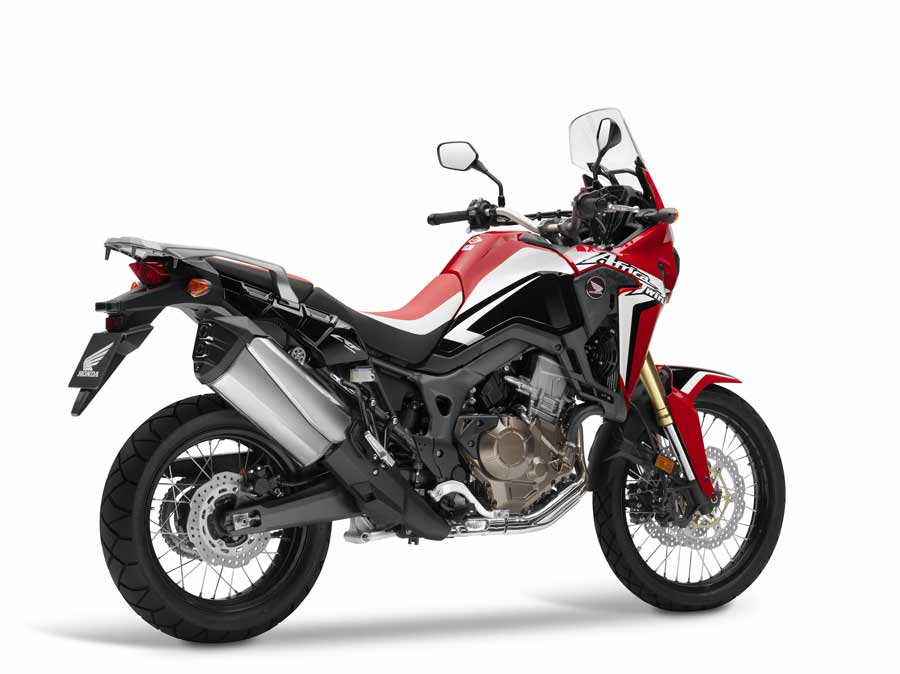
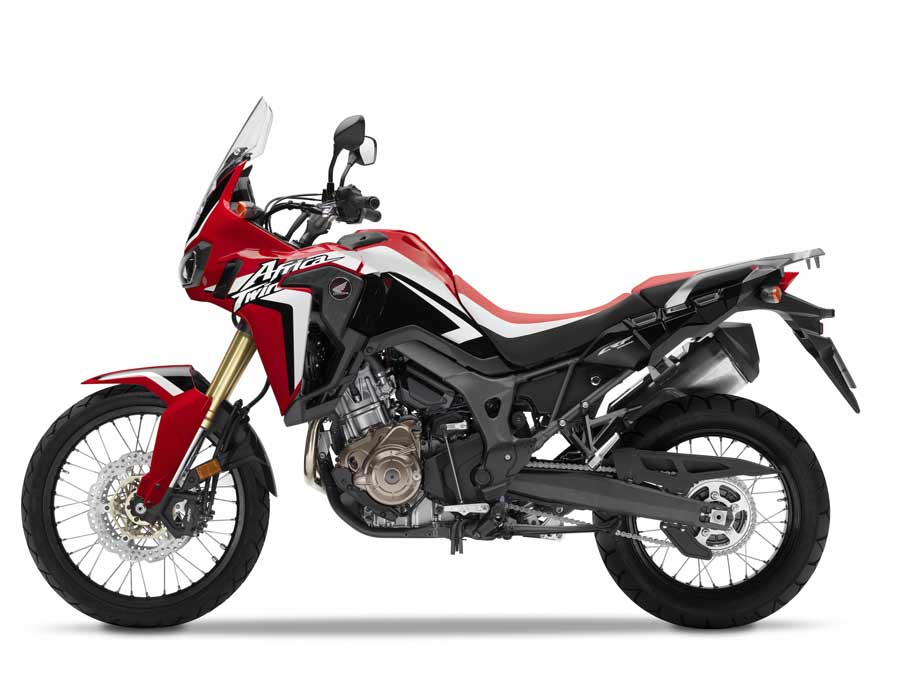
It all starts with the engine, which has to perform in off-road situations as well as on-road long-range touring, and all points in between. The CRF1000L Africa Twin’s 998cc parallel twin power plant draws heavily on Honda’s CRF250R/450R competition machines, using the same four-valve Unicam head design for compact overall dimensions.
Strong and linear power and torque deliver instant response anywhere in the rev-range - accompanied by a satisfying, characterful deep growl as rpm rises. A 270° phased crankshaft gives the power delivery a distinct character as well delivering excellent feel for rear wheel traction. Biaxial primary balance shafts cancel vibration.
The semi-dry sump engine’s short height contributes to the CRF1000L Africa Twin’s 250mm ground clearance. It also uses clever packaging of componentry to both dynamic and aesthetic effect. The water pump is housed within the clutch casing, and both water and oil pumps are driven by the engine’s balancer shafts. The lightweight six-speed manual gearbox uses the same shift-cam design as found on the CRF250R/450R to ensure positive changes and is equipped with an aluminium assist slipper clutch.
In addition to the standard model, two further versions are available: the first with ABS and multiple mode Honda Selectable Torque Control (HSTC), and the second equipped with Honda’s unique Dual Clutch Transmission (featuring new off-road functionality), ABS and HSTC. On ABS-equipped models, it is possible for the rider to turn off the ABS system for the rear brake, allowing the rider to lock the rear wheel when riding off-road. There are four levels of control to choose from the Honda Selectable Torque Contol: Level 1, 2, 3 and Off. The degree of intervention decreases as the levels rise, allowing increasing amounts of rear wheel spin.
The unique DCT (Dual Clutch Transmission) version features the standard manual mode - allowing the rider to operate gear shifts through triggers on the left handlebar - and two automatic modes. D mode offers the best balance of fuel economy and comfort cruising whilst S mode has been revised to give extra levels of sports performance, with three different shift patterns to choose from.
Of course, for the CRF1000L Africa Twin, DCT is also fully equipped to operate in an off-road environment and off-road functionality is enhanced by the G button. Pushing the G button in any riding mode modifies the control of the clutch system to give a more direct drive. The CRF1000L Africa Twin’s semi-double cradle steel frame provides the perfect balance of high-speed stability - while fully loaded - matched to genuine off-road ability by combining sheer strength with flexibility. Mass centralization - with items like the battery packaged at the rear of the cylinder head - contributes to a low centre of gravity and aids agility.
The 45mm Showa inverted forks are fully adjustable and feature dual radial-mount Nissin four-piston brake calipers and 310mm ‘wave’ style floating discs. The Showa rear shock has hydraulic spring preload adjustment. Like the CRF450R Rally, the CRF1000L Africa Twin uses 21 inch front and 18 inch rear spoked wheels. This enables a wide range of off-road tyres to be fitted in addition to the standard duel purpose 90 front / 150 rear tyres.
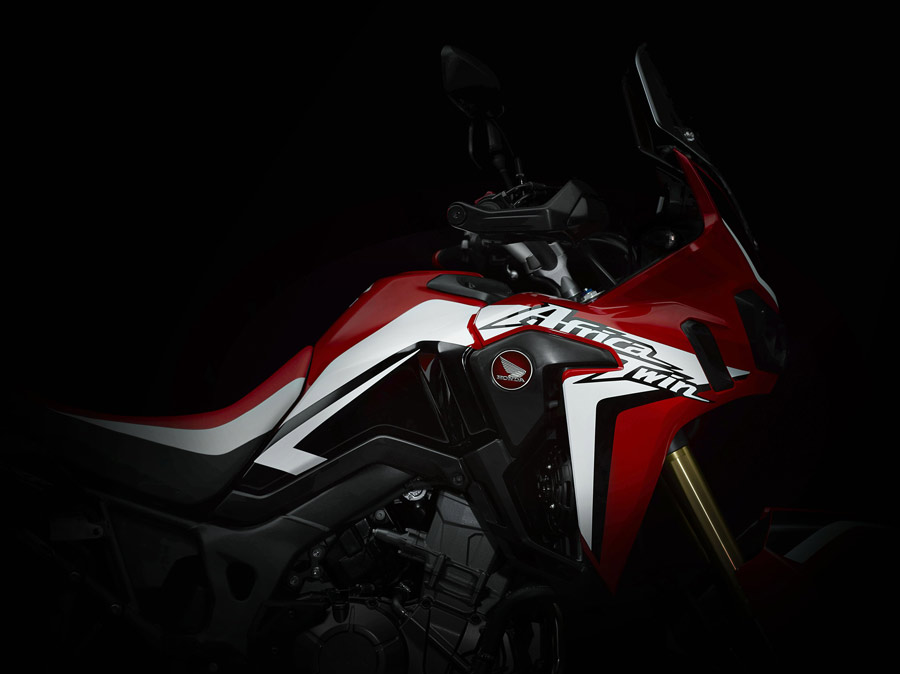
Following its design theme of “unlimited adventure”, the Africa Twin is styled with minimum bodywork in a tough, lightweight form that offers both weather protection for the rider and a slim, agile feel. Dual LED headlights maintain the original’s presence and the seat height adjusts 20mm from the standard 870mm down to 850mm. A large 18.8-litre fuel tank - and the engine’s fuel efficiency of 21.8km/l (WMTC in DCT mode) - provides a range of over 400km.
Key Features
Engine
Compact, lightweight and powerful; the CRF1000L Africa Twin’s parallel twin-cylinder engine makes 70Kw peak power @ 7,500rpm, and 98Nm torque @ 6,000rpm. It features a 270° phased crank, Unicam 4 valve-per-cylinder head and dry sump plus common crankcases for both DCT and manual 6-speed gearbox versions.
The CRF1000L Africa Twin’s engine has been engineered with a special focus on two key areas - tractable and usable all-day touring performance and a power and torque delivery that offers genuine feel for rear wheel traction. The natural by-product of these abilities is that the machine is also a great all-rounder - as happy on the urban commute as anywhere else.
The parallel twin layout in 998cc form gives an optimum balance between power, torque, mass and physical dimension, especially when designed from the ground up with weight saving, mass centralisation and a low centre of gravity in mind. And lessons learned in both HRC’s CRF250/450R Motocross and CRF450R Rally competition programs have been thoroughly applied to keep the dimensions and weight to a minimum - longitudinally the CRF1000L engine is the same length as the CBR500R engine.
A V-twin of the same capacity and output is physically too long and tall to effectively package a motorcycle with the Africa Twin’s performance objectives. With 70Kw peak power produced at 7,500rpm, and 98Nm torque arriving at 6,000rpm the new engine creates a linear, straight power curve and bulging torque curve for fluid, accessible bottom and mid-range drive, plus consistent top-end punch.
Good ground clearance - crucial to off-road performance - starts with a compact, short engine. The crankcases are split vertically with a built-in oil tank (the first Honda to feature such a design). The water pump is housed within the clutch casing (a first for a motorcycle engine) with a thermostat integrated into the cylinder head.
This allows a shorter hose length and frees up scope for appealing exterior design (also eliminating the external mounting bolts) while saving weight. The water and oil pumps are driven by the engine’s balancer shafts; Manual and DCT versions of the engine share common crankcases with only minor external differences.
The engine uses a semi-dry sump and in-tank lower crankcase oil storage. This allows a lower pan depth, reducing overall engine height. As the pressure-fed pump is located within the tank where it delivers its oil from, there is no need for a pressure-feed passage; again saving weight and space.
The four-valve cylinder heads, fed by PGM-FI fuel injection, each employ twin spark plugs and dual and sequential ignition control for even combustion, and their phased firing order contributes to engine character and feel. Compression ratio is set at 10:0:1.
Honda’s SOHC Unicam valve train is a feature of the CRF250/450R and the low-set position of the cast camshaft (as used on the CBR1000RR Fireblade) contributes to the compact nature of the cylinder head and allows freedom for the included valve angle, and therefore an ideal combustion chamber shape. It’s also a lightweight design and helps with mass centralization, thus low centre of gravity. The inlet valves are 36.5mm in diameter, the exhaust valves 31mm.
The firing order and ‘power pulse’ of the XRV750 Africa Twin’s V-twin engine gave excellent traction and feedback for how much grip the rear tyre was finding. For the CRF1000L Africa Twin to achieve the same kind of throttle feel an uneven-interval firing order, through use of a 270° phased crank system is employed.
Secondary vibrations are neutralised by the mutually reciprocating motion of the pistons, while primary inertial and coupling vibrations are cancelled by the use of biaxial balance shafts. The front balancer shaft uses two weights, the rear only a single weight in order to save weight.
Bore and stroke is set at 92 x 75.1mm. This bore size is used to optimise the CAE-designed pistons’ balance of rigidity and strength and a resin coating on the skirts reduces friction. Further reducing friction, AB-1 chromium plating and Palphos M1-A treatment (as used on the CBR600RR) are applied to the piston pins and con-rods.
The aluminium clutch centre and pressure plate use ‘assist’ cams to ease upshift and downshift (with lighter lever feel) and ‘slipper’ cams for deceleration and downshifting. Backlash between the pressure plate and centre has been optimized, as has backlash between the friction plate and clutch outer.
As the six-speed gearbox is a brand new design - with ‘pierced’ shape dogs for 1st, 2nd, 3rd and 4th gear - the clutch itself is physically smaller, saving 500g compared to conventional units. Oil gathering ribs have been added to the main journal side of the primary gear, ensuring consistent lubrication for the gear, damper spring and primary sub-gear.