 Sticky logo
 Search


Weight-saving helps with another vital point for any overlander to consider; in particular the solo traveler. One of the things I feared most in my early days on the road was what would happen if I fell off the bike and it landed on top of me. If there wasn’t anyone around to help me escape I would be in serious trouble. Recently, I was reading about Nick Sanders; long-time adventure traveler. On one of his trips through the Americas he landed himself in the sort of trouble I feared. On his way across Patagonia, the winds combined with the road conditions to make life suddenly go wrong, big time. His bike ended up on top of his leg, and broke it. It started to snow and he’d hardly seen any traffic for days. Sheer guts and desperation eventually drove him to drag his broken leg out from his bike boot, which he had to dig out from under the bike. He was lucky, but still had to ride with that broken bone.
Ed commented on this, “I’ve ridden down roads that big bike riders won’t in case they fell over and couldn’t pick the bike up, I’ve even lifted my bike over fences (she only weighs 180 lbs.). And I’ve even done a test to see if I can pick her up with only one arm and one leg in case I fall off and badly injure myself with no-one around. The average “adventure” bike weighs over 500lbs….”
Nathan told me that there were other advantages of this ilk. “My bike was so small that I could easily squeeze her between a gap in the hedge in order to camp out of sight for the night.”
The guys grinned when I brought up the subject of spare parts. We’ve all heard of people waiting for weeks for simple parts for their BMWs, KTMs, KLRs, and so on. Nathan’s bike only needed a new front sprocket and regular oil changes. Although he went through eight rear tires, and one front, those tires cost less than $5 each—fitted. In Thailand, Ed’s C90 started smoking, so he decided to get an engine rebuild. A new piston, rings, valves, a carburetor rebuild, gaskets, oil change, spark plug and lunch, all at a genuine Honda garage, only cost him $43. And, it took under three hours to sort out and have the parts fitted. In another grin-accompanied comment Ed said, “I can get any engine component just about anywhere in the world for my C90, almost instantly.”
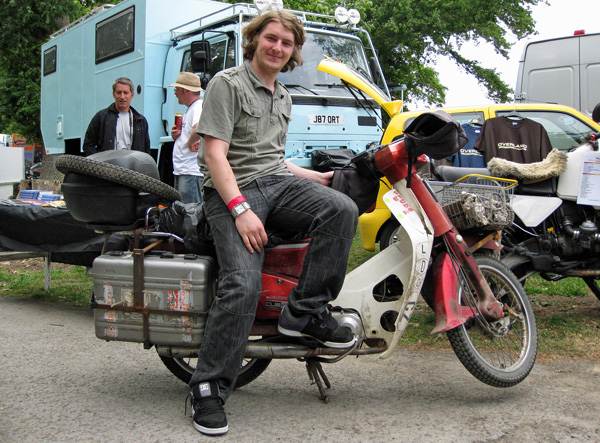
One of the key things I’ve picked up from them both is that they feel their slower pace allowed them to connect with the locals in a way that would have been much more difficult otherwise. What a bonus.
A story of Ed’s that I particularly liked was the tale of the Malaysian customs officer at Kuala Lumpur. The official was very serious and methodical. He told Ed that the task of passing the bike through customs required hours of paperwork before he’d be able, finally, to begin the inspection of Ed’s bike; the checking of chassis and engine numbers and looking through his luggage, etc. But when the customs officer saw the little C90, he said, “You’re riding that around the world? You’re crazy!” And, as soon as he stopped laughing he stamped all the paperwork and sent Ed on his way without checking anything else.
Ed told another story that really hit home. “Throughout Southeast Asia, whenever I stopped at a local’s home, or a friendly hotel, I lost count of the amount of times that I was dragged off to be shown their Honda C90 or close variant. The thing I enjoyed most was the realization, during many of these conversations, that their dream was also to ride around the world… and that their bikes were often in better condition than mine! They’d always been told they could never afford to buy the “right” bike to do it, and there I was, riding around the world on a bike just like theirs.”
Are you beginning to be convinced? Surely a cheaper bike that weighs less, drinks less, has no problem with spare parts, and is the best ice-breaker ever between the rider and the local people, has to be a go. And, we haven’t even talked about saving on the motorcycle kit. I know Nathan is extreme, because his kit amounted to not much more than a pair of Converse boots and skateboard trousers. Thankfully, a chap he met along the way kitted him out with some cast-off waterproofs—pink ones! There seems to be a significant change in pride points for these small CC overlanders.
So, how did their choice of bikes affect their adventures? The key was that they were quite happy to adapt their plans accordingly. In fact, other than some mechanical issues along the way, it appears as though they each had a stunningly good time. They rode on some of the most rugged roads in the world, and at altitudes that no sane person would be advised to take small CC bikes. Their attitude? It’s all part of the challenge, and out of every challenge rolls an adventure.
All this still begs the question, “Are small bikes better than big bikes for overlanding?” Nathan sums things up very well. “I don’t think it’s so much a case of choosing the bike best suited for the adventure, it’s more a case of choosing the bike that can give you what you want out of your journey. At the end of the day, all bikes are built for adventure. But my CT110 was very close to being ideal. With bikes, as with many aspects in life, you make do with what you have or can afford, and most of all us choose our bikes accordingly. If that’s a Harley Davidson, a BMW GS, or a little red postie bike named Dorothy, then so be it. What matters most is the way you ride it and the adventures you allow it to take you on.
Ed had a rather more pointy comment, “If the road is too straight and boring to ride a small bike on, blame your choice of road, not the bike.” Now there’s a thought. I wonder…