 Sticky logo
 Search


Cash rich, time poor? Or time rich and aware of a wealth of opportunities? I’m often caught saying that you can do your trip on any bike you like, but what’s the reality? The idea of this article began easing into my mind whilst reading a book that was recently republished. Peggy Iris Thomas motorcycled across Canada, through the U.S. and Mexico on a 125cc BSA Bantam. To add to her adventure, she rode with a 125-pound Airedale dog on the bike’s rack! But, did she see any downside to riding such a small bike? Before she departed her critics hammered home the point that it simply wasn’t possible to do such a mega trip as a novice on an underpowered motorcycle. In her book, Gasoline Gypsy, Peggy does mention the lack of power at altitude but other than that….
Of course, ADVMoto readers will already know about small bike adventuring from Lois Pryce, author of Lois on the Loose and Red Tape and White Knuckles. For those of you who don’t know Lois, her first big transcontinental bike trip was from Alaska to Patagonia on an XT225 Serow. And, you’ve probably heard of Simon Gandolfi, who was 73 when he set off from the Gulf of Mexico and made his motorbike trip to Tierra del Fuego at the southern tip of South of America. His ride? A 125cc Honda.
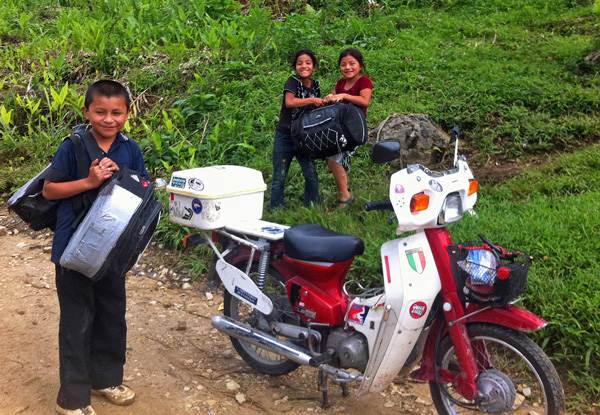
But, the idea for this article really came together at the Horizons Unlimited Overlanders Meet in the U.K. There I met a couple of young lads who’ve broken plenty of the respected overlanding standards, and had a ball doing it. I’m itching to say that they are ordinary blokes, but I soon found out that they’re far from it. To begin with they have a huge enthusiasm for a version of motorcycle travel that many have never seriously considered, let alone put into practice. As you read on, perhaps you’ll be happy with calling them odd-bods, but don’t be surprised if you start to come around to their way of thinking.
Chatting with Ed and Nathan lead me re-analyze some of my own considerations, and that’s part of the beauty of overlanding isn’t it? Travel allows us all to test and knock preconceived ideas. For sure this duo made their solo adventures happen in their own rather unique ways.
Ed March had just ridden from Malaysia on through Southeast Asia, and from Asia and the Middle East to the U.K. on a Honda C90. And Nathan Millward rode a Honda CT110, an Australian postman’s bike, from Sydney across the Himalayas, through the old Soviet countries of Central Asia and across Europe to London. A distance of 23,000 miles, taking him nine months to complete and passing through 18 countries along the way.
As we chatted I quickly became aware that they were very conscious of two key points. If they spent less on their bikes and cobbled their kit together, then the money saved would:
1. Make it affordable for them to travel in the first place, and,
2. Give them the chance to stay out on the road much longer.
But, there are both advantages and disadvantages to traveling by a small bike, isn’t there? The first that leaps into my mind is speed. Part of the reason I enjoyed my own trip around the world was that most of the time my BMW R80GS allowed me to judge how fast I could cover ground.
Nathan, on his Honda CT110, told me that he sometimes did wish for a touch of extra speed. With throttle wide open, his cruising speed was 45 mph. But even that allowed him to cover as much as 400 miles in a day when he needed to. “With the imposed top speed of 45 mph, it meant that I couldn’t race to get anywhere, and because of that I got to see and experience more, which is really what it’s about.” However, there were moments crossing the Himalayas at 17,388 feet, or riding the German Autobahns during the night time, when he really wished for a touch more than 7 HP. The bonus, of course, is that his bike was returning 100 mpg!
Ed’s Honda C90 was also only able to cruise at 45 mph, and he said, “If you’re riding around the world and everyone else is on bikes that do 45 mph, and the road surface isn’t good enough to do over that, and the scenery is stunning—why would you want to go over 45 mph?”
A bonus of small bike travel has to be the weight savings. I know I battled with the bulk of my bike on some dirt roads and there were a couple of occasions when local guys on small CC bikes shot past me looking as if they didn’t have a care in the world. And, on the occasions when I’ve ridden small bikes off-road, they have proven their point. There were some wooden bridges, for example, that my GS would have fallen straight through!
If you are planning to ride anywhere other than South and Central America, then the cost of your carnet de passage is another very pertinent point. The fee is judged, in the main part, by the value of your bike. There’s also the shipping and air freighting costs that an overlander must take into account.
Nathan gave me some practical examples. “My bike didn’t cost much to ship between various places (Darwin to East Timor by sea—$318, Bangkok to Kathmandu by air—$650), and on an Australia to Europe trip, those are two of the most expensive costs one is likely to encounter.
Ed told me that it wasn’t only the continent-to-continent costs that were affected. A small bike can often let you get into places that a traveler with a big bike just can’t. “I spent hours in Thailand trying to get my bike onto a passenger ferry to Ko Phi Phi Island with no luck (there are no roads on the island and as such no vehicle ferries). After a day of asking I was close to giving up when I decided on a new approach. I’d take my bike along into the office when meeting with the officials. The first place I went back to said, “Oh that bike, we though you meant a huge European bike!” I ended up paying an extra $4 charge for two people to lift it onto the boat over the handrail and all was well.