 Sticky logo
 Search


“Our biggest mistake was not doing enough research and planning beforehand. The finale was rolling our bikes across a 2" x 6" plank while teeter-tottering them from boat to land. The town of Turbo isn’t as bad as most people say, however it isn’t exactly the kind of town you want to hang out in.”—Caroline Brown
Without the proper planning you too might find yourself walking the plank.
The Darién Gap is one of the greatest challenges to overcome when riding the famous Pan American route that stretches from Alaska to Ushuaia, the southernmost tip of Argentina. With the route’s growing popularity there are now several shipping options available. We compiled a list to help save time and money, depending on what you’re looking to accomplish.
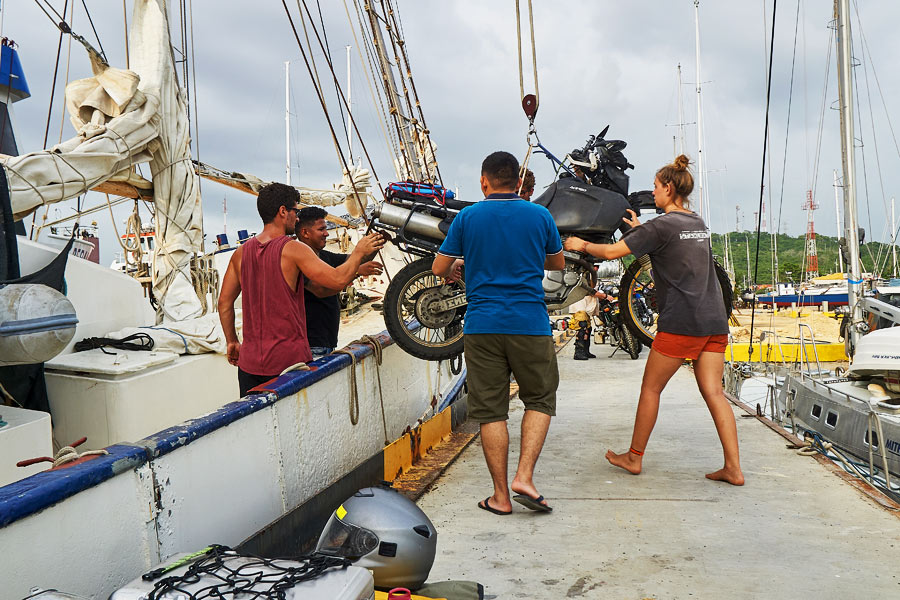
Risking safety and sanity. The "under-researched" option.
A number of rogue operators run pleasure crafts bypassing the gap and promote themselves as discount carriers. Caroline Brown of DR Amigos fell victim to one such operator known currently as The San Blas Cat.
They were picked up in Panama and promised passage to Sapzurro, Colombia, a remote town with no roads exiting into mainland Colombia. From there they were told it would be easy to transport the bikes and themselves to the town of Turbo. This proved not to be the case. Instead they discovered that importing legally or easily into Colombia would be near impossible.
Caroline says, “The dock in Turbo is like nothing I’ve ever seen. Boats of varying sizes and conditions ranging from barely afloat to mostly intact were stacked as much as three deep. Most appeared to be abandoned. News spread quickly that there were three people waiting for their motorcycles, most dock hands knew our boat by name so that was comforting. With the help and chaos of about 20 dock hands, we found a place to move our bikes to land—we just had to go over three other boats and their cargo in order to do it!”
Original quote from The San Blas Cat: $450/person and $350/bike.
Surprise cost for three bikes out of Sapzurro: $25 plus shipping themselves on a separate boat.
Total cost in the end: “Roughly $1,000 per person and bike, four hours of customs/immigration, and a hell of a lot of luck.”
Contact: Don’t bother.
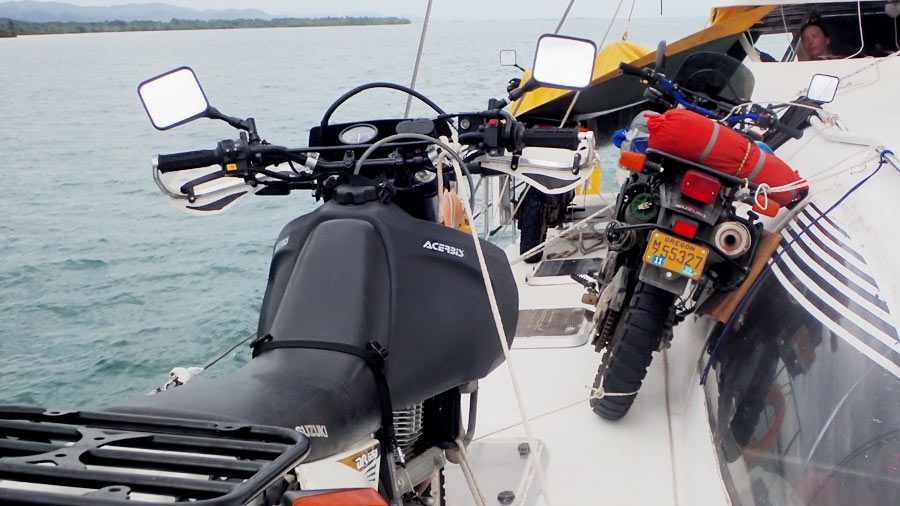
"Sailing the Stahlratte", a 110-year old schooner option.
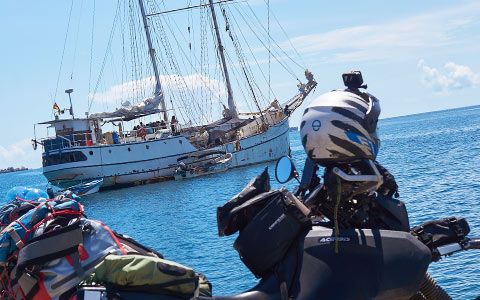
If you’re looking for a more reliable and enjoyable experience that’s been well reviewed, the Stahlratte is a 120-ft. schooner that’s more than 110 years old, and able to transport 21 people and motorcycles. Philippe Berini of Motophil.ch recently shipped his Suzuki DR650 with this service and had this to say: “I love to be on boats and I found new energy for my traveling. It’s great to experience the San Blas Islands and life on the boat for a few days. Captain Ludwig is a fantastic guy and the crew was very good too. You will meet many other moto travelers, too. The food is great and all the paperwork for entering either Panama or Colombia is taken care of. If you can afford it (and are not overly prone to seasickness) then I’d highly recommend it!”
Cost: $1,200 for bike and rider, including all food, transport and paperwork.
Additional cost: $23 paid directly to the Kuna people for passing through their territory, the San Blas Islands.
Contact: Stahlratte.org
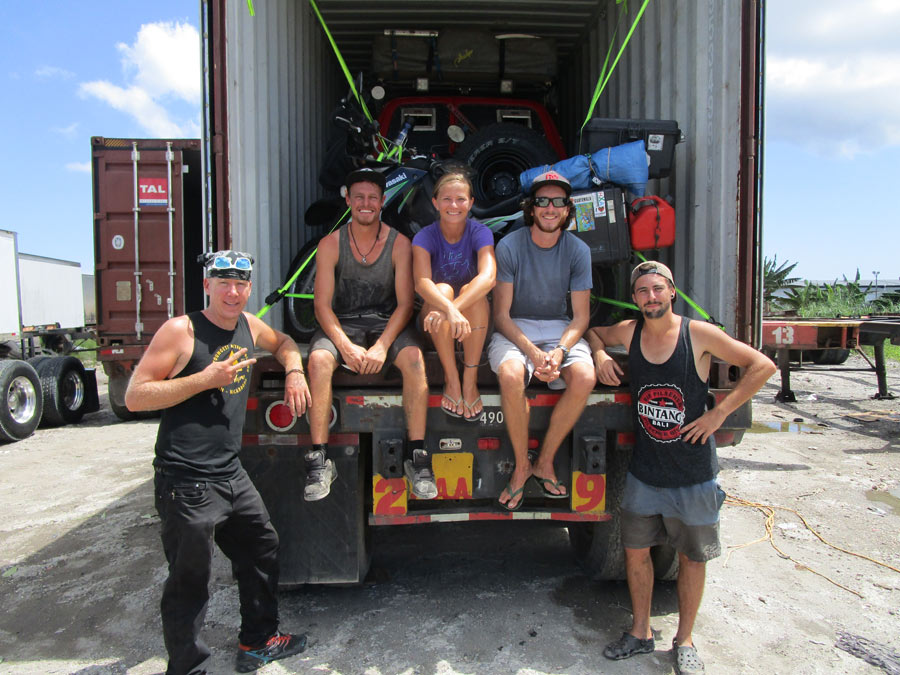
The "more time, less money, budget-friendly" option.
I chose the best value option by splitting a shipping container with two other overlanders and their SUVs. This is the best overall cost savings. However, it’s the least exciting and most frustrating option, taking five to 10 days and sometimes more, along with two full days of running around Cartagena chasing paperwork.
On a popular Facebook group, PanAmerican Travelers Association, I found a posting for some overlanders looking to split a shipping container from Panama to Colombia: Me with a fully loaded Kawasaki KLR650, two Germans with a Toyota Land Cruiser, and an Australian/Polish couple with their Mitsubishi Montero.
Loading on the Panama side was relatively easy, and I was surprised that we were allowed into the shipping yard to help. On the Colombia side the bureaucracy is enough to test one’s patience running from port to office to Aduana (Customs) to photocopy center and around again. This goes on for two entire days in the mid-30-degree Celsius heat.
Cost: $2,100 for the shipping container, we split 40/40/20.
Additional cost: $3 for photocopies, about $100 for a personal flight, as well as hostels for seven nights at $15/night.
Overall review: Great for anyone looking to do it the least expensive way possible; however, after factoring in food and fun in Cartagena for a week, for a few hundred dollars more a sailing trip aboard the Stahlratte would be much more memorable.
Contact: Boris Jaramillo at Everlogistics.
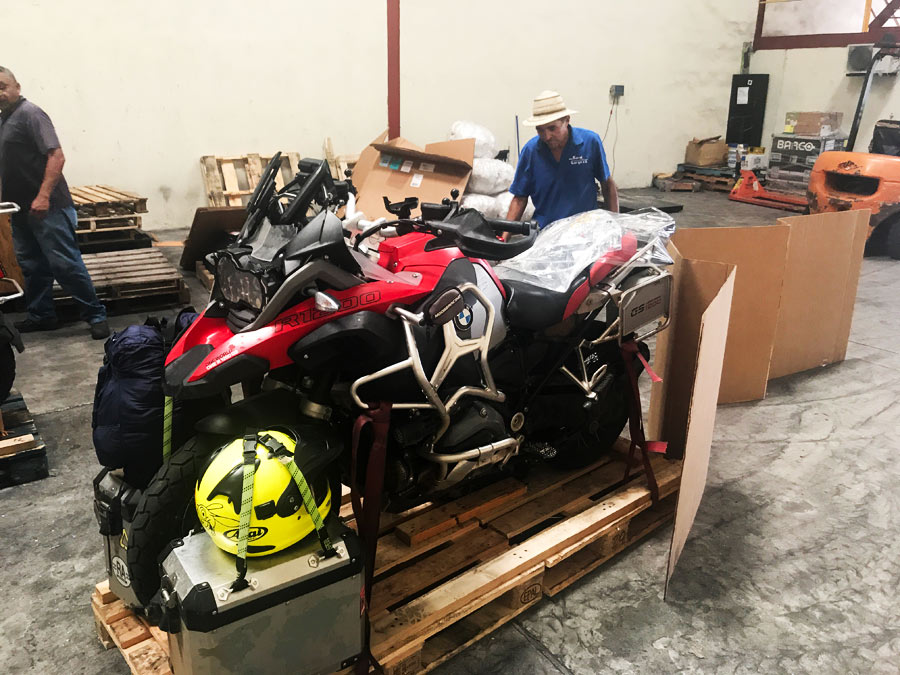
The "more money, less time, less hassle" option.
If you’re racing against the clock, or perhaps you’ve got more money than time, or if you just have a preference for efficiency, then flying your bike is likely your best option.
A number of companies will allow you to easily and efficiently fly your bike direct from Panama to Colombia or vice versa. Erwin Estigarribia, who shipped his BMW R1200GSA with DHL from Panama City to Bogotá said, “Getting the bikes out of customs in Bogotá was a game of cat and mouse with officials. It took us eight hours mostly just waiting around. Take water and snacks as you’ll need them.”
Cost: “$800, plus a personal plane ticket and a few nights in a hotel as the bike was shipped on a Friday and could not be picked up until Monday.”
Overall experience: “Very easy, just go to the freight part of Panama International Airport and look for DHL who will point you to the freight forwarders down the street. They do the paperwork and pack the bike. However, you will need to bring your own tools in order to disconnect the battery, remove the windshield and mirrors. Also leave just enough gas in the tank to ride to the closest fuel station once you land.”
Contact: DHL.com.pa
Alternately, Dan Long shipped his KLR650 with Air Cargo Pack from Panama City to Bogotá. He said, “I reached out to the company about two weeks before, but I didn’t send them a firm date until four days before shipping.”
Cost: The cost was $1,100 for the bike. And Dan had to pay for a flight for his flight separately.
Overall experience: “Very easy process. Dropped the bike off at 8:00 a.m. and was done shortly after 9:00 a.m. Picked the bike up in Colombia right after landing, it took about two hours to clear customs, etc. The staff at Air Cargo Pack don’t speak the best English, so if you don’t speak Spanish be prepared to work on translating. The company handled all the paperwork and dealt with all of the customs officials. All I had to do was sit and then sign the paperwork.”
Contact: AirCargoPack.com
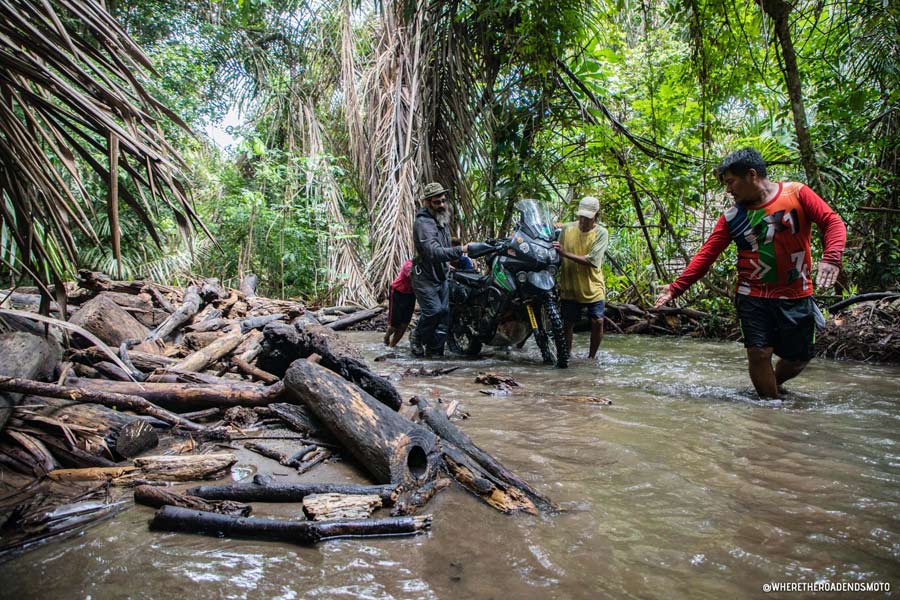 Photo by Where the Road Ends
"Push, pull or drag" option.
If, say, you are a team of military veterans with a number of sponsors and the budget to hire a team of locals that live in the Darién, then your options just diversified. That’s what the boys from Where the Road Ends have done on Kawasaki KLR650s—successfully pushing their bikes (well, all but one of them) through the sweaty jungle in early 2018. Have a look at their story online: WhereTheRoadEndsMoto.com
Things change, boats sink, countries go through political unrest, and new routes open and close all the time. When embarking on an epic adventure such as riding the Pan American Highway it’s best to confirm all your information before hitting the road. The above options are as current as it gets in term of shipping over the Darién Gap—but don’t forget to follow up your research.
 Kix Marshall is a Canadian-born speaker, travel writer, and entrepreneur. His first love is travel and when it seemed he wouldn’t be able to finance a plane he settled for the next best thing, a 2009 Kawasaki KLR 650. Now he has a second love, adventure motorcycling. TravelSchooL101.com | KixMarshall.com