 Sticky logo
 Search


A Five-Step Guide to Prepare Your Own Motorcycling First Aid Kit & Sample Kit
As a former first responder and pediatric nurse, I’ve put together the following tips to help make a first aid kit suited for the average adventure motorcycle traveler. A proper kit is something you hope you never need, but if you do, it could save a life. In this five-step guide, you’ll learn what’s needed to properly prepare a first aid kit, where to train for the moment you need it, and why training is far more important than a fancy first aid kit.
Step 1: Decide what you need to learn
How well do you want/need to be prepared? That’s a question only you can answer. There is general first aid training, such as the Red Cross, or Wilderness First Aid training, and even Extreme Motorcycle First Aid training. Whichever you choose, it all comes back to the same basics. Don’t have any training yet? Start by getting general first aid training, the knowledge from which will prove helpful in everyday life, regardless of whether you are on the road or not.
Step 2: Get decent training
The better the training, the less gear you’ll need. With training, you’ll be able to improvise better, keep your cool in an emergency, and have far less chance of making mistakes. For example, we carry tourniquets, which are used to stop heavy bleeding such as an arterial wound. However, with proper training, you’ll learn how to make a tourniquet from scratch in seconds. Put another way, it’s better to have decent training but no gear than all the gear but no training. Your first aid kit might not help if you don’t know how to use it.
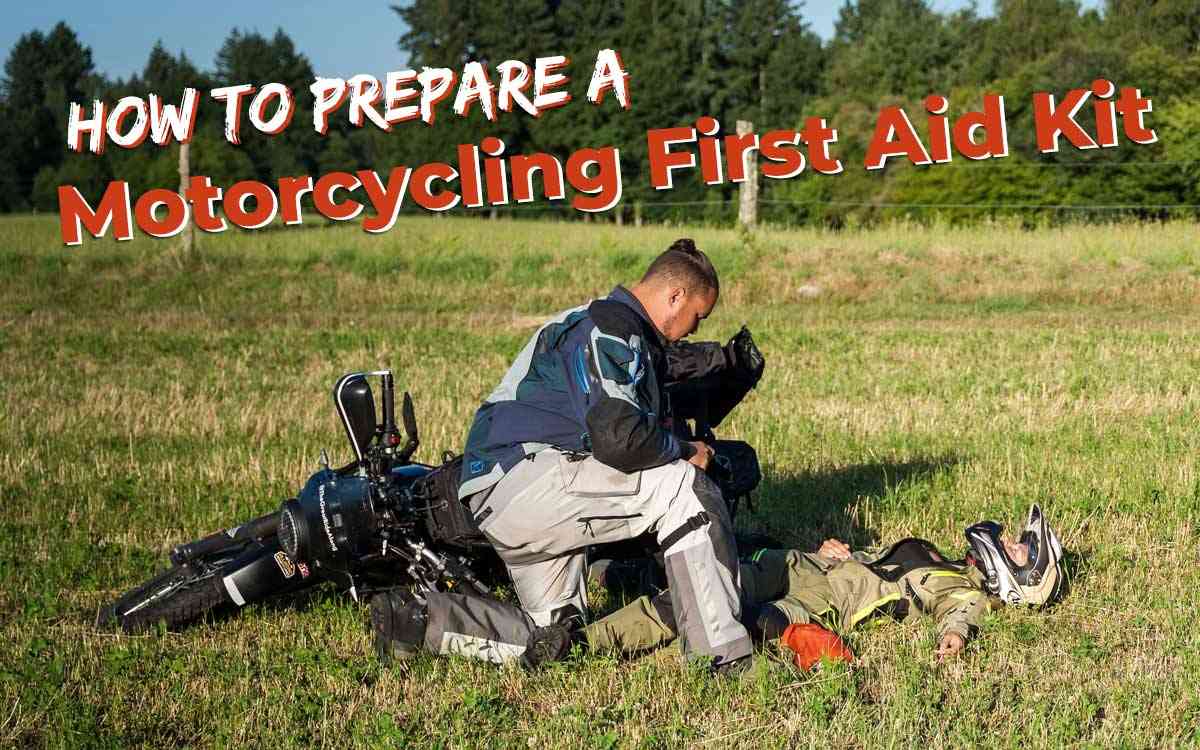
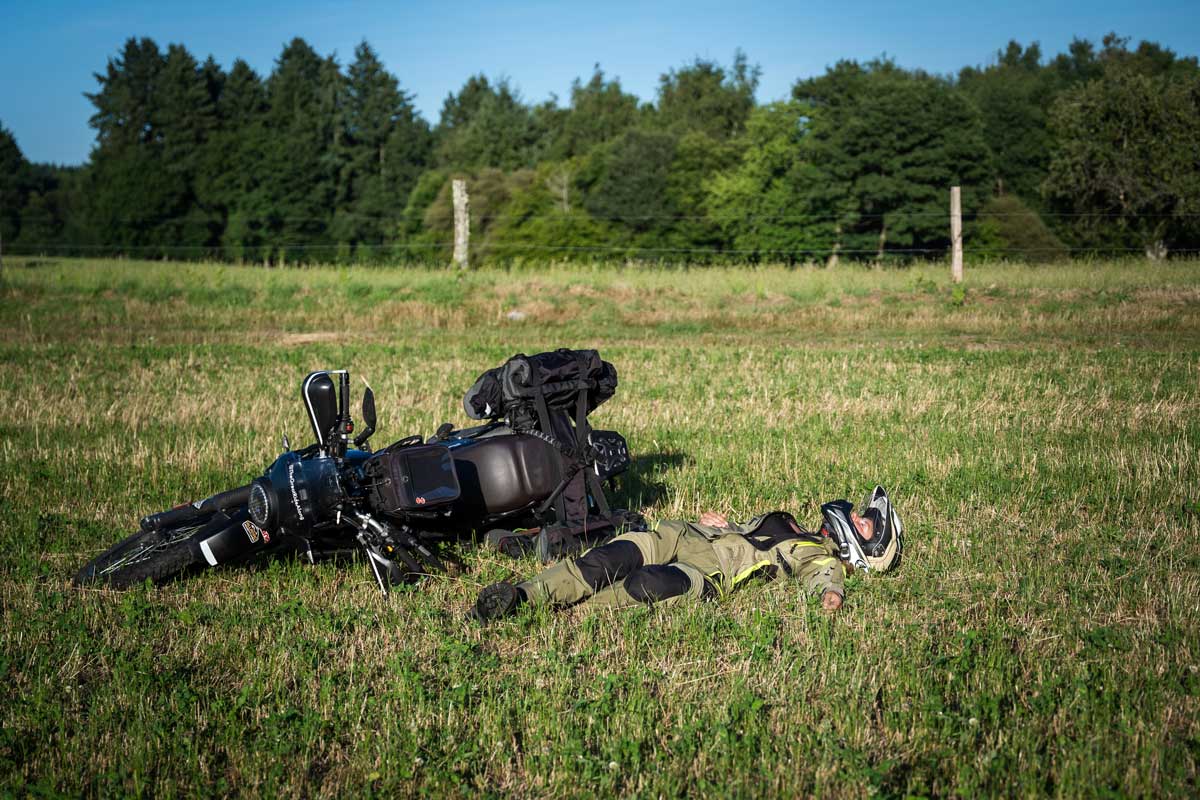 To make sure we are prepared, we practice with simulated crashes.
Step 3: Be real
The chances of a major accident happening where you need to apply that tourniquet before the victim bleeds out are slim. But you do need to be ready for day-to-day incidents. In Wilderness First Aid training, it’s easy to get excited about emergency helicopter extractions in the middle of the night. However, the truth is that most of us will more likely be removing ticks and will never be involved in such an experience. The point is that it’s just as important to be prepared for the smaller things as for that one major event.
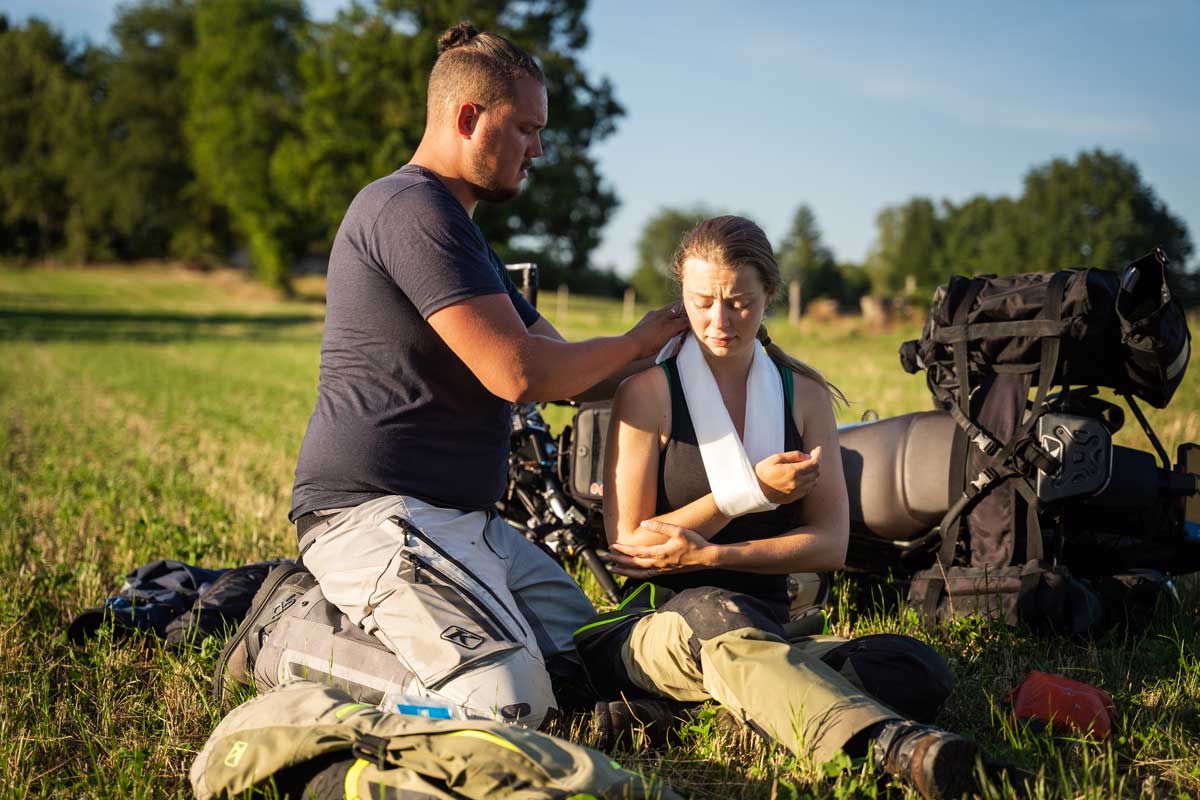 Simulation showing assisting a rider with a broken upper arm.
Step 4: What you want in your first aid kit
The most important rule in (extreme) first aid: Don’t be a hero! This also applies to your kit. Only bring gear you know how to use. If you’re not trained in using a tourniquet, adrenaline, or heavy painkillers, don’t bring them with you. That said, do bring what you anticipate might be needed and you’re not likely to have easy access to in areas you'll be. In populated first-world areas, there’s no need to carry emergency antibiotics. But for areas such as the Amazon rainforest, African deserts, or even riding days away from major towns in the Americas, check with a specialized physician for suggestions and recommendations (and the meds you can legally cross borders with).
Step 5: Properly pack your first aid kit
The final step is to pack your first aid kit properly. This mostly means three things:
- Always carry it in a quick-access location and always use the same location.
- Make absolutely certain the bag (or bags) is waterproof. Most first aid items won’t fare well if they get wet.
- Find an organizational system that works for you. For our system and other suggestions, keep on reading.
Our first aid kit
Remember, know what you are doing. Don’t know how to use something? Check whether you really want to bring it.
We travel on two motorcycles, and our first aid kit is divided into four 2–3L bags. The system is quite simple, the RED bags are for “nearly dead” items, and GREEN are for “later seen.” In the RED bags are the most critical items in case of a major crash, a big fall while hiking, an animal attack, etc. The first GREEN bag is filled with emergency medication like antibiotics, painkillers, and post-malaria pills. The second GREEN bag is filled with all non-critical supplies like band-aids and large plasters, burn shields, tapes, and equipment like tweezers. For a full list, see below.
On both motorcycles, the RED bags are always kept in the exact same locations and contain exactly the same items. So, no matter which RED bag we grab, we’ll always have everything we need. Fortunately, so far, all we’ve needed were tweezers, scissors, band-aids, and small amounts of natural ointments. But there’s great peace of mind knowing that we’re well prepared if something bad happens.
Contents of RED Bags:
- 1x emergency trauma dressing 4-in.†
- 1x tourniquet†
- 1x trauma scissors (capable of cutting through the motorcycle suits)
- 1x triangular bandage
- 1x hand disinfectant
- 1x pulse oximeter†
- 1x glowstick
- 1x rescue cover
- 1x HiBiCet (15cc)
- 1x superglue
- 1x permanent marker
- 1x sterile gloves (M & L)
- 1x instant cold pack
- 1x pack of dextrose tablets
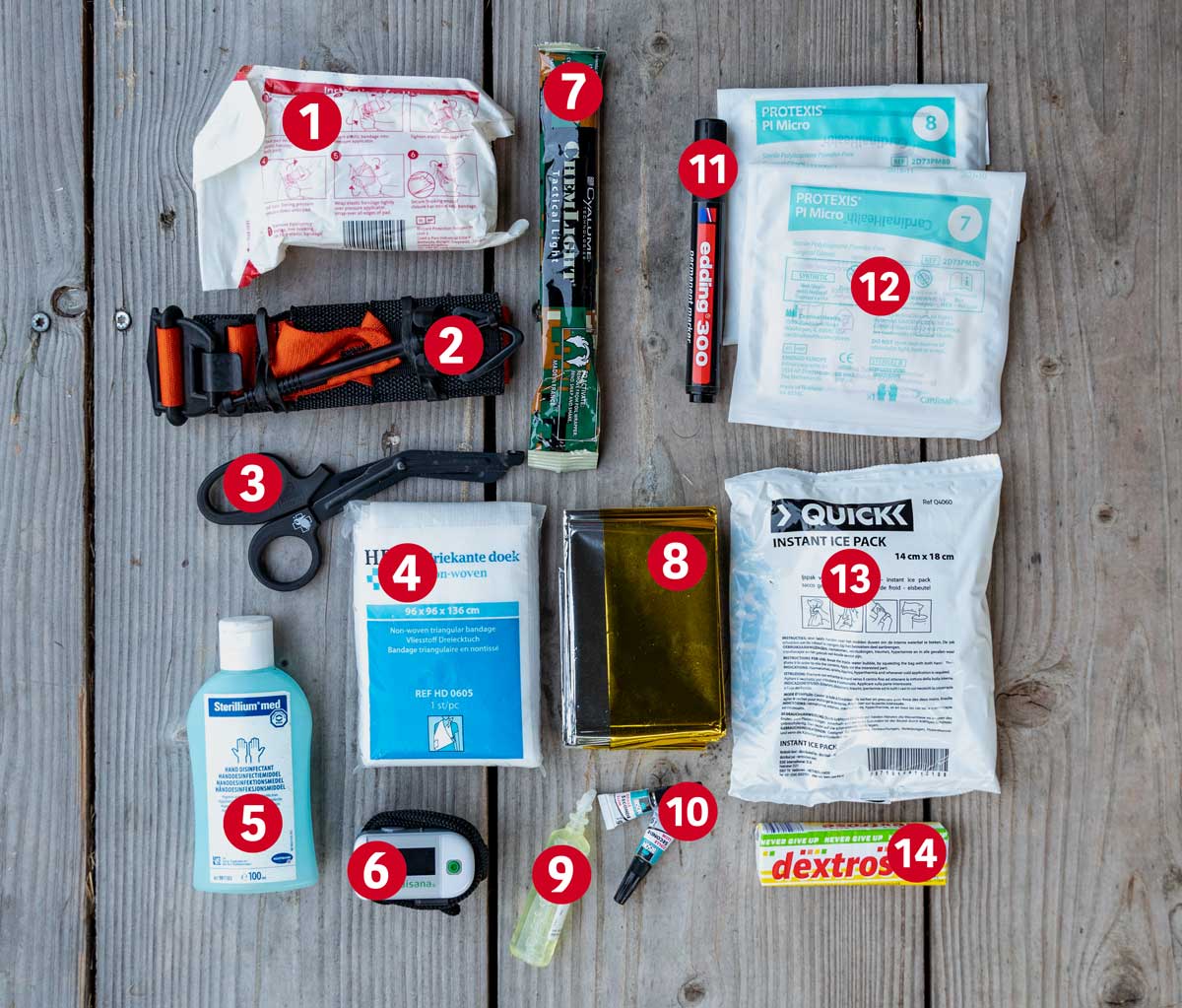 Contents of the red bags. On both bikes we have the “RED bags,” which makes them always quick and easy to find.
GREEN Bag Supplies:
Tape:
- 1x small tape
- 1x big/body tape
Plasters/band-aids:
- 6x plasters 5x7cm
- 6x non-adherent swabs
- 10x small band-aids
- 5x finger band-aids
- 2x adhesive bandage 7.5cm
- 2x burn shield 10x10cm
- 2x second skin 10x10cm
Special use:
- 1x SAM splint 36-in.†
- 2x pregnancy test
Equipment:
- 1x thermometer
- 1x tick tweezers
- 1x normal tweezers
GREEN Bag Medications*
Non-prescription:
- 20x Paracetamol 500mg
- 5x Paracetamol 1,000mg suppository
- 10x Ibuprofen 200mg
- 10x Ibuprofen 400mg
- 50x Norrit active charcoal 125mg
- 30x Norrit active Charcoal 200mg
- 6x O.R.S. sachet
- 5x sterile water 10cc
- 24x rennie (calcium carbonate with magnesium subcarbonate)
Prescription:
- 12x Atovaquone/proguanil hydrochloride (post-malaria)
- 20x Ciprofloxacin 500mg (broad-spectrum antibiotics)
- 14x Furabid 100mg (antibiotics for urinary infection)
Other:
- 1x manuka honey
- 1x tea tree oil
- 1x Nestosyl wound gel
†Only bring when you are trained in the application.
*Consult with your physician or medical professional for what medications may be useful and suitable on your route.
Disclaimer: This guide is no substitute for medical advice or any form of training. Use it at your discretion and risk.
 As an adventure-destined couple, Mitchel & Nadia de Jager are exploring the world. Creating a life as adventurers, digital nomads, content creators, and brand ambassadors, they share their journey into the world of ADV. Join their adventures at “The Great Ride Along” on Instagram and YouTube.