 Sticky logo
 Search


Ted was an accomplished rider. Returning from a camping trip at dusk, a decreasing radius corner caught him off guard. Once the front wheel touched the loose gravel on the far side of the road, man and machine embarked on a trajectory for the drainage ditch paralleling the blacktop. Rocks vise-clamped Ted’s leg, pinning him under his bike—a full 700 pounds of a heavily laden R1200GSA; he couldn’t move. Lying five feet below the road surface, it was 18 hours before he was found by state rangers—alone, dehydrated, wracked with pain and, as he would soon learn, unable to walk on a shattered ankle. Ted is now back to riding and enjoying his passion of adventure touring, but nowadays with an everpresent emergency locator.
I was new to adventure riding when I met Ted and heard his story, but with friends and family expressing concern about being kept up to date about my welfare on a planned solo trip to Alaska, it was natural for me to get a device.
The peace of mind I was able to provide to my circle of people with daily text messages was priceless. I’ve yet to send an SOS, but I’m never concerned about traveling into the woods or desert where there is no cell coverage, having my “just in case” safety net.
Another major feature of these devices is the ability to let others track your progress by inviting them to your personal travel site. Some models and subscription features allow you and those you’ve invited to see your travels in satellite earth photos, such as Google Maps, including details like your speed and elevation. Emergency locators are accurate to about five meters, so you’d be easy to find if the need arose.
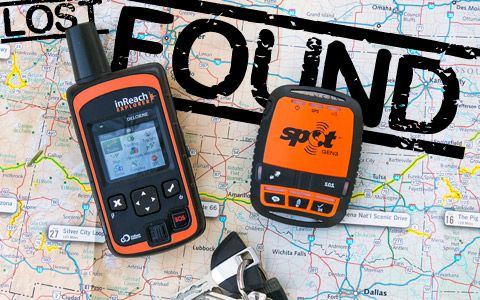
There are two major players in the emergency locator market: Spot (FindMeSpot.com) and Garmin inReach (Garmin.com). They both offer tracking and emergency medical summoning features, but their subscription plans are very different.
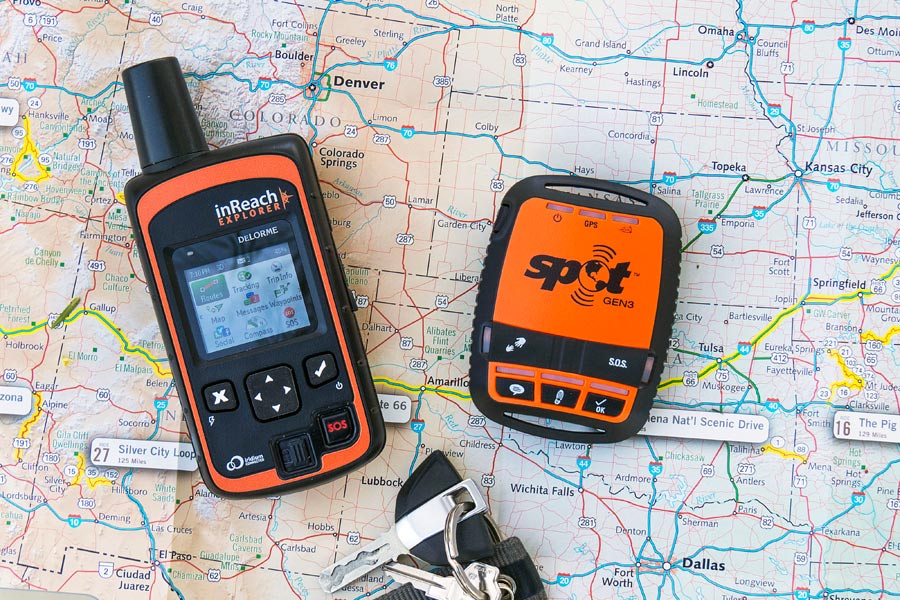 The inReach Explorer and Spot Gen3 are the leading emergency locators. A savvy motorcyclist venturing off the beaten path will keep one on their person while traveling. Shown with keys for size, both units will fit in a jacket pocket, the prime place to carry them when traveling alone.
The inReach products include two models, the SE and the Explorer. Both models have an internal rechargeable battery and allow two-way text messaging with a virtual keyboard and a color screen. The screen is small, so if you need reading glasses, keep ’em handy. The tracking feature lets you see where you’ve been and lets those checking in keep up with your progress. Text messages are limited to 160 characters, but that’s plenty. Garmin's product utilizes the Iridium satellite network, which promises 100% coverage around the globe. Clicking on a tracking point, the GPS coordinates can be viewed. Their efficient emergency response feature is active 24/7.
The Explorer model from inReach is the more expensive of their devices at $449 (versus $399 for the SE) but adds GPS features such as being able to pre-map a route, leave electronic waypoints to retrace your route, a digital compass, altimeter, odometer, and average as well as max speed. This is my top choice for a dual-sport rider, as this single device can serve as an emergency locator, two-way text communicator, and GPS. You can also pair it with your smartphone to access topographic maps. There are RAM mounts (RAMmount.com) that allow easy attachment to your handlebars and the built-in rechargeable lithium batteries can go about 100 hours before needing a charge (inReach also sells a kit that includes a Goal Zero solar charger).
However, the cost of the unit can soon be eclipsed by the subscription fees. Although the basic subscription starts at $12 per month, that does not include tracking, which is an additional per use fee; 10 text messages are allowed along with unlimited “preset” messages. The $25 per month plan allows 40 monthly texts, unlimited preset texts, and unlimited tracking points. The full spectrum of plans, including some pay-as-you-go options, are on their website.
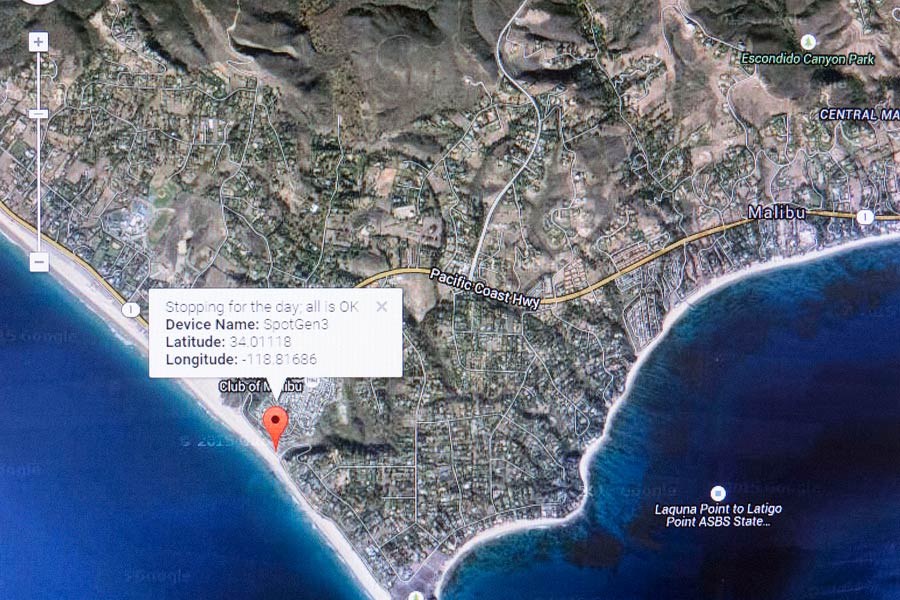 A Spot screen shot reveals how it integrates with Google Maps. The fine details of message location can be seen with accuracy of 25 feet or less.
The highly price-competitive, AAA battery-powered, Spot Gen3, currently on sale at their website for $75, will send tracking points, SOS, and can send a pre-programmed message, as well as a pre-programmed request for nonemergency assistance, with fees starting at $199 per year. Add another $99 if you want unlimited tracking (full details are on their website). The Spot is smaller than the inReach and will easily fit in a pocket; some adventure riding suits have a special pocket for the popular Spot. The folks at Spot realize the value of social media and include, free, the ability to share your GPS location and message on Facebook or Twitter. You can download a smartphone app and see what your tracks have been. There’s a global coverage map on the Spot website. Although most of the globe is covered, Spot does not have the 100% coverage promised by inReach. If you plan on travel to central Africa, the Poles, lower South America, or Southeast Asia, you won’t see great, if any, coverage. Otherwise, you should be fine, although there are reports from the field that some text messages can miss going out.
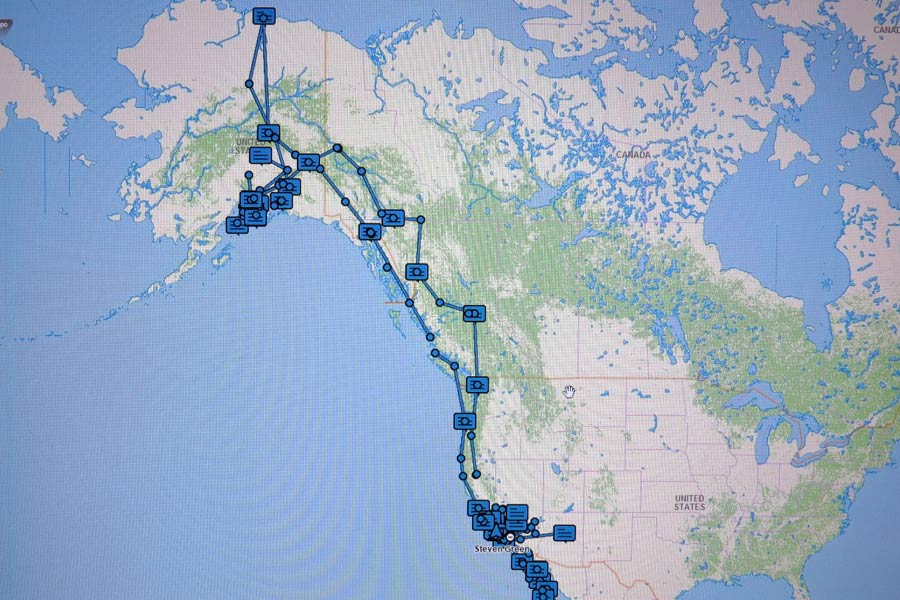 On your inReach account page, you can specify the time frame for your tracking points. Set for “All,” this rider can retrace his path from Prudhoe Bay, Alaska to La Paz, Baja.
In summary, the inReach has much more capability, offering GPS and two-way texting. The Spot is notably less expensive, easier to post to Facebook or Twitter, and fits in a pocket easily. Whether the rechargeable battery-powered inReach or the AAA-powered Spot, make sure your device is sending tracks each time you stop. The locator is useless if the batteries are dead. Both devices require activation and sign-in. It is a good idea to put the device in a jacket pocket. If you get separated from your bike, it will still be with you. I hope you’ll only use it to let folks know you’re having a good time, but they’ll also know where you are if you don’t show up when you’re supposed to, or if you summon emergency help. Ted learned the hard way; now he doesn’t leave home without it!
Where to Buy:
| SPOT Gen3: | Garmin inReach: |
 |  |